AC vs Heat Pump
So you want to cool your home. Or maybe heat it. Or both. And now you’re staring at two options — a regular air conditioner or a heat pump — and you have no idea which one to pick.
Don’t worry. This guide breaks it all down in plain English. No confusing jargon. No fluff. Just the facts you need to make a smart call.
Let’s get into it.
What Is an Air Conditioner?
An air conditioner does one thing. It cools your home.
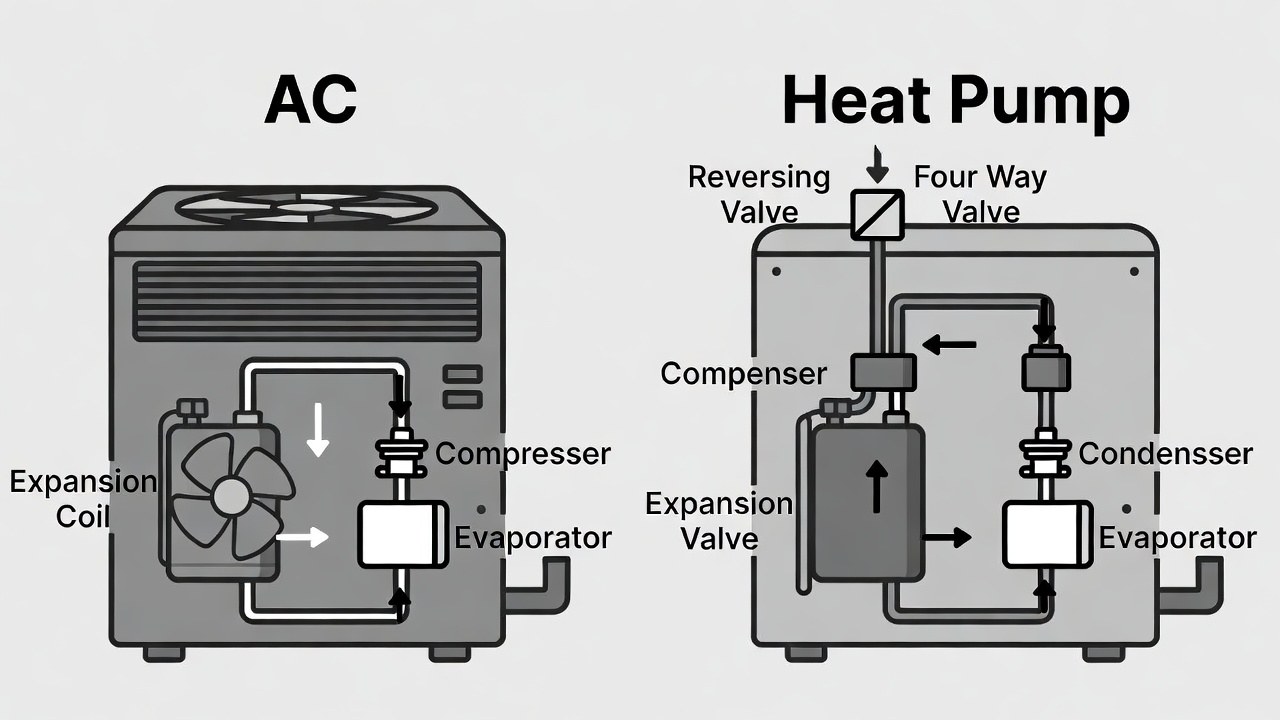
It pulls warm air from inside your house. Then it runs that air over cold refrigerant coils. The refrigerant absorbs the heat. The cooled air goes back into your rooms. The heat gets dumped outside.
That’s the whole process.
Air conditioners come in a few forms. You’ve got central AC systems, which cool your whole home through ducts. You’ve got window units, which cool one room at a time. You’ve also got mini-split systems, which cool specific zones without needing any ductwork.
But no matter the type, a traditional AC does not heat. When winter hits, you need a separate heating system — like a gas furnace or electric baseboard heaters — to stay warm.
What Is a Heat Pump?
A heat pump looks a lot like an AC unit on the outside. And honestly, it works in a very similar way.
Here’s the key difference: a heat pump moves heat in both directions.
In summer, it works just like an AC. It pulls heat from inside your home and pushes it outside. Your house gets cool.
In winter, it flips the process. It pulls heat from the outside air — even when it’s cold out — and brings it inside your home. Your house gets warm.
Yes, even cold air has heat energy in it. A heat pump is smart enough to extract it.
So with a heat pump, you get both cooling and heating from a single unit. That’s the big deal.
AC vs Heat Pump: The Core Difference
Here it is in one sentence: An AC only cools. A heat pump cools AND heats.
That’s the foundation of this whole comparison. Everything else builds on top of that.
If you live somewhere warm year-round and you never need heat, an AC might be all you need. But if you need both heating and cooling, a heat pump does both jobs with one system.
How Does a Heat Pump Heat Your Home?
This confuses a lot of people. How can a machine pull heat out of cold winter air?
Think of it this way. Even at 30°F outside, there’s still heat energy in that air. A heat pump uses refrigerant to absorb that energy. Then it compresses the refrigerant, which makes it hotter. Then it pushes that warmth into your home.
It’s like squeezing water from a sponge that looks dry. There’s still something in there.
This process is called the refrigeration cycle in reverse. And it works really well — right down to about 0°F for most modern heat pumps. Some cold-climate models work even lower than that.
Energy Efficiency: Heat Pump vs AC
Here’s where heat pumps really shine.
A standard electric resistance heater — like the kind in a space heater — turns 1 unit of electricity into 1 unit of heat. That’s 100% efficiency.
A heat pump doesn’t generate heat. It moves heat. So for every 1 unit of electricity it uses, it can move 2 to 4 units of heat into your home.
That means it can be 200% to 400% efficient. That’s not a typo. Heat pumps are wildly efficient heaters.
An AC is also efficient at cooling, but it can’t heat. So for homes that need both functions, the heat pump wins on total energy use.
The metric used to measure heat pump heating efficiency is called COP — Coefficient of Performance. A COP of 3 means you get 3 units of heat for 1 unit of electricity. Most modern heat pumps have a COP between 2.5 and 4.
For cooling, both ACs and heat pumps use SEER ratings — Seasonal Energy Efficiency Ratio. Higher SEER means more cooling per dollar spent. A good modern system runs at 16 SEER or higher.
Cost: Upfront and Long-Term
Let’s talk money.
Upfront Cost
A central AC system usually costs less to buy and install than a heat pump. Basic central AC units run cheaper because they’re simpler — they only cool.
Heat pumps cost more upfront. You’re paying for a two-in-one system. But you’re also not buying a separate heater, which matters.
Mini-split heat pumps can be on the pricier end too. But they offer zoned comfort, which means you heat or cool only the rooms you use.
Long-Term Running Costs
This is where the math gets interesting.
If you currently heat with natural gas, a gas furnace might still be cheaper to run than a heat pump — depending on your local gas and electricity prices. Gas is often cheap enough that even a less efficient gas furnace beats a heat pump on monthly bills.
But if you heat with electric resistance heat (baseboard heaters, electric furnaces), switching to a heat pump can cut your heating bill by 50% or more.
So the long-term cost winner depends on your fuel source.
Climate: Does It Matter Where You Live?
It matters a lot.
Warm Climates
If you live in the South, Southwest, or anywhere that stays mild in winter, a heat pump is a great fit. You barely need heat. When you do, the heat pump handles it with ease.
In fact, heat pumps were built for warm climates. That’s why you see them everywhere in places like Florida, Texas, and the Gulf Coast.
Cold Climates
For years, heat pumps had a reputation for struggling in very cold weather. Older models lost efficiency fast below freezing.
That’s changed. Modern cold-climate heat pumps — also called variable-speed heat pumps or inverter heat pumps — work efficiently in very cold conditions. Some models are rated for temperatures as low as -13°F.
Still, if you live somewhere with brutal winters, you might want a hybrid heat pump system. That pairs a heat pump with a gas furnace. The heat pump handles mild-to-cold days. The furnace kicks in only when it’s extremely cold. You get the efficiency of the heat pump for most of the year, plus the power of gas for the coldest days.
Moderate Climates
In moderate climates — think the mid-Atlantic states, Pacific Northwest, or parts of the Midwest — a heat pump is often the ideal choice. You get a balanced system that handles both seasons without breaking a sweat.
Heating and Cooling in One Unit: Is That Actually Better?
For most homeowners, yes.
One outdoor unit. One indoor air handler. One thermostat. One system to maintain.
This simplicity is a huge plus. You’re not managing a furnace AND an AC. You’re managing one system.
Less equipment means fewer parts that can break. Fewer service calls. Fewer headaches.
The tradeoff is that if your heat pump has a major failure, you lose both heating and cooling at once. With separate systems, you might lose one but keep the other.
Still, modern heat pumps are reliable. That risk is real, but not something most homeowners lose sleep over.
Ductwork: Do You Need It?
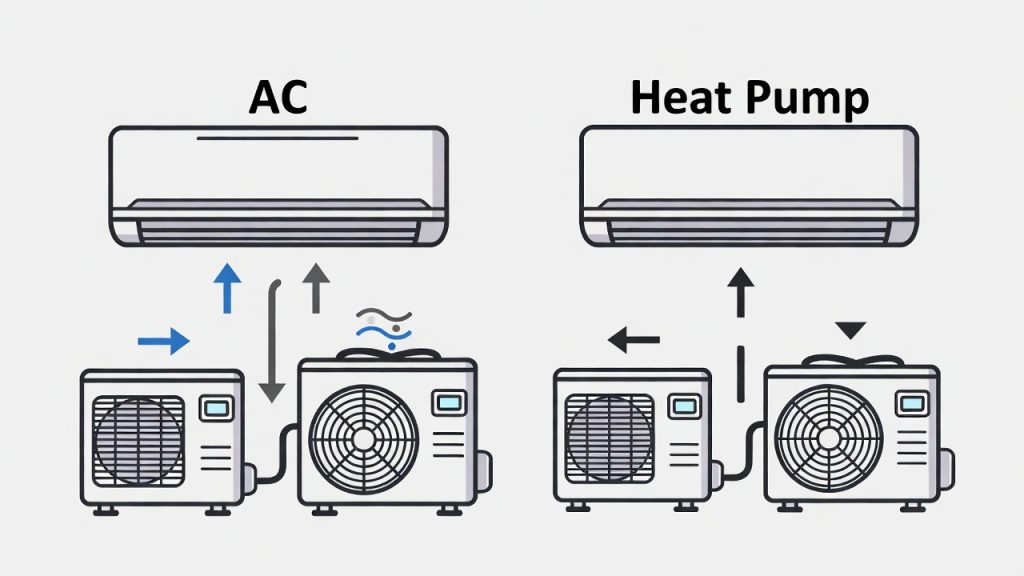
Central AC systems need ducts to move air through your home. Most heat pumps also use ducts.
But ductless mini-split heat pumps don’t need ducts at all.
These systems use a small outdoor unit connected to one or more indoor air handlers. Each indoor unit sits on a wall and conditions the air in that room or zone.
Mini-splits are perfect for:
- Older homes without existing ductwork
- Additions, garages, or bonus rooms
- Homes where you want zone control
- Apartments or small spaces
They cost more per zone than a ducted system, but they save you the cost of installing ducts. And they offer serious energy savings because you only condition rooms you’re actually using.
Environmental Impact
Heat pumps are much better for the environment than fossil fuel heating systems.
Gas furnaces burn natural gas and release carbon dioxide. The more you run them, the more emissions you produce.
A heat pump runs on electricity. If your electricity comes from renewable sources — solar, wind, hydro — your heat pump produces almost zero direct emissions.
Even if your grid runs on a mix of renewables and fossil fuels, a heat pump typically produces fewer emissions than a gas furnace. That gap keeps growing as electricity grids get cleaner.
If you care about reducing your carbon footprint, a heat pump is the clear winner over a gas system.
Lifespan and Maintenance
Air conditioners typically last 15 to 20 years with proper care.
Heat pumps run year-round — cooling in summer, heating in winter. Because they work in both seasons, they sometimes wear out a bit faster. Most heat pumps last 10 to 15 years, though well-maintained units can go longer.
Both systems need regular maintenance:
- Change or clean air filters every 1 to 3 months
- Get a professional tune-up once a year
- Keep the outdoor unit clear of debris
- Check refrigerant levels if you notice reduced performance
The maintenance is similar between the two. Neither system is dramatically harder to care for than the other.
Heat Pump vs AC: Side-by-Side Comparison
| Feature | Central AC | Heat Pump |
|---|---|---|
| Cools your home | Yes | Yes |
| Heats your home | No | Yes |
| Energy efficiency (heating) | N/A | Very high |
| Upfront cost | Lower | Higher |
| Need a separate heater | Yes | No |
| Works in cold climates | N/A | Yes (modern models) |
| Eco-friendly | Moderate | High |
| Lifespan | 15–20 years | 10–15 years |
| Ductless option available | Yes (mini-split AC) | Yes (mini-split HP) |
So Which One Should You Get?
Here’s a simple way to think about it.
Get a regular AC if:
- You already have a gas furnace you love
- You live in a very warm climate and rarely need heat
- You’re on a tight budget and just need cooling now
- Your existing heating system is new and works great
Get a heat pump if:
- You need both heating and cooling
- You currently heat with electric resistance heat
- You want to lower your energy bills long-term
- You care about reducing your environmental impact
- You’re building a new home or doing a full system replacement
- You want the simplicity of one system for everything
Get a hybrid heat pump if:
- You live in a very cold climate
- You want maximum efficiency with a backup for extreme cold
- You like the idea of a heat pump but want a safety net
What About Mini-Split Systems?
Mini-splits deserve their own mention because they’ve become incredibly popular.
A mini-split heat pump gives you zone-by-zone control. You can cool the bedroom on a hot night without cooling the whole house. You can heat the living room in the morning without wasting energy on empty rooms.
They’re quiet. Most indoor units run almost silently. They’re efficient. No ducts means no duct leakage, which can waste 20–30% of energy in a ducted system.
The downside? Cost per zone is higher than a central system. And installation requires a professional with refrigerant certifications.
But for the right home — especially older homes, additions, or small spaces — a mini-split heat pump is often the best of both worlds.
Common Questions About Heat Pumps and ACs
Can a heat pump replace a furnace?
Yes. In moderate climates, a heat pump can fully replace a furnace. In very cold climates, a cold-climate heat pump or a hybrid system is the better answer.
Is a heat pump the same as an AC?
They use similar technology. The difference is that a heat pump can reverse its cycle to heat your home. An AC can only cool.
Do heat pumps work in freezing temperatures?
Modern heat pumps do. Cold-climate models work in temperatures as low as -13°F. Older models struggled below 32°F, but the technology has improved a lot.
Is it cheaper to run a heat pump or a gas furnace?
It depends on your local electricity and gas prices. In areas with cheap electricity or expensive gas, heat pumps usually win. In areas with cheap gas, a gas furnace might still be more affordable to run.
Do heat pumps dehumidify air?
Yes. Just like a standard AC, a heat pump removes humidity from the air when it runs in cooling mode. This makes hot weather feel more comfortable.
The Bottom Line
Here’s the simple truth.
A regular air conditioner is a great tool for cooling. It’s reliable, affordable, and does its one job very well. If you already have a solid heating system, there’s nothing wrong with sticking to a good AC.
But a heat pump is a smarter, more flexible system for most homeowners. It handles both heating and cooling. It uses far less energy for heating. It’s better for the planet. And it keeps getting better every year.
If you’re replacing an old system, building a new home, or just looking for ways to lower your energy bills, a heat pump deserves a serious look.
Talk to a licensed HVAC professional before making a final call. They can assess your home’s insulation, your local climate, your duct setup, and your existing equipment. The right answer for your neighbor might not be the right answer for you.
But now you know the basics. You know what each system does. You know how they differ. And you know what to ask when you make that call.
That puts you way ahead of most people walking into this decision.
Need help figuring out the right HVAC system for your home? Talk to a local HVAC contractor for a free assessment. They can walk you through your options based on your specific home, climate, and budget.