How Much Electricity Does a Dehumidifier Use?
If you’ve ever walked into a basement that feels sticky, or a bedroom where your windows fog up constantly, you’ve probably thought about getting a dehumidifier. But before you rush out to buy one, you might be wondering: how much electricity will this thing actually drain from my power bill? Let’s dig into that question and break down everything you need to know about dehumidifier power consumption.
What’s Actually Happening Inside Your Dehumidifier
Before we talk numbers, let’s understand what a dehumidifier does. These machines pull moisture out of the air in your home. Think of it like this: your dehumidifier sucks in humid air, removes the water from it, and then pushes the dry air back out. That process takes energy.
The amount of energy your dehumidifier uses depends on how hard it’s working. When the air in your room is super wet, the unit has to work overtime. When the air is already pretty dry, it can relax and use less power. This is important because it means your dehumidifier won’t use the same amount of electricity every single day.
The Basic Numbers: What Dehumidifiers Actually Use
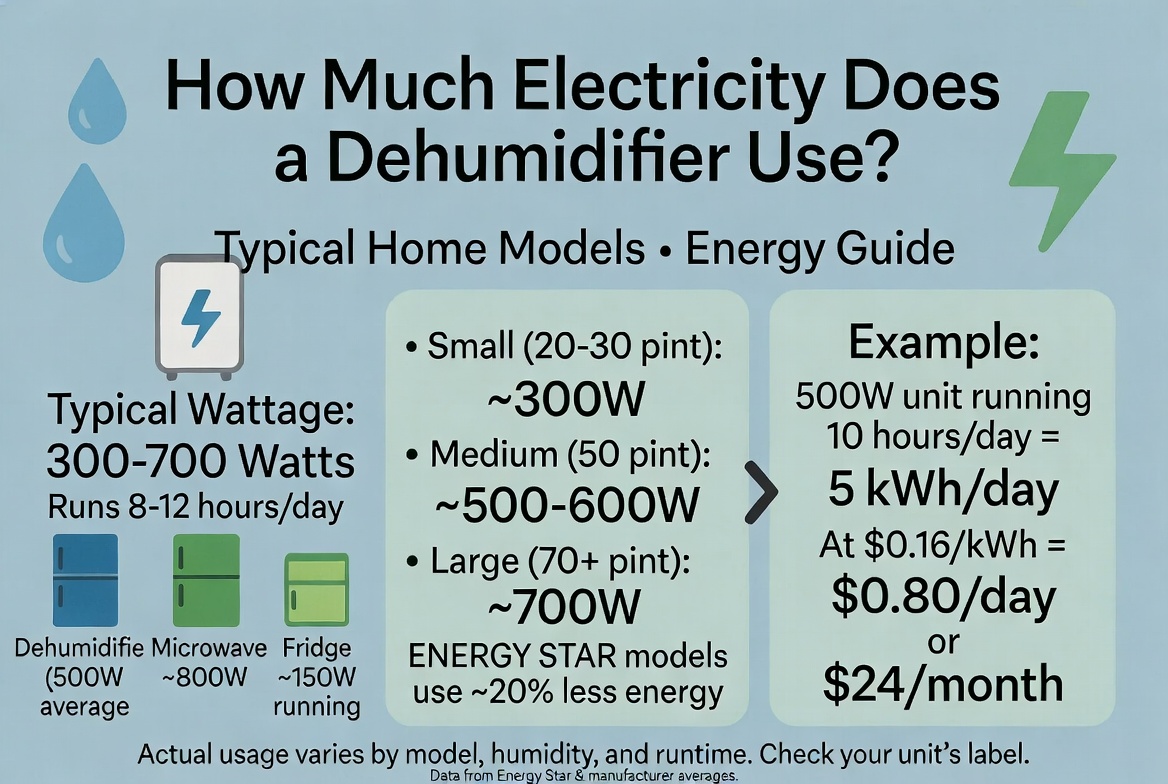
Let’s get straight to the point. Most dehumidifiers use between 300 and 700 watts of power when they’re running. Some bigger units can go up to 1000 watts, and some small portable ones might use as little as 200 watts.
To put that in perspective, a typical hair dryer uses about 1500 watts. So your dehumidifier is actually using about half the power of a hair dryer, or roughly the same as a microwave oven.
The wattage rating you’ll see on your dehumidifier is the maximum power it uses. Just like your car’s engine doesn’t always run at full throttle, your dehumidifier doesn’t always pull that full amount of electricity. It only hits that maximum when it’s working at full speed to remove moisture.
Different Types, Different Power Demands
Not all dehumidifiers are created equal, and they don’t all use the same amount of electricity.
Portable Dehumidifiers
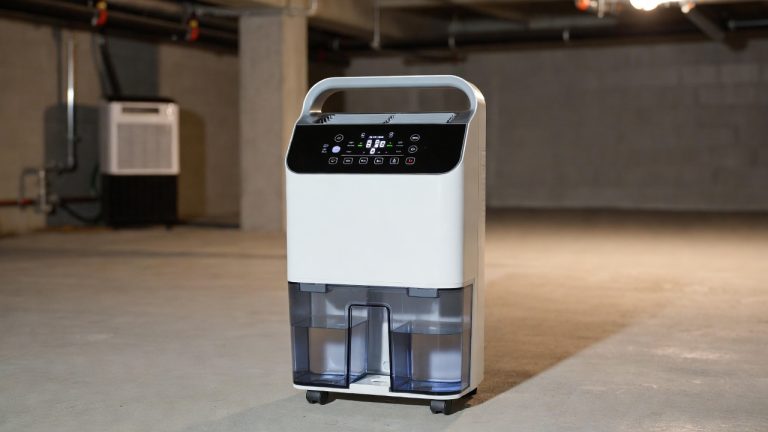
These are the small units you can pick up and move from room to room. They’re great for damp closets, small bedrooms, or bathrooms. Most portable dehumidifiers pull between 300 and 600 watts. They’re smaller and less powerful, so they don’t demand as much electricity from your wall outlet.
Whole-House Dehumidifiers
These are the heavy hitters. They hook up to your home’s air conditioning system or ventilation and work throughout your entire place. Whole-house models need more power because they’re dehumidifying a lot more space. These units can use 1000 watts or more because they run constantly and cover a much larger area.
Desiccant Dehumidifiers
These work differently from the more common refrigerant-based models. Instead of using cooling to pull moisture from the air, they use special materials to absorb humidity. Some desiccant models actually use less power than refrigerant types, while others use similar amounts. It really depends on the specific model.
Refrigerant Dehumidifiers
These are the most common ones you’ll find in stores. They work by cooling air until water condenses out of it. These typically use between 400 and 700 watts when running.
What Factors Make Your Dehumidifier Use More Power
The wattage rating tells only part of the story. Several things influence how much electricity your dehumidifier actually burns through in real life.
How Wet Your Air Is
The more moisture in the air, the harder your dehumidifier has to work. If you live in a very damp climate or have a basement that’s basically underwater, your unit will be running constantly at high power. In a less humid environment, it might run less often and use less electricity overall.
The Size of the Space
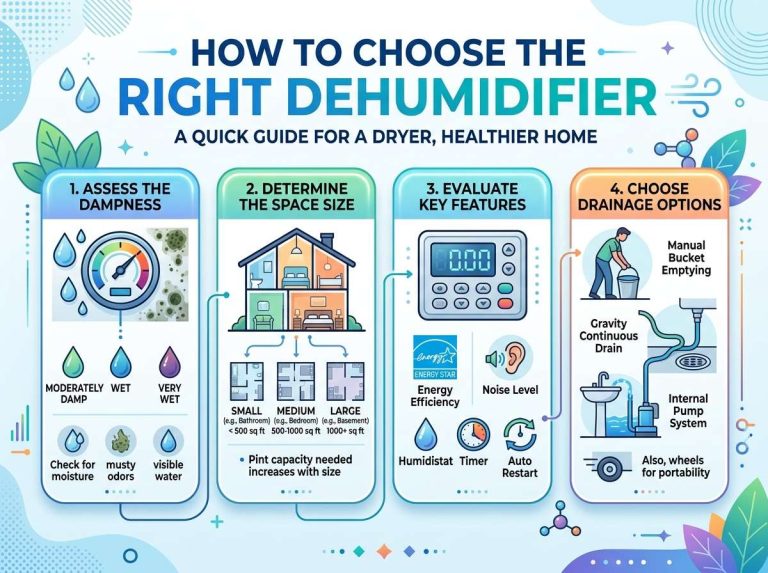
Trying to dry out a 2,000 square foot basement with a tiny portable dehumidifier is like using a toothbrush to paint a house. The dehumidifier will run continuously and never catch up, wasting tons of electricity. Get the right size for your space, and the unit won’t have to overwork.
Room Temperature
Here’s something that surprises people: dehumidifiers work better when it’s warm. Cold air holds less moisture, so if you’re running a dehumidifier in a cold basement, it has to work extra hard to pull moisture out. When it’s warm, the air naturally holds more moisture, and the dehumidifier can grab it more easily.
How Often You Open Doors and Windows
Every time you open a door or window, you’re letting new moist air into the space. Your dehumidifier then has to work harder to deal with that fresh humidity. If you’re constantly opening windows or doors, your dehumidifier stays busy and burns more electricity.
The Settings You Choose
Most dehumidifiers have different speed settings. If you run yours on high all the time, it pulls more power. Running it on a lower setting uses less electricity but takes longer to dry things out. You might find a sweet spot that balances comfort with cost.
Calculating Your Actual Electricity Costs
Okay, so your dehumidifier uses 500 watts. What does that mean for your electricity bill?
First, let’s talk about how electricity gets measured. Your power company charges you by the kilowatt-hour (kWh). That’s how much power you use in one hour. So if your dehumidifier uses 500 watts, that’s 0.5 kilowatts.
Here’s the math: if you run a 500-watt dehumidifier for one hour, you use 0.5 kWh. The average electricity rate in the US is around 14 cents per kWh, though it varies by location. So one hour of running that dehumidifier costs you about 7 cents.
Let’s say you run it for 8 hours a day for a whole month. That’s 240 hours. At 500 watts, you’re pulling 120 kilowatt-hours over that month. At 14 cents per kWh, that’s about $17 per month.
Not bad, right? That’s less than the cost of most streaming services. But the actual number depends on several things: how many watts your dehumidifier uses, how many hours you run it, and what your local electricity rates are.
To figure your actual costs, you can look at your last electricity bill to find your rate per kilowatt-hour, then use this simple formula:
(Watts ÷ 1000) × Hours per day × Days × Your rate per kWh = Monthly cost
Energy-Efficient Dehumidifiers: Do They Save You Money?
You’ll find some dehumidifiers marketed as “energy efficient” or “high-efficiency” models. These use less electricity than older models while still removing moisture effectively.
The reason they save power is usually because they have better motors, improved designs, or smart controls that don’t run the compressor when it’s not needed. Some modern dehumidifiers can sense humidity levels and turn themselves on and off automatically, rather than running constantly.
The trade-off is that efficient models usually cost more upfront. A basic dehumidifier might cost $150, while an energy-efficient one costs $400. Over time, the electricity savings add up, but you need to use it for a few years before you break even on that price difference.
If you’re going to keep a dehumidifier running most of the time, an efficient model makes sense. If you only use it seasonally, a cheaper basic model might be fine.
How Your Dehumidifier Compares to Other Appliances
Wondering if a dehumidifier is a power hog? Let’s stack it up against other common household items.
A refrigerator runs all day and night. It uses about 200-600 watts depending on the model. But because it runs constantly, it can add $10-20 per month to your bill.
A window air conditioner uses 1000-1500 watts and costs $20-40 per month to run.
A space heater pulls 750-1500 watts and can cost $30-50 per month.
Your dehumidifier at 300-700 watts falls right in the middle. It’s not the worst offender for electricity use, but it’s not the cheapest either.
The real cost depends on how long you run it. A dehumidifier you only use for a few hours a day costs way less than an AC unit you run for 16 hours.
Smart Ways to Lower Your Dehumidifier’s Power Consumption
Want to keep using your dehumidifier without watching your electricity bill skyrocket? Try these strategies.
Run It Strategically
You don’t always need to run your dehumidifier at full blast. Many people find that running it on medium speed for longer is better than high speed for shorter periods. The unit uses less power overall, and moisture still gets removed.
Use a Humidistat
A humidistat is a sensor that tells your dehumidifier when to turn on and off. Instead of running constantly, the dehumidifier only kicks in when humidity rises above your target level. This can cut your energy use by a ton because the unit isn’t running when it doesn’t need to.
Make Sure Your Dehumidifier Is the Right Size
This matters more than people realize. A unit that’s too small will run constantly trying to keep up. A unit that’s too big will cycle on and off frequently, which actually wastes energy. The right-sized dehumidifier works steadily and efficiently.
Empty the Tank Regularly
This mainly applies to models that collect water in a tank rather than draining to a floor drain. If the tank gets full, the dehumidifier stops working. An empty tank keeps the unit running at proper efficiency.
Keep Doors Closed
Seal off the area you’re dehumidifying. Close bedroom doors, close basement doors, don’t open windows constantly. The more contained the space, the less your dehumidifier has to work.
Position It Properly
Place your dehumidifier where air can flow around it easily. Don’t shove it into a corner or against a wall. Good airflow means it works more efficiently and uses less electricity.
Clean the Coils
The coils inside your dehumidifier collect dust over time. Dusty coils make the unit work harder and use more power. Cleaning them periodically keeps efficiency high.
Seasonal Considerations for Dehumidifier Usage
Your dehumidifier probably doesn’t need to run year-round. In dry seasons, you might not need it at all. In rainy seasons, it becomes essential.
Think about when you actually need a dehumidifier in your area. If you live somewhere with a wet season and a dry season, you might only run it for six months. That naturally cuts your annual electricity cost in half compared to running it year-round.
Some people forget to turn off their dehumidifiers when the humid season ends. If you’re one of them, you’re literally throwing money away on electricity for a problem that doesn’t exist anymore.
The Real Bottom Line on Dehumidifier Electricity
Here’s what you need to know: a dehumidifier uses moderate amounts of electricity compared to other household appliances. It’s not cheap to run, but it’s not breaking the bank either. A typical dehumidifier costs $10-30 per month to operate, depending on size and usage.
That cost is worth it if the dehumidifier solves a real problem in your home. Excess moisture leads to mold, mildew, musty smells, and damage to your belongings. Preventing that damage with a dehumidifier is actually a smart investment.
The key is running your dehumidifier intelligently. Use it when you need it, turn it off when you don’t, keep it properly maintained, and choose an appropriately-sized unit. Do that, and you’ll keep both the humidity and your electricity bill at reasonable levels.
If you’re concerned about power consumption, look for models with energy ratings or certifications. Energy Star rated dehumidifiers meet certain efficiency standards, and while they cost more upfront, they’ll save you money over time.
Final Thoughts
Don’t let fear of high electricity bills keep you from getting a dehumidifier if you need one. These machines use power, sure, but so does everything plugged into your house. The cost is manageable when you’re not running the unit unnecessarily.
The real question isn’t how much electricity your dehumidifier uses. It’s whether fixing your moisture problem is worth that electricity cost. For most people dealing with damp basements, humid bedrooms, or sticky bathrooms, the answer is absolutely yes. A dry, healthy home is worth a few extra dollars on your power bill.
Now that you understand how dehumidifier energy consumption works, you can make a smart decision about whether one is right for your space. Pick the right model, run it efficiently, and enjoy the benefits of a properly humidified home without guilt about your electricity usage.