
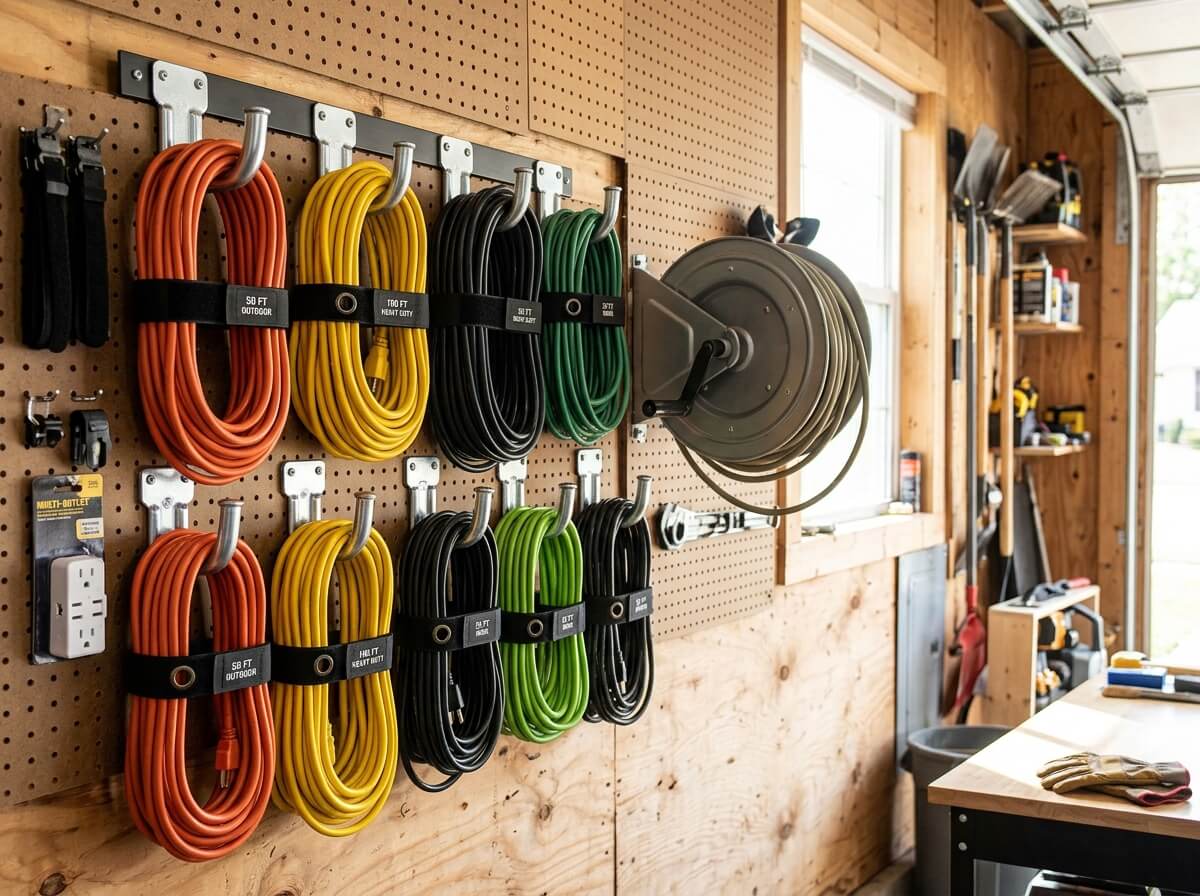
5 Best Extension Cord Organizer In 2026
Tangled cords are a small problem that gets annoying fast. You grab an extension cord for a quick job, and it comes out as a knotted mess. You spend five minutes pulling loops apart before you can even plug anything in. Worse, a cord left on the floor can trip people, collect dust, and get damaged over time.
A good extension cord organizer fixes this. It keeps your cords wrapped, hung, or tucked away so you can find them and use them quickly. The tricky part is that “extension cord organizer” covers a lot of different products. Some are wall-mounted holders for the garage. Some are straps that wrap around a coiled cord. Some are trays that sit under a desk and hide your power strip.
This roundup looks at five popular options, each built for a slightly different job. We go through what each product is, where it works best, what it does well, and where it falls short. At the end, you will find a simple buying guide, a list of common mistakes, and a final verdict to help you pick the right one.
A quick note on how we wrote this. The reviews below rely on the product listings, the features each maker describes, and the kind of feedback buyers commonly share for this type of product. We do not claim any special lab results. Where a detail depends on the exact version you buy, we tell you to check the listing before you order.
Quick Comparison: Best Extension Cord Organizers at a Glance
| Product | Type | Best For | Mounting Needed? |
|---|---|---|---|
| ZTSXLLIM Extension Cord Holder Organizer | Garage cord holder | Garage and workshop storage | Usually yes (wall or surface) |
| UNIS 8 Pack 13-inch Extendable Straps | Strap loops / hangers | Cords, hoses, rope, cables | Hang on a hook or nail |
| Extension Cord Organizer Adjustable, 2 PCS, 5 Slots | Slotted cord organizer | Sorting several cords side by side | Depends on design, check the listing |
| Wrap-It Storage Straps, Assorted 6-Pack | Hook-and-loop wrap straps | Mixed cord sizes, travel, and storage | No |
| Univivi Under Desk Cable Management Tray, 32 inch | Under-desk tray | Power strips and desk cables | Yes (screws under the desk) |
Why You Need an Extension Cord Organizer in the First Place
Before the reviews, here is a quick look at why cord storage matters. Many people toss cords into a bin and move on. That works for a while, but it causes a few problems.
First, tangled cords wear out faster. Sharp bends and tight knots stress the wire inside the cord cover. Over time, that can cause cracks in the outer layer. A cracked cord is a safety risk, so you should replace it instead of using it.
Second, loose cords take up space. A pile of cords in a garage corner turns into a hiding spot for dust and bugs. Hanging them on a wall frees your floor and keeps them clean.
Third, you waste time. When every cord is wrapped and stored in a set spot, you grab what you need in seconds.
Finally, a tidy setup is simply safer. Cords on the floor are a tripping hazard, especially in busy areas like a garage, workshop, or home office. Good cable management keeps walkways clear.
With that in mind, let us look at the five products.
1. ZTSXLLIM Extension Cord Holder Organizer: Best for Garage Wall Storage
Product Description
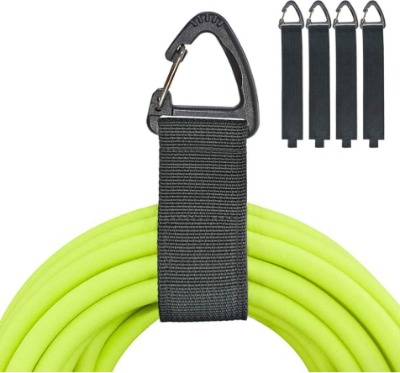
The ZTSXLLIM Extension Cord Holder Organizer is sold as a garage organization and storage tool. In simple terms, it is a holder you fix to a wall or another surface so you can wrap long cords around it and keep them off the floor. It follows the same idea as a hose reel hook, but it is shaped for extension cords, rope, and similar items.
Holders like this are popular in garages, sheds, basements, and workshops. These are the places where long, heavy cords pile up fastest.
Best Use Cases
This type of holder works well when you have a few long cords that you use often. Examples include:
- A 50-foot outdoor extension cord for yard work
- A heavy-duty cord for power tools
- Holiday light cords that need a home between seasons
- Air hoses, garden hoses, or rope in the same space
If your garage has an empty stretch of wall, this kind of holder turns it into useful storage.
Key Features Explained Simply
The listing positions the product for garage organization and storage. Here is what that usually means in plain words:
- Wall or surface mounting: You fix the holder in place with screws or similar hardware. Check what comes in the box, because some holders include screws and some do not.
- Wrap-and-hang design: You loop the cord around the holder in even turns. The cord stays up and off the ground.
- Sturdy build: Garage holders are meant to carry the weight of thick cords, so they are normally made from tougher material than a simple strap.
Always read the listing for the exact size, weight limit, and material. Those details change between versions, and they matter a lot for heavy cords.
Real-Life Usage Insight
A holder like this changes how a garage feels. Before, a cord lives in a bucket, and you dig it out and fight the knots. After, the cord hangs in neat loops at eye level. You pull it off the holder, use it, and wrap it back on.
The trick is to wrap the cord the same way each time. Use even loops and keep the turns smooth, not tight. If you twist the cord or pull it hard, you can create kinks. Many users find that a relaxed, over-and-under style of wrapping keeps a cord from twisting.
One more tip: mount the holder at a height you can reach without a ladder. A cord that is hard to reach does not get put back.
Pros
- Frees up floor space right away
- Keeps heavy cords off the ground and out of dirt
- Simple idea that is easy to use every day
- Works for more than cords, such as rope and hoses
- Helps you find your cord in seconds
Cons
- Needs mounting, so you must drill or screw into a wall
- Not ideal for renters who cannot make holes
- Holds only what you can wrap, so it does not sort many small cords
- Weight and size limits vary, so check before you buy
Performance
A wall holder has one job, which is to hold a coiled cord securely. Its performance comes down to how well it is mounted and how strong it is. If you fix it into a wall stud or use proper anchors, it should hold a heavy cord with no trouble. If you mount it on weak drywall with no anchor, even a good holder can pull loose.
Ease of Use
Installation takes a drill, a screwdriver, and a few minutes. After that, daily use is very easy. You hang the cord and take it down. Beginners will have no trouble.
Value for Money
For a garage owner with several long cords, a holder gives good value. It costs little compared with the cord itself, and it helps your cords last longer. If you only own one short cord, though, it may be more than you need.
Our Take
The ZTSXLLIM holder is a solid pick for anyone who wants a simple, permanent home for big cords in a garage or workshop. It is not fancy, and that is the point. If you can mount it to a wall, it earns its spot.
2. UNIS 8 Pack Heavy Duty 13-Inch Extension Cord Storage Straps: Best Multi-Pack for Hanging and Bundling
Product Description
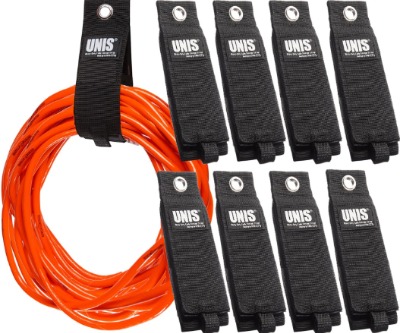
The UNIS 8 Pack is a set of eight large, 13-inch extendable straps. The listing describes them as storage straps with a loop and hanger design for cables, hoses, power cords, and rope. Each strap wraps around a coiled cord to hold it together. Then you can hang the whole bundle on a hook, nail, or peg.
Because you get eight in a pack, this set covers a lot of cords at once.
Best Use Cases
Straps like these suit people who own many cords and want a cheap way to tame them. Common uses include:
- Bundling extension cords of different lengths
- Holding garden hoses in a neat coil
- Wrapping rope or bungee cords
- Storing large cables from work gear
- Keeping holiday light strings from tangling
The extra length helps with thick, heavy cords that smaller ties cannot wrap.
Key Features Explained Simply
- 13-inch size: This is longer than the small cable ties you find in most drawers. It gives you enough strap to wrap a big coil of thick cord.
- Extendable design: The strap can stretch or adjust to fit different coil sizes, based on the listing description.
- Loop hanger: After you wrap the cord, you can hang it up using the loop, which keeps storage simple.
- Heavy-duty claim: The listing calls them heavy duty. That fits their job, but as with any strap, the real strength depends on the material and how you use them. Do not hang a very heavy coil from a single thin point and expect it to last forever.
Real-Life Usage Insight
This product shines when you have a bin full of mixed cords. You coil each one by hand, wrap a strap around the middle, and hang it. Now every cord has its own bundle, and none of them tangle with the others.
Here is a helpful habit: pair each strap with one cord and leave it there. That way, you never hunt for a strap when you need to put a cord away. With eight straps, you can cover most of a typical garage collection.
Also, keep the coil loose enough that you do not crush the cord. A very tight wrap can leave a permanent bend, especially in stiff outdoor cords.
Pros
- Eight straps in one pack, so you can cover many cords
- Long enough for thick extension cords and hoses
- No drilling or mounting required for the straps themselves
- Works for cords, cables, hoses, and rope
- Easy to use and reuse
Cons
- You still need a hook or hanger to store the bundle
- Does not sort or label cords by itself
- Very heavy coils can strain any strap if hung from a weak spot
- Looks plain, so it suits utility spaces better than a living room
Performance
For bundling, these straps do the job well. They hold coils together and stop cords from spreading out. Performance depends on strap material and wear. With normal use, straps like these generally hold up. Over a long time, repeated stretching and sun exposure can make any strap material weaker, so keep them out of strong sunlight when you can.
Ease of Use
This is about as simple as storage gets. Coil the cord, wrap the strap, hang it up. A beginner can learn it in a minute. No tools are needed, unless you add hooks to the wall.
Value for Money
An eight-pack usually costs little per strap. If you have six or seven cords, the math works out well. You also get flexibility, because you can use the straps on hoses and rope too. For many households, this is one of the most cost-friendly ways to get organized.
Our Take
The UNIS 8 Pack is a great choice for people with lots of cords who do not want to install anything big. Pair it with a few wall hooks, and you have a full storage system at a low cost.
3. Extension Cord Organizer Adjustable, 2 PCS with 5 Slots: Best for Sorting Multiple Cords
Product Description
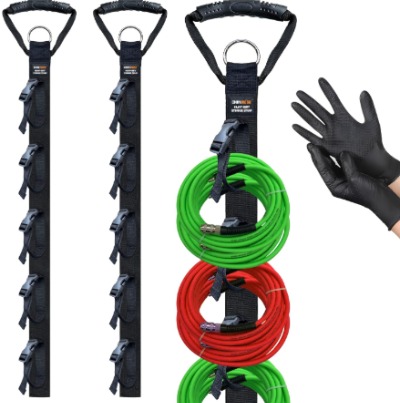
This product is a set of two adjustable extension cord organizers, each with five slots. The slot design is meant to hold several cords or cables side by side, so they stay sorted instead of crossing and tangling. You get two pieces in the pack, which gives you ten slots in total.
The exact shape, material, and mounting method can differ between listings of this type. So read the product page closely to see how the organizer attaches and how wide each slot is. This detail decides which cords will fit.
Best Use Cases
A slotted organizer fits situations where you have many thin or medium cords that you want to keep apart. Good examples:
- A workbench with several power tool cords
- A home office with chargers and power cables
- A media area with a mix of cords behind a TV stand
- A craft room or hobby space with multiple small devices
- A utility closet where you store cords of different lengths
It is less suited to very thick, heavy-duty outdoor cords, since slots are usually sized for smaller diameters.
Key Features Explained Simply
- Five slots per piece: Each slot holds a cord or a small bundle. This keeps cords in their own lane.
- Adjustable design: The word “adjustable” suggests you can change the fit, position, or spacing. This helps when your cords differ in thickness.
- Two-piece set: You can spread the organizers in two places, such as one at each end of a shelf or workbench, to keep long cords tidy along the way.
Real-Life Usage Insight
Slotted organizers work like a comb for your cords. Instead of letting everything dangle in a heap, you drop each cord into a slot and it stays in line. At a workbench, that means your drill cord, sander cord, and shop light cord each have their own path. You can reach the one you need without pulling the others.
A good habit is to match slots to purposes. For example, put the cord you use daily in the easiest slot, and place the seldom-used ones toward the edge. Over time, your hands learn where each cord lives.
One thing to watch: if a slot is too tight, a thick plug will not pass through. Measure your plug heads before you buy any slot-style organizer.
Pros
- Keeps many cords separated and easy to find
- Two-piece pack gives you flexibility in placement
- Reduces tangles on desks, benches, and shelves
- Useful for small and medium cords
- Helps you build a clear, repeatable cord routine
Cons
- Slots may not fit large plugs or very thick cords
- Mounting or placement method varies, so check the listing
- Does not wrap or coil the cord, so excess length still needs handling
- May feel less useful if you only have one or two cords
Performance
The strength of this style is order. It does not carry heavy loads like a wall hook does, but it keeps cords lined up and separate. In daily use, that cuts down on the “cord spaghetti” problem. How well it performs depends on how closely the slots match your cord size and on how firmly it stays in place.
Ease of Use
Most slot organizers are easy. You place or attach them, then drop in your cords. If the product needs adhesive or screws, installation takes a few more minutes. After that, you barely think about it.
Value for Money
With two pieces and ten slots in total, the value looks fair for anyone with a lot of small cords. If you only need to organize two cords, you will not use the full set. In that case, a pair of simple straps may cost less and do the job.
Our Take
This pick suits people who want order more than heavy storage. If your problem is a mess of several smaller cords in one spot, the 5-slot set can calm things down. If your problem is a big, bulky outdoor cord, look at a holder or strap instead.
4. Heavy-Duty Wrap-It Storage Straps, Assorted 6-Pack: Best for Flexible, Reusable Cord Wrapping
Product Description
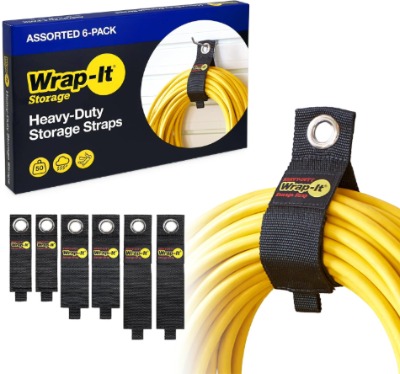
The Wrap-It Storage Straps come as an assorted 6-pack of hook-and-loop straps. Hook-and-loop is the same fastening style people often call Velcro. You wrap the strap around a coil of cord, press the ends together, and it holds. To release it, you peel it open.
The “assorted” part means the pack includes different sizes. That is handy because cords come in many lengths and thicknesses. These straps are known for being reusable, and many include a hole or loop so you can hang the bundle on a hook.
Best Use Cases
These straps fit almost any cord job:
- Short charging cables and long extension cords
- Garden hoses and rope
- Cords you carry in a bag or toolbox
- Holiday decorations and light strings
- Items in a garage, shed, boat, or RV where space is tight
Because they do not need mounting, they also work well for renters and anyone who moves a lot.
Key Features Explained Simply
- Hook-and-loop closure: The strap sticks to itself, so you can set the tightness. It also opens easily.
- Assorted sizes: A mix of lengths lets you cover small cables and large coils with one pack.
- Reusable: You can open and close the strap many times without trouble. This makes it better than a one-time zip tie.
- Heavy-duty feel: The listing calls them heavy duty. In general, hook-and-loop straps handle repeated use well, though they can lose grip if lint, dust, or dirt builds up in the fuzzy side.
Real-Life Usage Insight
The best thing about these straps is how quickly they adapt. If you grab a new cord, you simply pick the size that fits. There is no need to buy a new organizer.
They also help a lot with cords that travel. Toss a wrapped cord into a toolbox or bag, and it stays neat. When you arrive at the job, you peel the strap and unroll.
One small tip: do not wrap too tight. A firm hold is enough. Squeezing a cord hard for months can leave a crease, and you do not want that on a cord that carries real power.
Pros
- Reusable and adjustable
- Assorted sizes cover many cords
- No tools or mounting needed
- Easy to open and close, even with work gloves in many cases
- Great for travel and tight storage spaces
Cons
- Six straps cover fewer cords than an eight- or ten-pack
- Hook-and-loop can pick up dirt and lose some grip
- Does not hang by itself unless you add a hook or use a built-in loop
- Not a fix for sorting many cords in one place
Performance
Wrap-style straps do what they promise. They keep a coil together, stop it from unwinding, and let you hang or stack it. Over a long time, the grip may soften, which happens with all hook-and-loop products. Brushing out lint now and then keeps them working well.
Ease of Use
This is among the easiest products in the roundup. There is nothing to install or adjust beyond choosing a strap size. Anyone, including kids and older adults, can handle it.
Value for Money
A 6-pack with mixed sizes gives strong value for people who need flexibility. You get more variety than a pack of identical straps. If you have a large pile of cords of the same size, though, a bigger single-size pack may be cheaper per cord.
Our Take
The Wrap-It 6-Pack is a smart all-around choice. It is simple, flexible, and good for both home and work use. If you want just one strap-style product to start with, this is an easy one to recommend.
5. Univivi Under Desk Cable Management Tray, 32 Inch, Black: Best for Desk Setups and Power Strips
Product Description
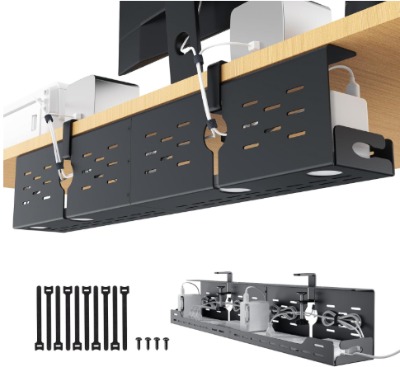
The Univivi Under Desk Cable Management Tray is a 32-inch tray in black that mounts under your desk. It gives you a spot to rest a power strip, a surge protector, or a bundle of cables. That keeps the mess off the floor and out of sight.
This is a different kind of organizer from the rest of the list. It does not wrap or hang cords. Instead, it hides and supports them. If your “extension cord” problem lives at your desk, this one speaks right to it.
Best Use Cases
A tray like this suits:
- Home offices with a computer, monitor, and charger
- Gaming desks with many devices
- Standing desks that need cables to stay tidy as the desk moves
- Craft or study tables with a power strip
- Workbenches where you want a power strip off the floor
At 32 inches, it has room for a standard power strip and extra cable length.
Key Features Explained Simply
- 32-inch length: This gives space for most power strips plus the extra cord slack.
- Under-desk mounting: You attach it to the underside of the desk with screws. Check that your desk material can hold screws. Thin or hollow desks may need extra care.
- Open or tray-style build: The tray holds cords in place and lets heat escape better than a closed box. This is a good thing for power strips and adapters.
- Black finish: The dark color blends in under most desks.
Always read the listing for the weight limit, screw type, and desk thickness range before you buy.
Real-Life Usage Insight
Anyone who has crawled under a desk to unplug a charger knows the pain. A tray fixes it. You mount it, drop the power strip inside, and run your cables along the tray. From the front, the desk looks clean.
One smart move is to leave a bit of cord slack so you can pull the strip out when you need to. Another is to label the cords near the plug end. Small tags make later changes much easier.
Do not hide a power strip so tightly that it has no air. Power strips and adapters can get warm, so a tray with open sides works better than a sealed space.
Pros
- Clears cords off the floor and out of sight
- Supports a full power strip with room to spare
- Good airflow compared with closed boxes
- Helps keep your desk area safe and clean
- Great fit for home office and gaming setups
Cons
- Needs drilling into the desk
- Not useful for garage or outdoor cord storage
- Cannot coil or sort long heavy-duty cords
- May not suit glass or very thin desk tops
Performance
For its job, a tray like this does well. It holds weight steadily and stops cords from falling or dangling, provided you mount it with proper screws into solid material. The long 32-inch size also helps when you have a longer power strip.
Ease of Use
Installation takes a drill or screwdriver and a bit of patience to line up the holes. Once it is up, you rarely touch it. For beginners, it is a simple weekend project.
Value for Money
If you work at a desk daily, a tray gives you a clean look and safer floor space for a modest price. Compared with buying a new desk with built-in cable management, it is a cheap upgrade.
Our Take
The Univivi tray is not a cord holder in the garage sense, but it solves the same core problem in a different place. For desk users, it may be the best pick in this roundup.
How These Extension Cord Organizers Compare
Each product handles a different kind of problem. The table above gives the short version, and here is a deeper look.
Best for heavy cords: The ZTSXLLIM holder and the UNIS straps. The holder gives a fixed home on a wall. The straps bundle cords so you can hang them anywhere.
Best for flexibility: The Wrap-It 6-Pack. Its mixed sizes let you adapt to nearly any cord, and you can move it around freely.
Best for sorting small cords: The 5-slot organizer set. It keeps several cords apart on a bench or shelf.
Best for desks: The Univivi tray. No other product here deals with a power strip so neatly.
Easiest to set up: The Wrap-It straps and the UNIS straps. Neither needs tools.
Most permanent: The ZTSXLLIM holder and the Univivi tray. Both mount in place, so they take more effort but give a lasting setup.
A lot of people end up using more than one. For example, a homeowner might hang a long outdoor cord on a wall holder, bundle shorter cords with straps, and mount a tray under the desk. The tools work well together because they solve different problems.
Extension Cord Storage Ideas for Garage, Home, and Office
Good gear works best with a simple plan. Here are practical ideas for each space.
Garage and Workshop
- Mount a wall holder near the door you use most
- Give each long cord its own hook or strap
- Keep cords off the floor to avoid moisture and oil
- Place the most-used cord at waist or chest height
- Store cords away from sharp tools and hot surfaces
Home Office
- Use an under-desk tray for the power strip
- Bundle extra cable length with small straps
- Tag each plug so you know what it powers
- Leave some slack for moving a chair or standing desk
Closets, Sheds, and Storage Rooms
- Hang cord bundles on a row of hooks
- Group cords by length or purpose
- Keep seasonal cords in a labeled bin when not in use
On the Go
- Wrap cords with reusable straps before packing
- Use one strap per cord so nothing mixes up
- Store them in a toolbox section or a small bag
Buying Guide: How to Pick the Best Extension Cord Organizer
This section keeps things simple. Ask yourself a few easy questions, and the right product becomes clear.
1. Where Will You Use It?
The location decides almost everything. A garage needs strong wall hooks or straps. A desk needs a tray. A workbench with many cords needs a slotted organizer. Start with the place, not the product.
2. How Thick and Long Are Your Cords?
Thick, heavy cords need a sturdy holder or a long strap. Thin cables can use small straps or slots. Measure the width of your cord and the size of its plug before you shop. A slot that is too small becomes useless.
3. Can You Drill or Screw Into the Surface?
If you rent or cannot make holes, pick a strap-based option. Straps need no mounting. If you can mount things, a holder or tray gives you a more permanent fix.
4. How Many Cords Do You Have?
If you have two cords, a couple of straps will do. If you have ten, a multi-pack or a slotted set makes more sense. Count first, so you do not overbuy or run short.
5. Think About Weight
Cords get heavy when coiled. A 100-foot heavy-duty cord can weigh several pounds. Make sure the holder or hook can carry that weight. Look for a stated weight limit on the listing.
6. Look at the Material
Plastic is light and cheap, but it can crack in cold or after long sun exposure. Metal is stronger but may rust if the finish is thin and the space is damp. Fabric straps are flexible but can collect dirt. Pick the material that matches your space.
7. Check What Comes in the Box
Some products include screws and anchors. Others do not. A missing screw is a small thing, but it can stall a project on a Saturday afternoon.
8. Read Recent Buyer Feedback With a Careful Eye
Reviews help, but look for patterns, not single stories. If many buyers mention the same issue, such as weak hardware or a poor fit, pay attention. If only one person complains, it may be a one-off.
9. Plan for Safety
An organizer should never hide a damaged cord. If a cord has cracks, exposed wire, or melted plugs, replace it. Do not use a storage product to cover up a problem. Also, keep coiled cords from sitting on hot surfaces like water heaters or engines.
Who Should Buy These Products?
Here is a quick guide to match each product with the right person.
Buy the ZTSXLLIM holder if you have a garage or shed and want a fixed spot for long, heavy cords. It also suits people who like a clean wall and a quick grab-and-go setup.
Buy the UNIS 8 Pack if you own many cords and want an affordable way to bundle them. It also fits anyone who stores hoses, rope, or cables with their cords.
Buy the 5-slot organizer set if you work with many small to medium cords in one place, like a workbench, shelf, or media stand.
Buy the Wrap-It 6-Pack if you want a flexible, reusable option that works almost anywhere. It suits renters, travelers, and anyone who changes their setup often.
Buy the Univivi tray if your biggest mess sits under a desk. It suits home office workers, students, gamers, and anyone with a power strip on the floor.
Common Mistakes to Avoid
Even a great organizer cannot help if you use it the wrong way. These are the most common errors.
Wrapping Cords Too Tight
A cord needs to rest in loose loops. If you pull it tight, you can crush the outer cover and bend the wire inside. Wrap with smooth, even turns.
Twisting the Cord While Coiling
Twists build up when you wrap in one direction only. Use an over-and-under style so the twists cancel out. This keeps the cord straight when you uncoil it.
Hanging Heavy Cords From Weak Spots
A thin nail or a loose hook cannot carry a heavy coil for long. Use strong hooks, and fix them into studs or proper anchors.
Storing Cords While They Are Hot or Wet
Let a cord cool and dry before you wrap it. Damp cords in a tight coil invite corrosion on the plug and wear on the cover.
Hiding Power Strips With No Airflow
Power strips and adapters make a little heat. Do not bury them in a closed box or under piles of cloth. An open tray or a well-ventilated spot works much better.
Buying Before You Measure
Check plug size, cord thickness, desk thickness, and wall space first. A product that does not fit is wasted money.
Mixing Up Cords
If you have several cords that look alike, add a label or a color tag. It saves you from grabbing the wrong one, especially when they have different ratings.
Ignoring Cord Condition
An organizer cannot fix a damaged cord. Inspect your cords from time to time. If a cord looks worn, replace it instead of storing it.
Tips to Keep Your Cords Organized for the Long Run
A tidy setup is easier to keep than to build. These small habits help.
- Return every cord to the same spot. Habit beats any product.
- Sort by length. Put long cords together and short ones together.
- Label what you can. A strip of tape and a marker works fine.
- Check your cords twice a year. Look for cracks, bent prongs, and loose ends.
- Clean your straps. Brush out lint from hook-and-loop straps to keep their grip.
- Leave a little space. Do not crowd a wall holder or a tray. Extra room makes it easy to add one more cord later.
Frequently Asked Questions
What is the best way to store an extension cord?
Coil it in loose, even loops, secure it with a strap, and hang it on a hook or wall holder. Keep it off the floor and away from heat, moisture, and sharp objects.
Is a wall-mounted holder better than a strap?
They do different jobs. A wall holder gives your cord a fixed home. A strap keeps a coil bundled and works anywhere. Many people use both.
Can I store extension cords outside?
It depends on the cord and the space. Outdoor-rated cords handle weather better, but long sun exposure and constant moisture still wear them down. A covered spot like a shed or garage is a safer home.
How do I stop an extension cord from tangling?
Use the over-and-under wrapping method, avoid twisting, and secure the coil with a strap before you store it.
Are hook-and-loop straps safe for power cords?
Yes, as long as you wrap them snugly and not too tight. Do not wrap a cord that is hot or in use under heavy load, since a tightly wrapped, working cord can trap heat.
How many organizers do I need?
Count your cords. Plan one strap or holder spot per cord. For a desk, you usually need just one tray.
Final Verdict: Which Is the Best Extension Cord Organizer?
There is no single winner for everyone, because cord problems come in different shapes. Still, we can give clear picks based on the job.
Best overall for flexibility: The Wrap-It Storage Straps, Assorted 6-Pack. They work in a garage, an office, or a travel bag. They need no tools, and the mixed sizes cover most needs.
Best for garage storage: The ZTSXLLIM Extension Cord Holder Organizer. If you have long, heavy cords and a bit of wall space, this gives them a permanent, tidy home.
Best value for many cords: The UNIS 8 Pack. You get eight long straps, which suits a big cord collection and keeps costs low.
Best for sorting smaller cords: The Extension Cord Organizer Adjustable 2 PCS with 5 Slots. It keeps several cords separated and easy to reach on a bench or shelf, as long as the slots fit your cords.
Best for desks: The Univivi Under Desk Cable Management Tray, 32 Inch. It clears the floor, hides power strips, and keeps a desk area neat and safe.
If you are still not sure, start small. Grab a pack of straps, bundle your messiest cords, and see how it feels. Then add a wall holder or a tray where you still need help. Cord control does not need a big budget or a big project. A few smart pieces, used the same way each day, make a real difference.
A tidy cord setup saves time, protects your gear, and keeps your floors clear. Pick the organizer that matches your space, measure before you buy, and stick with one simple routine. Your future self will thank you the next time you reach for a cord and it comes off the wall without a single knot.

Hi, I’m Mary, the founder of Homygear.com. I’m passionate about creating a comfortable, smart, and beautiful home. I share practical insights and real-world experience on home gear that makes everyday life easier. Behind the scenes, my dedicated research team studies products in depth, and our writers craft honest reviews using trusted, authentic sources—so you can choose home gear with confidence.