5 Best Power Tool Organizer for Garage In 2026
If your garage floor looks like a tool graveyard, you are not alone. Drills roll under the car, wrenches hide behind paint cans, and cords tangle into knots that make you want to just buy new tools instead of digging for the old ones. A good power tool organizer fixes all of that in one weekend project.
In this roundup, we look at five garage tool organizers that cover almost every need: wall mount racks for garden tools, heavy-duty steel systems for big loads, a rolling cart with a built-in charging station, and a wall unit made just for cordless drills and batteries. We break down what each one does well, where it falls short, and who should actually buy it.
By the end of this guide, you will know exactly which organizer fits your garage, your tool collection, and your budget. Let’s get into it.
Why a Power Tool Organizer Matters
Before we jump into the reviews, let’s talk about why this small investment makes such a big difference.
A messy garage wastes time. Every minute spent hunting for a missing screwdriver or a charger cable adds up over weeks and months. A dedicated tool organizer gives every item a home. You grab what you need, use it, and put it right back. No more digging through bins or tripping over rake handles.
There is also a safety angle here. Loose tools on the floor are a tripping hazard, especially in a garage where you might also park a car or store a bike. Wall mounted racks lift everything off the ground and keep walkways clear. For power tools with batteries, a proper charging station also reduces the risk of using a tool with a half-dead battery, since everything stays charged and ready.
And let’s be honest, a clean garage just feels better to work in. You stay motivated to finish projects when your space is organized instead of chaotic.
Now, let’s review the five organizers on our list.
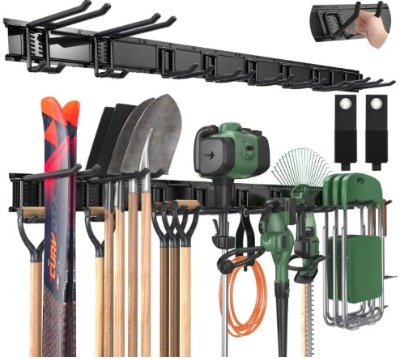
1. LBT 66″ Garage Tool Organizer Wall Mount – 720lbs Garden Tool Organizer
Product Description
The LBT 66-inch wall mount is built for garages that store a mix of garden tools and long-handled equipment. At 66 inches wide, this is one of the longest organizers on this list, giving you serious horizontal space to spread out rakes, shovels, brooms, and hoses. The steel rail construction is rated to hold up to 720 pounds, which is a huge number that tells you this thing is not messing around.
This is technically marketed as a garden tool organizer, but it earns a spot on a power tool organizer roundup because many garage owners use rail-style systems like this one to hang cordless tool bags, extension cords, and tool belts alongside their yard equipment. If your garage doubles as a spot for both yard work and DIY projects, a long rail system like this gives you flexible storage that adapts as your tool collection grows.
Best Use Cases
- Garages that store a large mix of garden tools plus miscellaneous items
- Homes with long driveways or big yards that need multiple rakes, shovels, and hoes
- Anyone who wants one long rail instead of several small racks scattered around
- Renters who want a mountable system that does not require cutting into drywall extensively (rail systems usually need fewer studs)
Key Features Explained Simply
Rail and hook system: Instead of fixed hook spots, most 66-inch rail organizers use a track design. You slide hooks along the rail and lock them wherever you want. This means you are not stuck with a fixed layout. As your tool collection changes, you can move hooks around in seconds.
720-pound weight rating: This number refers to the total capacity across the whole rail, not one single hook. Still, it shows the steel is thick enough to handle a garage full of heavy tools without bending or sagging over time.
Wide hook variety: Most kits like this ship with multiple hook sizes and shapes, so you can hang anything from a thin trowel to a bulky snow shovel.
66-inch length: This is longer than most competitors, which usually top out around 48 inches. That extra length matters if you have a two-car garage with a long empty wall.
Real-Life Usage Insight
Picture a typical two-car garage where one side wall runs the length of the space. A 48-inch rack only covers about a third of that wall, leaving a lot of wasted space. The 66-inch option stretches across most of that same wall, letting you hang everything from hedge trimmers to extension cords to a broom, all on one continuous system. You end up with fewer gaps, and the tools look more organized as a set instead of scattered across three different mini-racks.
Installation does take a bit more planning since you need to find studs across a longer span, but once it’s up, the payoff is a genuinely clean wall.
Pros
- Very long rail gives you way more hanging space than shorter competitors
- High weight capacity means you rarely have to worry about overloading it
- Rail and hook design lets you rearrange your layout anytime
- Good for mixed garages that store both yard tools and power tools
- Steel build feels sturdy and should hold up for years
Cons
- Takes longer to install because of its length
- Needs a long, mostly empty wall to make full use of the space
- Not ideal for small garages or single-car setups
- Garden tool focus means it lacks dedicated slots for drills or batteries
Performance Discussion
In terms of raw holding strength, this organizer performs above average. The steel gauge used in most 66-inch rail systems is thick enough to resist bending under a full load of rakes, shovels, and hoses. Hooks stay locked in place once tightened, and there is minimal wobble even when tools are added or removed frequently.
Ease of Use
Setup is straightforward if you have basic tools and can find wall studs. The rail mounts first, then hooks slide on and lock with a simple twist or screw mechanism. Rearranging hooks later takes seconds, no drilling required. The main challenge is just handling a 66-inch piece of steel during installation, which is easier with two people.
Value for Money
For the price point typical of this category, you get a lot of length and weight capacity, which makes the cost per inch of storage quite reasonable. If you have the wall space, this is one of the better value picks on this list, especially for anyone who wants to consolidate garden tools and miscellaneous garage items onto one system.
2. Garage Tool Organizer Wall Mount, 48-inch Heavy-Duty Storage System with 6 Adjustable Double Hooks
Product Description
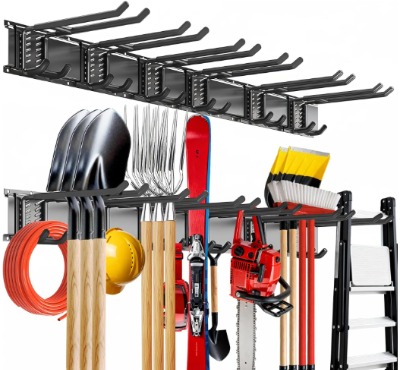
This 48-inch wall mount system takes a simpler approach than the LBT rail. Instead of a sliding track, it comes with 6 adjustable double hooks fixed along a sturdy rail. It’s built for shovels, snowboards, yard tools, and general shed items, making it a solid middle-ground option between a compact starter rack and a massive garage-length system.
Best Use Cases
- Single-car garages or sheds with limited wall space
- Storing snowboards, skis, and other seasonal gear alongside yard tools
- Homeowners who want a simple, no-fuss setup without a full track system
- Anyone organizing a mix of long-handled tools and bulky recreational gear
Key Features Explained Simply
Six double hooks: Each hook has two prongs, so you can hang two items per hook, giving you up to 12 hanging points across the rail. This is great for maximizing a shorter 48-inch space.
Adjustable hook positions: While not a full sliding rail like the LBT model, the hooks on this system can typically be repositioned within set slots, giving you some flexibility without a complex track mechanism.
Heavy-duty build: The steel construction is designed to hold everyday garage tools without sagging, even with double the load per hook thanks to the double-pronged design.
Compact 48-inch length: This size fits comfortably in smaller garages, sheds, or narrow wall sections where a 66-inch rail simply would not fit.
Real-Life Usage Insight
This type of organizer works especially well for households with seasonal sports gear. Snowboards and skis are awkward shapes that do not fit neatly into cabinets or bins, and this rack’s double hook design lets you hang boards, poles, rakes, and shovels all in the same compact footprint. For a one-car garage or a garden shed, this size hits a sweet spot: enough hanging points to matter, without eating up an entire wall.
Pros
- Compact size fits smaller spaces easily
- Double hooks double your hanging capacity without extra wall length
- Simple to install compared to full track systems
- Works well for both yard tools and recreational gear like snowboards
- Reasonably priced compared to longer rail systems
Cons
- Less flexible layout compared to sliding rail systems
- 48 inches may feel limiting for larger tool collections
- Not designed specifically for power tools or batteries
- Six fixed hook slots can feel crowded if you own a lot of oddly shaped items
Performance Discussion
The double-hook design performs well for its intended purpose. Long-handled tools sit securely, and the heavy-duty steel resists bending under normal garage loads. Because the hooks are fixed rather than sliding freely, there is slightly less wobble compared to track-based systems, which some users may actually prefer for stability.
Ease of Use
This is one of the easier organizers to install on this list. With pre-set hook positions, you spend less time figuring out spacing and more time just mounting the rail to studs and hanging your gear. It’s a good pick for anyone who wants results fast without overthinking the layout.
Value for Money
Given its compact size and simple design, this organizer sits at a friendly price point. It’s a smart buy for smaller garages or sheds where a longer, pricier system would be overkill. You get solid functionality without paying for length you do not need.
3. JUNNUJ Power Tool Organizer Cart with Charging Station, 6 FT Cord
Product Description
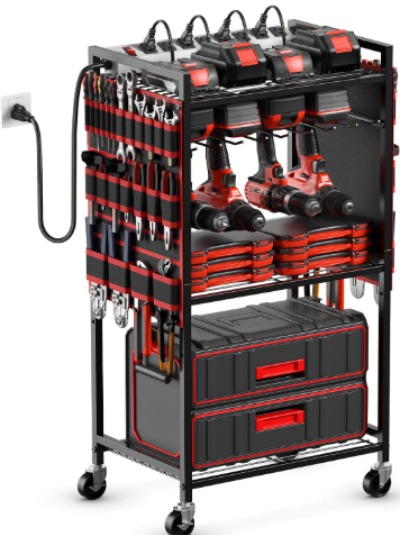
The JUNNUJ cart is a completely different approach from the wall mount options above. Instead of hanging tools on a wall, this is a rolling cart with a built-in charging station and a 6-foot power cord. It’s designed specifically for power tools like drills, saws, and their batteries, giving you a mobile storage and charging hub you can wheel anywhere in the garage or job site.
This is a strong pick if wall space is limited or if you simply prefer a movable setup over a fixed one.
Best Use Cases
- Garages with limited or unusable wall space (shared walls, windows, garage doors)
- DIYers and contractors who want to charge multiple tools at once
- Anyone who wants to wheel their whole tool setup to different work areas
- People who own several cordless tools and batteries that all need regular charging
Key Features Explained Simply
Built-in charging station: This is the standout feature. Instead of running extension cords to each individual charger, the cart has a centralized charging setup so multiple tool batteries can charge at the same time in one spot.
6-foot cord: The cord length gives you enough reach to plug into a nearby outlet without needing an extension cord, which keeps your garage safer and less cluttered.
Rolling cart design: Wheels let you move the whole unit around the garage or even out to the driveway for outdoor projects. This mobility is something none of the wall-mounted options can offer.
Compact footprint: Since it stands on its own instead of spreading across a wall, it works in garages where wall space is already used for shelving, cabinets, or a car.
Real-Life Usage Insight
Think about a weekend project where you need a drill, an impact driver, and a circular saw, all cordless. Normally you’d have three separate chargers plugged into different outlets, cords running everywhere. With this cart, you plug in once, charge everything on the built-in station, and roll the whole cart to wherever you’re working, even out to the driveway if needed. That kind of convenience is hard to match with a static wall rack.
For garages where wall space is already taken by cabinets, pegboards, or windows, this cart solves the storage problem without needing extra wall real estate at all.
Pros
- Centralized charging saves you from juggling multiple chargers and outlets
- Mobile design means you can bring your tools to the job instead of the other way around
- Great option when wall space is limited or unavailable
- Keeps cords and chargers organized in one place instead of scattered
- Useful for both garage work and outdoor projects
Cons
- Takes up floor space instead of wall space, which matters in tight garages
- Not built for garden tools like rakes or shovels
- Wheels and cart body require occasional maintenance to keep rolling smoothly
- Limited capacity compared to a full wall system if you own a large number of tools
Performance Discussion
The charging station performs reliably for typical household power tool batteries, and having everything charge in one place genuinely cuts down on daily hassle. The cart frame itself feels stable enough for rolling around a garage or smooth driveway, though it’s not designed for rough outdoor terrain.
Ease of Use
This is about as beginner-friendly as it gets. There’s no wall mounting, no stud finding, no drilling. You assemble the cart, plug in the cord, and start using it. For anyone who wants a fast setup with zero wall work involved, this is the easiest option on the list.
Value for Money
Considering it combines storage and charging into one unit, the JUNNUJ cart offers strong value, especially for people who own several cordless tools. You’re not just buying storage, you’re buying convenience and time savings every time you charge your batteries.
4. TIDYME Garage Tool Organizer Wall Mount, 48″, 3 Racks 6 Hooks, 300 lbs
Product Description
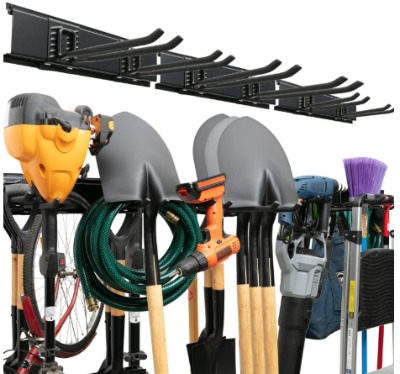
The TIDYME organizer is a compact wall mount system that combines three racks with six hooks in a 48-inch frame. It’s rated to hold 300 pounds, which is plenty for typical garage tools, and the mix of racks and hooks gives you more variety than a hooks-only system. Racks are great for wider items like buckets or bins, while hooks handle long-handled tools.
Best Use Cases
- Garages that need a mix of shelf-style and hook-style storage
- Small to medium tool collections that don’t require a massive rail system
- Homeowners who want an all-in-one solution without buying separate shelves and hook racks
- Anyone setting up a first-time garage organization system on a budget
Key Features Explained Simply
Three racks: These act like small shelves, giving you flat surfaces to rest items that don’t hang well, like small bins, spray bottles, or tool boxes.
Six hooks: These handle the classic long-handled tools, hoses, and extension cords that need to hang rather than sit flat.
300-pound capacity: While lower than the LBT’s 720-pound rating, 300 pounds is still more than enough for the average homeowner’s tool collection.
48-inch frame: A manageable size for most single or two-car garages, striking a balance between coverage and ease of installation.
Real-Life Usage Insight
The combination of racks and hooks makes this a genuinely versatile pick for someone starting fresh with garage organization. You get shelf space for bins and boxes, plus hook space for rakes, brooms, and hoses, all without buying multiple separate products. It’s the kind of setup where you install once and organize your whole garage entry wall around it.
Pros
- Mix of racks and hooks covers more storage needs than a hooks-only design
- 300-pound capacity is solid for typical household use
- 48-inch size fits most garage walls without overwhelming the space
- Good all-in-one option for first-time buyers
- Reasonably priced for the amount of functionality included
Cons
- Lower weight capacity than heavy-duty rail systems like the LBT
- Not specialized for power tools or battery charging
- Rack shelves have limited depth, so bulky items may not fit well
- Fixed hook and rack positions offer less flexibility than sliding rail designs
Performance Discussion
For its weight class, the TIDYME system performs well. The blend of shelf and hook storage means you’re not forcing every item into a hanging position, which actually reduces strain on the hooks themselves. It holds up fine under normal daily use in a typical residential garage.
Ease of Use
Installation is straightforward, similar to other 48-inch systems. You mount the frame to studs, and the racks and hooks come pre-positioned, so there’s minimal guesswork. This makes it a good pick for beginners who want results without a complicated setup process.
Value for Money
This is one of the more balanced value picks on the list. You get variety (racks plus hooks), a manageable size, and solid weight capacity, all at a price that suits most household budgets. For general garage organization beyond just power tools, this is a smart all-rounder.
5. POKIPO Large Power Tool Organizer Wall Mount with Charging Station, 4 Layer Heavy Duty Metal Rack
Product Description
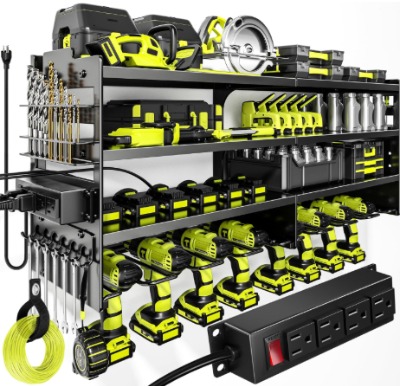
The POKIPO organizer is built specifically for power tool users, and it shows. This is a 4-layer heavy-duty metal rack rated for 600 pounds, with 8 cordless drill holders, a battery utility rack, and 4 power strips built right in. If your garage is full of cordless drills, impact drivers, and spare batteries, this is the most purpose-built option on this entire list.
Best Use Cases
- Garages with a large collection of cordless power tools and multiple batteries
- DIYers or small contractors who need to charge several tools at once on the wall
- Anyone who wants drills and batteries stored vertically instead of in messy drawers
- Households replacing a cluttered tool bench setup with a dedicated vertical system
Key Features Explained Simply
4-layer design: This gives you distinct levels for organizing different categories of items, drills on one layer, batteries on another, and so on, instead of piling everything together.
8 cordless drill holders: Each holder is shaped to cradle a drill securely, so your drills stand upright and visible instead of lying flat and getting buried under other tools.
Battery utility rack: A dedicated section just for batteries keeps them separated from tools, which makes it easy to grab a charged battery without digging through a drawer.
4 power strips built in: This is the charging station part of the design. With four strips, you can charge multiple tools or batteries at once without running separate extension cords across the garage.
600-pound capacity: A strong rating that reflects the heavier nature of metal drills and multiple batteries all stored on one unit.
Real-Life Usage Insight
For anyone who has ever dumped a pile of cordless drills and loose batteries into a plastic bin, this organizer solves that exact problem. Each drill gets its own holder, so you can see at a glance which one you need. Batteries sit in their own rack instead of rolling around loose. And because the power strips are built into the unit, you charge everything right where it’s stored, no extra cords stretching across the garage floor.
This setup shines in garages that have grown a serious power tool collection over the years, multiple drills, drivers, saws, and a drawer full of batteries that never seem to be charged when you need them.
Pros
- Purpose-built for power tools, not just a general-use rack
- Dedicated drill holders keep tools upright and easy to identify
- Battery rack keeps batteries organized and separate from tools
- Built-in power strips mean charging happens right at the storage spot
- High 600-pound capacity handles a large, heavy tool collection
- 4-layer design maximizes vertical space instead of just horizontal
Cons
- Larger and more complex setup compared to simple hook racks
- Not suited for garden tools like rakes or shovels
- Takes up more wall height, which may not suit garages with low ceilings or windows
- Price tends to run higher due to the built-in electrical components
Performance Discussion
This organizer performs best when you actually have the power tool collection to justify it. With 8 drill holders and a full battery rack, it’s clearly designed for serious DIYers rather than someone with just one drill and a hammer. The built-in power strips work well for daily charging routines, and the metal construction holds up under the weight of multiple heavy tools without sagging.
Ease of Use
Setup takes a bit more time than a basic hook rack, mainly because of the electrical wiring for the power strips and the multiple layers that need careful alignment during installation. Once it’s mounted, though, day-to-day use is simple: hang a drill, plug in a battery, done.
Value for Money
Given the built-in charging station and the specialized drill and battery storage, this organizer costs more than basic hook racks, but the value is clear if you own multiple cordless tools. It replaces the need for a separate charging station, a drill rack, and general shelving, combining them into one unit.
Comparison Insights: How These Five Stack Up
Let’s break down how these organizers compare across a few key factors that matter most to garage owners.
Weight capacity: The LBT 66-inch rail leads with 720 pounds, followed by the POKIPO at 600 pounds. The TIDYME sits in the middle at 300 pounds, while the JUNNUJ cart and the 48-inch double hook system don’t advertise a single headline weight number since their capacity is spread across a rolling cart or fixed hook count.
Best for power tools specifically: The POKIPO and JUNNUJ cart are the clear winners here, since both include built-in charging stations. If your main goal is organizing drills, batteries, and cordless tools, these two should be at the top of your list.
Best for garden and yard tools: The LBT 66-inch rail and the 48-inch double hook organizer are built with rakes, shovels, and snowboards in mind. If your garage storage problem is more about yard equipment than power tools, lean toward these two.
Best for small spaces: The TIDYME and the 48-inch double hook system both fit comfortably in smaller garages or sheds without needing a huge stretch of open wall.
Best for mobility: The JUNNUJ cart is the only option on wheels, giving it a unique edge if you want to move your tools around instead of keeping them fixed to one wall.
Best all-rounder: The TIDYME system, thanks to its mix of racks and hooks, handles a broader variety of item shapes and sizes than a hooks-only or drills-only design.
Buying Guide: What to Look for in a Garage Tool Organizer
Here’s a practical rundown of the things you should think about before buying any of these organizers.
Measure Your Wall Space First
Before anything else, grab a tape measure and check the actual open wall space you have available. A 66-inch rail is fantastic if you have the room, but it’s wasted potential (and wasted money) if you only have 40 inches of clear wall. Match the organizer’s length to your real space, not the other way around.
Think About What You’re Actually Storing
If your garage is packed with cordless drills and batteries, a purpose-built option like the POKIPO or the JUNNUJ cart will serve you far better than a general hook rack. On the flip side, if your main clutter is rakes, shovels, and hoses, the LBT rail or the double hook system will make more sense.
Check the Weight Rating Against Your Tool Collection
Add up roughly how much your tools weigh, including any bins or accessories you plan to hang. Then compare that number to the organizer’s rated capacity, and try to stay well under the maximum rather than right at the limit. This gives you a safety margin and extends the life of the unit.
Consider Whether You Need a Charging Station
Not every garage needs a built-in charging setup. If you only own one or two cordless tools, a simple wall rack is fine and you can charge tools with their standard chargers plugged into a regular outlet. But if you own several cordless tools and batteries, a built-in charging station saves real time and reduces cord clutter.
Factor in Installation Difficulty
Rail systems and multi-layer racks generally take longer to install than simple hook racks. If you want something you can mount in under an hour, lean toward the simpler designs like the 48-inch double hook organizer or the TIDYME system. If you don’t mind spending a full afternoon on setup, the larger systems reward you with more storage and flexibility.
Don’t Forget About Studs
Almost every wall mount organizer needs to be anchored into wall studs, not just drywall, especially when holding heavy tools. Use a stud finder before you buy to confirm your garage wall layout supports the length of organizer you’re considering.
Who Should Buy These Products
Homeowners with mixed garages (yard tools plus power tools): The LBT 66-inch rail or the TIDYME 48-inch system will give you the flexibility to store both categories without needing two separate purchases.
Serious DIYers and small contractors with multiple cordless tools: The POKIPO wall mount is built exactly for this situation, with dedicated drill holders, a battery rack, and built-in power strips.
People who want mobility over fixed storage: The JUNNUJ cart is the right call if you want to wheel your tools to different parts of the garage or even outside for driveway projects.
Small garage or shed owners: The TIDYME or the 48-inch double hook system fit better in tighter spaces without overwhelming the wall.
First-time garage organizers on a budget: The 48-inch double hook system or the TIDYME rack offer simple installation and solid function without the higher price tag of specialized units like the POKIPO.
Common Mistakes to Avoid
Buying based on length alone: A longer rail looks impressive, but if it doesn’t fit your actual wall space, it becomes a hassle instead of a solution. Always measure first.
Ignoring the weight rating: It’s tempting to just hang everything you own on a new rack, but overloading any organizer, even a heavy-duty one, shortens its lifespan and creates a safety risk. Stay under the stated maximum.
Mounting into drywall alone: Skipping the stud finder step is one of the most common mistakes. Drywall anchors alone usually cannot support the weight of a full tool collection, especially on heavier systems like the LBT or POKIPO.
Not planning your layout before installing: Especially with fixed hook and rack systems, it helps to lay your tools out on the garage floor first and roughly plan where each item will go. This avoids awkward gaps or overcrowded sections later.
Overlooking your future tool collection: If you’re actively building your tool collection, it’s worth buying slightly more capacity than you need right now. Garages tend to fill up faster than expected.
Forgetting about charging needs: If you own several cordless tools, don’t just default to a basic hook rack out of habit. A charging station option like the POKIPO or JUNNUJ cart can save you a surprising amount of daily hassle.
Final Verdict
All five of these organizers do their job well, but each one shines in a different situation.
If you want the biggest, strongest general-purpose option and have the wall space to match, the LBT 66-inch rail is hard to beat, thanks to its huge 720-pound capacity and flexible sliding hook design.
If your garage is smaller and you want a simple, no-fuss setup for yard tools and recreational gear, the 48-inch double hook organizer gets the job done without overcomplicating things.
For anyone who wants mobility and centralized charging without touching a single wall stud, the JUNNUJ cart is a genuinely convenient pick, especially for households with several cordless tools.
If you want a balanced, do-it-all wall system that handles both hanging tools and shelf-style storage, the TIDYME 48-inch system is a smart, budget-friendly choice.
And if your garage is dominated by cordless drills, drivers, and spare batteries, the POKIPO organizer is the clear winner, purpose-built with drill holders, a battery rack, and a built-in charging station that eliminates the need for separate chargers scattered around your garage.
There’s no single “best” pick that fits every garage. It really comes down to what you store the most, how much wall space you have, and how important mobility or charging convenience is to your daily routine. Match the organizer to your actual habits, not just the flashiest spec sheet, and you’ll end up with a garage that finally works with you instead of against you.

Hi, I’m Mary, the founder of Homygear.com. I’m passionate about creating a comfortable, smart, and beautiful home. I share practical insights and real-world experience on home gear that makes everyday life easier. Behind the scenes, my dedicated research team studies products in depth, and our writers craft honest reviews using trusted, authentic sources—so you can choose home gear with confidence.