Alexa vs Google Home
Smart speakers have become a huge part of modern homes. They sit on nightstands, kitchen counters, and living room shelves, ready to help whenever you need them. Two names dominate this space: Amazon’s Alexa and Google’s Home speaker. Both are powerful, popular, and packed with features that can transform your daily routine. But which one should you actually buy?
This question comes up all the time from people looking to jump into the smart home world. The answer isn’t as simple as “pick one” because the right choice depends on what matters to you, what devices you already own, and how you want to interact with your home. Let’s break down everything you need to know so you can make an informed decision.
How These Smart Speakers Work
Before we dive into the comparison, let’s understand what these devices actually do. A smart speaker is basically a speaker with a virtual assistant built inside. You talk to it, and it listens for wake words—usually “Alexa” or “Hey Google”—and then carries out your commands.
When you say something, the speaker records your voice, sends it to servers in the cloud, and processes what you said. The assistant interprets your request and either performs an action or sends information back to your speaker. All of this happens in seconds.
Both Alexa and Google Home speakers work this way, but they use different technology behind the scenes. Amazon’s assistant is Alexa, while Google has its Assistant, often called Google Assistant. These aren’t just names—they’re the brains of the whole operation.
Amazon Alexa: The Market Leader
Amazon created Alexa, and it’s been around longer than Google’s smart speaker assistant. Because of this head start, Alexa has built a massive ecosystem of compatible devices and services.
What Alexa Does Well
Alexa is incredibly easy to use for basic commands. Ask it to play music, set a timer, check the weather, or turn off your lights—it handles these tasks smoothly. The device responds quickly and understands most of what you say without making you repeat yourself.
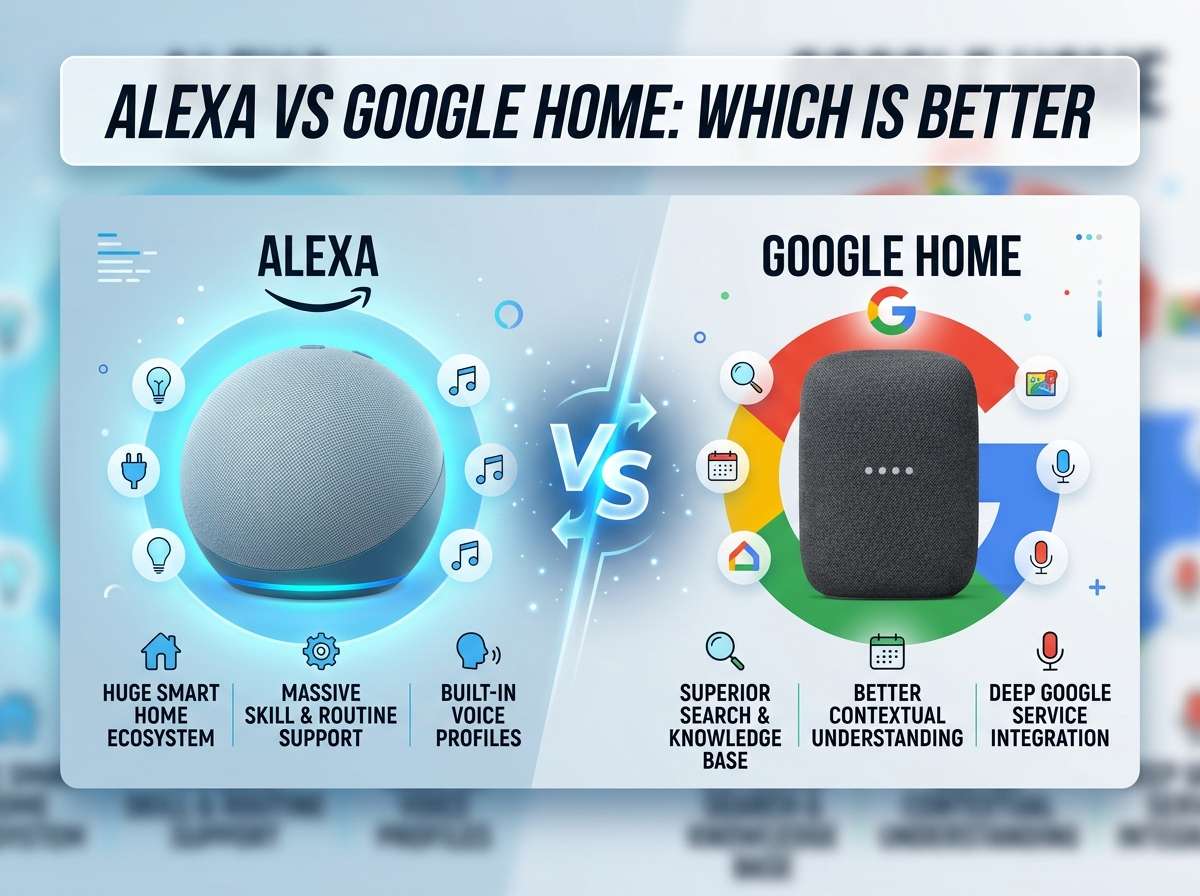
One huge advantage is Amazon’s smart home device network. Alexa works with thousands of different products. Smart plugs, light bulbs, thermostats, security cameras, door locks, and switches all connect to Alexa. If you want to build a connected home, Alexa gives you more options to choose from. Many companies make products that work with Alexa first, sometimes before making Google Home versions.
Shopping is another area where Alexa shines. Since Amazon owns the assistant, it integrates deeply with its shopping service. You can reorder items from your purchase history, add things to your cart, and even set up voice-activated shopping lists. If you’re an Amazon Prime member, this connection feels natural and seamless.
Alexa also has a massive skill library. Skills are like apps for your smart speaker. Developers have created thousands of skills that do everything from ordering pizza to playing trivia games to controlling your coffee maker. While not all skills are useful, the sheer variety means you can find tools for almost anything you want to do.
The Echo speakers themselves come in many sizes and price points. You can get a tiny Echo Dot for under thirty dollars, or spend more for the Echo Show, which adds a screen. The variety means you can find an Alexa device that fits your budget and space.
Where Alexa Falls Short
Alexa’s voice recognition isn’t quite as natural as Google’s. It sometimes struggles to understand complex sentences or longer requests. If you talk in complicated ways or use unusual phrasing, Alexa might not understand you the first time.
The Google Assistant is built on Google’s massive language processing technology. Google handles billions of search queries daily, which means their assistant has learned from an enormous amount of real-world conversation. This experience shows in how naturally it understands what you’re asking.
Alexa’s answer quality can be inconsistent. When you ask a question, Alexa pulls from Bing search results, Wikipedia, and other sources. Sometimes you get a great answer, and sometimes the response feels shallow or incomplete. Google’s answers are usually more detailed and accurate because of Google’s superior search engine and knowledge database.
Setup and connecting new devices can be tedious with Alexa. You often have to dive into the Alexa app, find the right skill or device integration, and enable things manually. Google Home usually makes this process smoother and more automated.
Google Home: The Search Giant’s Answer
Google entered the smart speaker game later than Amazon, but it brought serious technology from its search dominance. Google Home speakers run Google Assistant, which leverages Google’s incredible database of information and understanding of language.
What Google Home Does Well
Google Assistant is smarter at understanding what you really mean. Ask it a complex question or a follow-up that refers back to something you said earlier, and it usually gets it. This natural conversation ability makes Google Home feel less like a robot and more like talking to someone who actually understands you.
The quality of answers is noticeably better. Google Assistant pulls from Google Search, which has more comprehensive information than what Alexa can access. If you ask about a local restaurant’s hours, a recipe, or how to fix something, Google usually gives you better information faster. The assistant also understands context better, so you can have more natural back-and-forth conversations.
Google Home also handles personal information better. Since it ties into your Google Account, it can access your calendar, your emails, and your personal contacts. You can ask it to show you your schedule, remind you about meetings, or tell you about upcoming events. This integration feels intuitive because Google already knows this information.
Google’s smart home network is solid and growing. It works with thousands of devices including lights, thermostats, cameras, and locks. While the selection isn’t quite as massive as Alexa’s network, the devices that do work tend to integrate smoothly. Google Home works especially well with products from Google’s own brands and partners.
Setup is generally easier with Google Home. The assistant often recognizes devices automatically and gets them connected with minimal effort. You spend less time fiddling in apps and more time enjoying your smart home.
Where Google Home Falls Short
Google Home’s skill ecosystem is smaller than Alexa’s. While you can do quite a lot with the built-in features, custom actions and integrations aren’t quite as abundant. This won’t matter for most people, but if you want niche integrations, you might not find them.
Google Assistant doesn’t connect to shopping as naturally as Alexa. Google Express and Google Shopping exist, but the integration doesn’t feel as smooth as Amazon’s. If you love voice shopping, Alexa gives you a better experience.
Google Home speakers have fewer size options compared to Alexa. While Google makes several models, the selection isn’t as vast. If you want a tiny device or a specific form factor, Amazon probably has more choices.
Privacy concerns are sometimes raised about Google. Since Google’s business relies on advertising and data collection, some people feel uncomfortable with Google Home listening in their houses. Amazon faces similar concerns, but the perception that Google collects more data makes some people hesitant.
The Smart Home Ecosystem Battle
Your smart speaker choice matters most when you think about your entire smart home. The speaker becomes the hub that controls everything else in your connected home.
Alexa has the advantage here. More device manufacturers make Alexa-compatible products, which means more options for building your system. Whether you want smart lights, a connected doorbell, or a voice-controlled coffee maker, you’ll find more products that work with Alexa.
Google Home is catching up fast. Many newer smart home devices work with both assistants. The gap is narrowing, but Alexa still wins on pure selection and variety.
A practical tip: look at the specific devices you want to buy. Make a list of your must-have smart home items, then check compatibility. If most of them work with one assistant but not the other, let that guide your choice. Your smart speaker should serve your existing devices, not the other way around.
Voice Quality and Sound
If you care about listening to music, this matters. Both speakers can stream music, but their sound quality differs.
Alexa speakers generally produce better audio. The larger Echo models have decent speakers with decent bass and volume. They’re not studio-quality, but they’re fine for everyday listening and filling a room with sound.
Google Home speakers sound pretty good too, but they’re usually a step behind Echo speakers in audio quality. If you’re an audiophile or need excellent sound, neither speaker will impress you. For casual listening and everyday use, both are adequate.
The real difference comes in music service integration. Alexa integrates with Amazon Music, which is great if you’re a Prime member. Google Home connects to YouTube Music and works well with other streaming services too. Your choice here might depend on which music service you already use and prefer.
Price and Value
Let’s talk money. Both companies offer speakers at different price points.
Amazon Echo Dot costs around thirty to forty dollars, making it the cheapest entry point. For this price, you get basic smart speaker functionality. It sounds okay, understands voice commands reasonably well, and connects to your smart home. It’s perfect for testing whether you like smart speakers before spending more money.
Amazon Echo, the standard model, costs around a hundred dollars. This one has better sound and a nicer design. If you want your speaker to actually sound good while you listen to music, this is the minimum to consider.
Google Nest Mini is Google’s budget option, priced similarly to the Echo Dot. It has a nice design and integrates well with Google services. If you’re already in Google’s ecosystem with Gmail and a Gmail account, this is a solid cheap entry point.
Google Nest Audio is the comparable option to the standard Echo, priced around the same. It sounds slightly different than the Echo, but quality is comparable.
Both companies make premium versions with screens. The Echo Show and Google Nest Hub add touchscreen displays that let you watch videos, see recipes, check your calendar visually, and control your home through the screen. These cost more, typically between one hundred fifty and two hundred fifty dollars depending on screen size.
For pure value, the budget options from both companies are excellent. Spend thirty to forty dollars and you get a fully functional smart speaker. Upgrade to the hundred dollar model if you care about sound quality or want a nicer device to look at.
Privacy and Data Security
This is serious stuff. Both companies collect voice recordings, but they handle your data differently.
Amazon keeps your Alexa recordings on its servers. You can ask Alexa to delete your recent voice recordings, and you can access your entire history through the Alexa app. Amazon says it uses recordings to improve its assistant, which means humans sometimes listen to your commands. You can opt out of this, but not everyone knows that option exists.
Google works similarly. Google stores your voice commands and uses them to improve Google Assistant. You can manage your data through your Google Account settings. Like Amazon, Google gives you ways to review and delete your information, but many people don’t know where to find these settings.
Both companies have privacy policies that explain how they use your data. Both delete inactive accounts and follow regulations about data storage. Neither company has perfect privacy, but neither is secretly doing anything drastically different from the other.
If privacy is your top concern, a smart speaker might not be for you. Both devices listen for wake words constantly, which means they’re always ready to record. You can unplug them or mute them, but then they’re not as useful.
The practical approach is to accept that smart speakers require some trust in the company. If you’re comfortable with Amazon, get Alexa. If Google makes you feel better, get Google Home. The privacy differences aren’t huge enough to be a deciding factor for most people.
Compatibility with Your Existing Devices
Here’s the real-world question: what devices do you already own?
If you have an iPhone and use Apple services, you might think Google Home is better. While Google Home works fine with iPhones, Siri integration isn’t seamless. Google Home doesn’t control HomeKit devices as easily as Apple’s own devices do. If you’re deep in Apple’s ecosystem, you might eventually want a HomePod instead.
If you have an Android phone and use Google services—Gmail, Google Calendar, Google Photos—Google Home feels natural. It connects to your personal data automatically. You ask it to check your schedule, and it pulls from your actual calendar.
If you’re an Amazon Prime member and buy frequently on Amazon, Alexa makes your life easier. The shopping integration, the connection to Prime Video, and the ability to reorder your regular purchases all feel convenient.
If you use neither service exclusively and aren’t sure what to pick, look at which services you use daily. Are you searching the web? Google. Are you shopping online? Amazon. Are you listening to music? That one’s split, but your preference matters.
Making Your Decision
Both Alexa and Google Home are excellent smart speakers. Neither one is objectively better across the board. Your choice should come down to your specific situation.
Choose Alexa if:
- You shop on Amazon frequently or have Prime
- You want the most smart home device options
- You prefer Amazon Music for streaming
- You like having lots of skills and customization options
- You want the most budget-friendly entry point with great variety
Choose Google Home if:
- You use Google services daily (Gmail, Calendar, Photos)
- You want more natural conversations and better answers to questions
- You care about information quality and accuracy
- You prefer Google’s smart home approach
- You like the simplicity of automatic setup and integration
Start small. You don’t need to spend a lot of money to figure out which assistant you prefer. Buy a budget model from whichever company appeals to you more. Use it for a few weeks. Pay attention to how it understands your voice, whether it answers your questions well, and how smoothly it controls your devices.
If you don’t like it, you can always return it or give it to a friend. Smart speakers aren’t permanent decisions. You can change your mind.
The Real-World Experience
At the end of the day, both assistants work well for everyday tasks. Setting timers, checking weather, playing music, controlling lights—both handle these perfectly. The differences show up in edge cases and personal preferences.
Alexa users tend to love the ecosystem and the skill variety. They appreciate that they can customize their experience and find solutions for almost anything. If you like tinkering and exploring options, Alexa rewards that behavior.
Google Home users appreciate the simplicity and intelligence. They like that the device understands them without extra effort. If you want something that just works, Google Home is solid.
Neither choice is wrong. Both companies are investing heavily in their assistants. Both are improving continuously. The gap between them is smaller than it was a few years ago, and that gap keeps shrinking.
Final Thoughts
When you buy a smart speaker, you’re not just buying a device. You’re choosing which company you want to invite into your home. You’re deciding which services and ecosystem make sense for you. You’re picking the assistant that aligns with how you live your digital life.
Take your time with this choice. Look at your devices, your services, your preferences, and your budget. Consider which features matter most to you personally. Don’t just pick based on what others recommend.
If you have Amazon devices and use Amazon services, Alexa is the obvious choice. If you use Google every day and love how Google search works, Google Home makes sense. If you’re genuinely torn, buy the cheaper option first, try it, and see how you feel.
Smart speakers are useful, fun, and becoming more capable every day. Whether you go with Alexa or Google Home, you’re getting a solid piece of technology that will make your life a little more convenient. The “best” choice is the one that fits your life. So go with your gut, make a decision, and start enjoying your smart home.

Hi, I’m Mary, the founder of Homygear.com. I’m passionate about creating a comfortable, smart, and beautiful home. I share practical insights and real-world experience on home gear that makes everyday life easier. Behind the scenes, my dedicated research team studies products in depth, and our writers craft honest reviews using trusted, authentic sources—so you can choose home gear with confidence.