15A vs 20A Outlet
You’re standing in the hardware store, staring at electrical outlets. Some say 15A. Others say 20A. They look almost the same, but you know there’s got to be a difference.
So which one do you need?
Don’t worry. This guide will break down everything about 15 amp and 20 amp outlets in simple terms. By the end, you’ll know exactly what these numbers mean and which outlet belongs in your home.
What Do These Numbers Actually Mean?
Let’s start with the basics. The “A” stands for amperage, which is just a fancy way to measure electrical current. Think of electricity like water flowing through a pipe. Amperage tells you how much electricity can flow through that outlet at one time.
A 15A outlet can handle up to 15 amps of current. A 20A outlet can handle up to 20 amps. Pretty straightforward, right?
The higher the number, the more power that outlet can deliver to your devices. It’s like having a wider pipe that lets more water flow through.
How to Tell Them Apart
Here’s the fun part. These outlets don’t look identical, even though they’re pretty close.
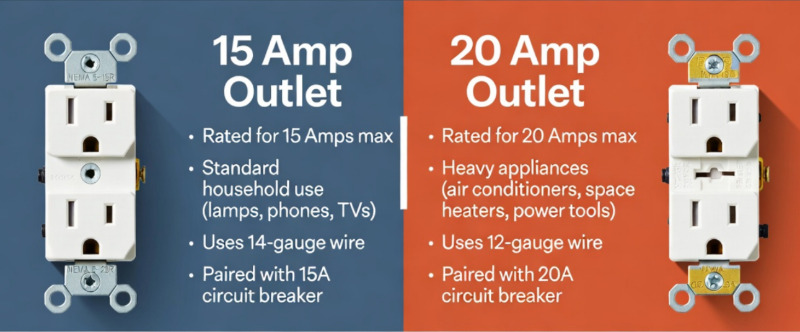
A standard 15 amp outlet has two vertical slots. You’ve seen this a million times. It’s the regular outlet in most rooms of your house.
A 20 amp outlet has one vertical slot and one T-shaped slot. That T-shape is the key difference. The horizontal line at the top of the T makes it wider than a normal slot.
Why does this matter? The T-shaped slot accepts both regular plugs AND special 20 amp plugs. This means you can plug a 15 amp device into a 20 amp outlet with no problems. But you can’t plug a 20 amp device into a 15 amp outlet because the plug won’t fit.
It’s a safety feature built right into the design. Smart, huh?
The Wiring Behind the Wall
Now let’s talk about what you can’t see. The wiring behind these outlets is different too.
A 15 amp outlet needs 14-gauge wire. This wire is a bit thinner and works perfectly fine for most household needs.
A 20 amp outlet requires 12-gauge wire. This wire is thicker and can carry more current without overheating. The lower the gauge number, the thicker the wire. So 12-gauge is actually bigger than 14-gauge.
You can’t just swap a 15 amp outlet for a 20 amp outlet if you only have 14-gauge wire in the wall. That would be dangerous. The wire could overheat and cause a fire.
On the flip side, you can put a 15 amp outlet on a 20 amp circuit with 12-gauge wire. It’s actually pretty common in homes. The circuit can handle 20 amps, but the outlet is rated for 15. This is perfectly safe and legal.
Circuit Breakers Play a Role Too
Every outlet connects to a circuit breaker in your electrical panel. The breaker acts like a safety guard. If too much current flows through the circuit, the breaker trips and cuts the power.
A 15 amp circuit needs a 15 amp breaker. A 20 amp circuit needs a 20 amp breaker.
The breaker, the wire, and the outlet all need to match up properly. You can’t mix and match randomly. Here’s what works:
- 15A breaker + 14-gauge wire + 15A outlet = Good
- 20A breaker + 12-gauge wire + 20A outlet = Good
- 20A breaker + 12-gauge wire + 15A outlet = Good
- 15A breaker + 14-gauge wire + 20A outlet = Bad (don’t do this)
That last combo is a big no-no. The outlet could deliver 20 amps, but the wire and breaker can’t handle it. Fire hazard alert.
Where You’ll Find Each Type
Walk around your house. Most of the outlets you see in bedrooms, living rooms, and hallways are 15 amp outlets. They handle lamps, phone chargers, TVs, and computers just fine.
But head to the kitchen or garage. You’ll probably find 20 amp circuits there. Kitchens need more power for appliances like microwaves, toasters, and coffee makers. Garages need extra juice for power tools and equipment.
Bathrooms often have 20 amp circuits too, especially if they’re newer construction. Hair dryers and curling irons pull quite a bit of power.
Laundry rooms? Definitely 20 amp circuits for the washing machine area. Some older homes might have 15 amp circuits, but modern codes usually require 20 amp.
The Power Difference in Real Terms
Let’s do some quick math. Don’t worry, it’s easy.
Most homes in North America run on 120 volts. To figure out how much power an outlet can deliver, you multiply voltage by amperage.
For a 15 amp outlet: 120 volts × 15 amps = 1,800 watts For a 20 amp outlet: 120 volts × 20 amps = 2,400 watts
That’s a difference of 600 watts. Not huge, but it matters when you’re running multiple appliances.
In practice, you shouldn’t max out a circuit. Electricians recommend using only 80% of a circuit’s capacity for continuous loads. So:
- 15 amp circuit: Use up to 1,440 watts safely
- 20 amp circuit: Use up to 1,920 watts safely
This gives you a safety buffer and keeps things from overheating.
Common Devices and Their Power Needs
Let’s look at what actually uses all this power. Here are some typical household items:
Low Power Devices (under 100 watts):
- Phone charger: 5-10 watts
- LED light bulb: 10-20 watts
- Laptop: 50-100 watts
- Clock radio: 10 watts
Medium Power Devices (100-1,000 watts):
- Desktop computer: 200-500 watts
- Television: 100-400 watts
- Ceiling fan: 75-100 watts
- Window AC unit (small): 500-1,000 watts
High Power Devices (1,000+ watts):
- Hair dryer: 1,200-1,800 watts
- Microwave: 1,000-1,500 watts
- Toaster: 800-1,500 watts
- Coffee maker: 900-1,200 watts
- Space heater: 1,500 watts
- Iron: 1,000-1,800 watts
Notice how many kitchen and bathroom appliances fall into that high-power category? That’s exactly why building codes require 20 amp circuits in those areas.
Can You Mix Outlets on the Same Circuit?
Yes, you can have multiple 15 amp outlets on a 20 amp circuit. This is super common.
Think about your kitchen countertop. You might have four or five outlets along the backsplash. The circuit feeding all of them could be 20 amps with 12-gauge wire, but each individual outlet might be rated for 15 amps.
This works because the 20 amp circuit can handle the total load across all those outlets combined. As long as you don’t pull more than 20 amps total, you’re fine.
You could also have all 20 amp outlets on a 20 amp circuit. This gives you the flexibility to plug in 20 amp equipment anywhere along that circuit.
What you can’t do is put 20 amp outlets on a 15 amp circuit. The outlets would promise more power than the circuit can deliver. Bad combination.
Installation and Replacement
Here’s where things get important. If you’re not comfortable working with electricity, call an electrician. Seriously. Electrical work can be dangerous if you don’t know what you’re doing.
That said, if you understand basic electrical safety and your local codes allow it, replacing an outlet is pretty simple.
For a Like-for-Like Replacement:
If you’re replacing a 15 amp outlet with another 15 amp outlet, it’s straightforward. Turn off the power at the breaker. Remove the old outlet. Connect the new one to the same wires. Turn the power back on.
Same thing for replacing a 20 amp outlet with another 20 amp outlet.
For an Upgrade:
Want to upgrade from a 15 amp to a 20 amp outlet? Stop right there. First, you need to check the wire gauge and circuit breaker. If you don’t have 12-gauge wire and a 20 amp breaker already, you need to upgrade those first.
This usually means running new wire from the electrical panel to the outlet. That’s a bigger job. Most people hire an electrician for this.
For a Downgrade:
Going from a 20 amp outlet to a 15 amp outlet? This is usually fine. The circuit can handle more than the outlet will deliver. Just make sure you’re following local electrical codes.
Building Codes and Requirements
Electrical codes exist to keep you safe. They vary by location, but here are some common rules:
Kitchen Requirements:
Most codes require at least two 20 amp circuits for countertop outlets in kitchens. These circuits should serve only the countertop areas, not lights or other appliances.
Each kitchen needs dedicated circuits because people use multiple high-power appliances at once. You might have the coffee maker and toaster running while the microwave heats something up. That’s a lot of power draw.
Bathroom Requirements:
Bathrooms typically need at least one 20 amp circuit. This circuit often serves just the bathroom outlets, keeping them separate from lights and fans.
Garage and Outdoor Requirements:
Garages usually get 20 amp circuits. Same with outdoor outlets. Power tools, lawn equipment, and other devices need the extra capacity.
Bedroom and Living Room Requirements:
These areas can usually get by with 15 amp circuits. The devices used here typically don’t pull massive amounts of power.
GFCI Protection
Here’s another safety feature you should know about. GFCI stands for Ground Fault Circuit Interrupter. These special outlets protect you from electrical shocks.
You’ll recognize them by the test and reset buttons in the middle. They monitor the electrical current and trip instantly if they detect a problem.
GFCI protection is required in bathrooms, kitchens, garages, outdoors, and anywhere near water. This applies to both 15 amp and 20 amp outlets.
You can get GFCI outlets in both 15 and 20 amp versions. The GFCI feature is separate from the amperage rating. So you might have a 20 amp GFCI outlet in your kitchen or a 15 amp GFCI outlet in your bathroom.
AFCI Protection
AFCI stands for Arc Fault Circuit Interrupter. These devices protect against electrical fires caused by arcing.
Newer electrical codes require AFCI protection in bedrooms, living rooms, and other living spaces. You can get this protection from AFCI breakers in the panel or AFCI outlets.
Like GFCI protection, AFCI comes in both 15 and 20 amp versions. The safety feature is independent of the amperage.
Cost Differences
Let’s talk money. How much more expensive is a 20 amp outlet compared to a 15 amp outlet?
Not much, actually. A basic 15 amp outlet costs around $1-3. A basic 20 amp outlet runs about $2-5. We’re talking just a couple bucks difference for the outlet itself.
The real cost difference comes from the installation. If you need to upgrade from 15 to 20 amps, you’ll need:
- New 12-gauge wire
- A new 20 amp breaker
- Labor to run the new wire
This could cost several hundred dollars, depending on how far the wire needs to run and how difficult the installation is. Running wire through finished walls costs more than running it in an open basement or attic.
If you’re building new or doing a major renovation, the extra cost for 20 amp circuits is minimal. It’s mostly just the slightly higher cost of 12-gauge wire versus 14-gauge wire.
Energy Efficiency Considerations
Here’s a common question: Does a 20 amp outlet use more electricity than a 15 amp outlet?
Nope. The outlet itself doesn’t use any electricity. It’s just a delivery system. The devices you plug into it determine how much electricity gets used.
A phone charger uses the same amount of power whether you plug it into a 15 or 20 amp outlet. The outlet just needs to be capable of delivering the power your device requires.
Think of it like a highway. A four-lane highway doesn’t make your car use more gas than a two-lane highway. But the four-lane highway can handle more traffic when needed.
The same principle applies here. A 20 amp circuit gives you more capacity when you need it, but it doesn’t increase your electric bill unless you’re actually using more devices.
Future-Proofing Your Home
If you’re renovating or building new, consider where you might want extra capacity.
Home offices are a good example. You might start with just a computer and monitor. But later you add a printer, scanner, desk lamp, phone charger, and maybe a small refrigerator. All of a sudden, that 15 amp circuit feels cramped.
Installing 20 amp circuits in home offices gives you room to grow. Same thing for hobby rooms, workshops, or any space where you might add equipment later.
The kitchen is another area where more capacity helps. As you add appliances or upgrade to more powerful ones, those 20 amp circuits become really valuable.
Garage and Workshop Needs
Garages deserve special attention. If you use power tools, a 20 amp circuit is basically mandatory.
Table saws, air compressors, and shop vacuums can pull serious power. A good table saw might draw 15 amps all by itself. Add in dust collection or task lighting, and you’ll trip a 15 amp breaker pretty quickly.
Many serious woodworkers and DIYers install multiple 20 amp circuits in their garages. This lets them run several tools at once without worry.
Electric vehicle charging is another consideration. Even a basic Level 1 charger benefits from a dedicated 20 amp circuit. Level 2 chargers need even more power, but that’s a whole different conversation.
RV and Specialized Applications
RVs and campers often use 20 amp outlets and plugs. The plug looks different from household 20 amp plugs. It has a horizontal blade, a vertical blade, and a round ground pin.
If you want to plug in an RV at home, you might need a dedicated 20 amp RV outlet. This is different from the 20 amp outlets we’ve been discussing for household use.
Some tools and equipment come with dedicated 20 amp plugs too. These won’t fit in a standard 15 amp outlet, which prevents you from overloading the circuit.
Testing and Troubleshooting
How can you tell if an outlet is actually wired correctly?
A simple outlet tester can help. These inexpensive devices plug into an outlet and show you if the wiring is correct. They can detect reversed polarity, missing grounds, and other common problems.
But an outlet tester won’t tell you the wire gauge in the wall. For that, you’d need to remove the outlet cover and look at the wire. The gauge should be printed on the wire insulation.
If you’re buying a house, having an electrician inspect the electrical system is smart. They can verify that outlets match their circuits and that everything meets current safety standards.
Common Mistakes to Avoid
Don’t put a 20 amp outlet on a 15 amp circuit. This is the biggest mistake people make. The outlet becomes a lie. It looks like it can handle 20 amps, but the circuit behind it can’t.
Don’t assume all outlets on the same circuit have the same rating. Previous owners might have mixed 15 and 20 amp outlets on the same circuit. Always check.
Don’t overload circuits by plugging in too many high-power devices. Just because outlets are available doesn’t mean the circuit can handle everything at once.
Don’t use extension cords as a permanent solution. If you need more outlets, install them properly. Extension cords should be temporary.
Don’t DIY electrical work if you’re not comfortable with it. The money you save isn’t worth the risk of fire or electrocution.
When to Call a Professional
Some electrical work is simple enough for a handy homeowner. Some isn’t. Here’s when you should definitely call an electrician:
- Running new circuits from the panel
- Upgrading wire gauge in walls
- Working in the electrical panel
- Installing outdoor outlets
- Any work you’re not confident about
Licensed electricians have the training and tools to do the work safely. They also know local codes and can get the proper permits.
Yes, it costs more to hire a pro. But it’s worth it for the safety and peace of mind.
The Bottom Line
So what’s the real difference between 15A and 20A outlets?
A 15 amp outlet can deliver up to 1,800 watts of power. It works great for most household needs like lighting, electronics, and small appliances.
A 20 amp outlet can deliver up to 2,400 watts. It’s better for kitchens, bathrooms, garages, and anywhere you might use high-power appliances or tools.
The outlets look slightly different. The 20 amp version has a T-shaped slot. They need different wire gauges and breakers behind the wall.
For most people, the outlets already in their home work fine. But if you’re renovating, building, or upgrading, think about where you need extra capacity.
Kitchens, bathrooms, and garages benefit from 20 amp circuits. These areas handle high-power devices regularly.
Bedrooms and living rooms usually do fine with 15 amp circuits. The devices used there don’t demand as much power.
The most important thing? Make sure your outlets match your circuits. The breaker, wire gauge, and outlet all need to work together. Don’t mix and match in unsafe ways.
If you’re not sure what you have or what you need, ask an electrician. They can assess your specific situation and make recommendations.
Electrical safety isn’t something to gamble with. But once you understand the basics of 15 and 20 amp outlets, you can make informed decisions about your home’s electrical system.
Now you know the difference. You can spot them, understand what they do, and know where each type belongs. That’s way more than most people know about the outlets in their walls.
And next time you’re at the hardware store staring at outlets, you’ll know exactly which one you need.