How to Measure for Curtains?
Getting new curtains is exciting. But measuring for them can feel tricky. The good news? It’s much easier than you think. This guide walks you through every step of the process. By the end, you’ll know exactly how to measure your windows like a pro.
Why Getting Your Measurements Right Matters
Before you buy any curtains, you need to get your measurements spot on. Bad measurements lead to curtains that look wrong or don’t work properly. They might be too short. They might be too wide. They might let in too much light.
When you measure correctly, your curtains will fit just right. They’ll look great. They’ll hang properly. They’ll open and close smoothly. Getting the measurements right saves you money too. You won’t waste money on curtains you have to return.
What Tools You’ll Need
You don’t need fancy equipment. Grab a measuring tape. A regular tape measure works fine. Make sure it’s at least 10 feet long. If you only have a small tape measure, you can still work with it. Just measure in sections.
A notepad and pen come in handy. Write down every measurement as you take it. You don’t want to forget a number later. A smartphone camera is also useful. Snap some photos of your window. It helps you remember the exact layout when you’re shopping.
For tall windows, you might need a step ladder. Don’t try to reach high spots on your toes. Safety comes first. Get a stable ladder.
That’s really all you need. No special tools required.
Key Measurements You Need to Take
There are four main measurements you need to record. Each one matters. Let me walk you through them.
1. The Width of Your Window
Start with the width. This is how wide your window opening is from left to right. Pull out your measuring tape. Measure the inside width of your window frame. Go from the left inner edge to the right inner edge.
Write this number down. This is your window width.
But wait. Curtains usually hang wider than just the window opening. You want them to cover the wall space around your window. This looks better and blocks more light.
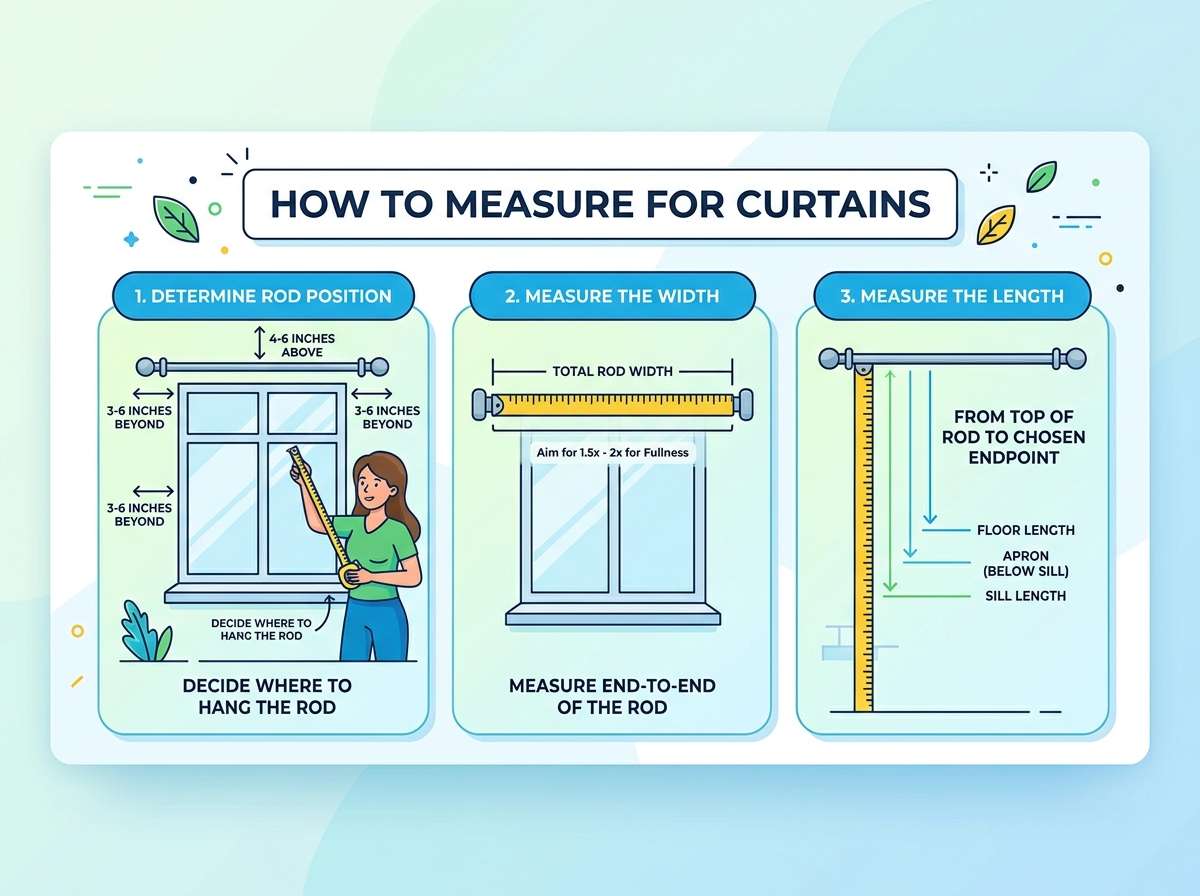
Measure how far you want the curtains to extend beyond the window on each side. Most people go about 4 to 12 inches on each side. Some go wider. It depends on your room and how much coverage you want.
Add these amounts to your window width. That’s your final width measurement for ordering curtains.
For example, if your window is 36 inches wide and you want 8 inches on each side, your curtain width is 52 inches. (36 + 8 + 8 = 52)
2. The Height of Your Window
Next, measure the height. This is where windows can get tricky. Height depends on where you want your curtains to start and stop.
Most people start their curtains from the top of the window frame or a bit above it. Measure from that starting point down to where you want the curtains to end. Common lengths are:
Sill length curtains end at the window sill. They’re shorter and show off your walls.
Apron length curtains hang about 4 to 8 inches below the sill. This is a classic look.
Flood length curtains end about halfway down the wall between the sill and the floor. They make rooms look taller.
Floor length curtains almost touch the floor. Most people leave about 1 inch of space so curtains don’t drag on the ground. These look fancy and formal.
Puddle length curtains actually touch and bunch on the floor a bit. This looks very formal and elegant. Use this style in formal rooms only.
Take your measurement from your starting point down to your chosen ending point. Write it down.
3. The Mounting Height
This matters a lot but many people forget about it. The mounting height is where your curtain rod will go. This determines where curtains start at the top.
Measure from the top of your window frame up to where you want the curtain rod. Going 4 to 12 inches above the window frame makes rooms look taller. Higher mounting always looks better.
If your ceiling is high, you can go even higher. This makes the room feel larger.
Write down this measurement too.
4. The Rod Mounting Distance
Finally, check how far the rod will stick out from the wall. This affects how wide your curtain track needs to be and how well curtains open.
Standard curtain rods stick out about 4 inches from the wall. Some stick out more. Check what your bracket allows.
Your rod width equals your window width plus twice the distance it sticks out. For example, if your window is 36 inches and your rod sticks out 4 inches on each side, your rod length is 44 inches.
Taking Your Height Measurement the Right Way
Height is the trickiest measurement. Let me break it down step by step so you get it right the first time.
First, decide where you want curtains to start. Most people mount rods 4 to 12 inches above the window frame. Higher is usually better. It makes windows look bigger.
Stand on a stable surface if needed. Use your tape measure to mark where the rod will go.
Next, decide where curtains should end. Look at your options again. Stand back from the window. Which length appeals to you most?
Now measure from your rod height down to where you want curtains to end. Be precise here. This is your height measurement.
If you’re unsure, use floor length with 1 inch clearance. It works with almost any style and room.
Pro tip: Measure more than one spot on your window. Walls aren’t always perfectly straight. Windows aren’t always level. Measure the left side, middle, and right side. Use the largest measurement. This ensures your curtains reach everywhere.
Understanding Curtain Rod Options
Different rods affect your measurements. Let’s talk about the main types.
Standard rods are the most common. They’re straight metal bars that hang curtains from rings or gliders. They work great for most windows.
Tension rods fit inside your window frame without drilling. Measure the inside width of your frame. These rods pull tight, so curtains don’t extend beyond your window. Perfect for renters.
Track systems work for odd-shaped windows or sliding glass doors. They bend and curve. Measure along the path you want the track to go.
Decorative rods feature ornamental finials. These visible rods make style statements. Measure the same way as standard rods.
Corner rods work for windows that meet at corners. Measure both sides separately.
Each type requires slightly different measurements. Know which rod you want before measuring.
Measuring for Different Window Types
Some windows are trickier than others. Here’s how to handle the common tricky ones.
Wide Windows
Wide windows need more support. Standard curtain rods might sag in the middle under the weight of fabric. For very wide windows, use a double rod. Measure the width from the left end to the middle, then from the middle to the right end. You’ll need two rods.
Tall Windows
Tall windows look great with floor length curtains. Start your measurement from higher up. Go 12 inches above the window frame at least. This makes the room feel bigger.
Arched or Circular Windows
These need special rods that curve. Measure the arch carefully. Take multiple measurements following the curve. Your hardware provider can help you figure out the exact shape.
Sliding Glass Doors
Mount rods as high as possible above the door. Extend them at least 12 inches beyond each side. You want curtains to open completely without blocking the door.
Corner Windows
These aren’t one window. Treat them as two separate windows. Measure and order curtains for each side. Use corner brackets to connect the rods.
Bay Windows
Bay windows stick out. Mount a rod in each section. Measure the width of each section separately. Order curtains for each one.
Accounting for Curtain Fabric Fullness
Fullness matters. It determines how the curtains hang and look.
Sheer curtains need 2 to 2.5 times your rod width. They’re light and move easily.
Regular lightweight curtains need 1.5 to 2 times your rod width.
Heavyweight or blackout curtains need 1.5 times your rod width. Heavy fabric drapes differently.
For example, if your rod is 50 inches wide and you want regular curtains, order panels that total 75 to 100 inches. (50 × 1.5 to 2)
Most curtain panels come in standard widths. You might buy two panels for one window. Two 50-inch panels give you 100 inches of fabric. That works well for 50-inch rods.
Common Curtain Rod Width Guide
Let’s talk about standard curtain rod sizes. Most windows fall into these ranges.
Small windows under 36 inches wide work with single panels. A 28 to 36 inch rod is plenty.
Medium windows 36 to 60 inches wide work with one or two panels. A 48 to 63 inch rod works well.
Large windows 60 to 120 inches wide need multiple panels. Use double rods or very large panels. Two 63 inch rods might work better than one massive rod.
Very large windows over 120 inches need custom solutions. Double rods or track systems are best.
These are just guides. Your exact needs depend on your style and room.
Making Your Measurement Notes
After you measure, write everything down clearly. Create a simple chart.
List the window location. (Living room, bedroom, kitchen, etc.)
Write the rod height. (How high above the window frame)
Write the rod width. (Outside wall to outside wall)
Write the desired curtain length. (Sill, apron, floor, etc.)
Write the finished panel width. (For ordering)
Write any special notes. (Arched window, sliding door, bay window, etc.)
Take a photo of your notes. Keep the original somewhere safe.
Factoring in Shrinkage
Some fabrics shrink. Cotton and linen can shrink 3 to 5 percent when washed. This matters for floor length curtains.
If you want floor length and your fabric might shrink, order slightly longer. Add 2 to 3 inches extra.
Check your curtain care label. Most modern curtains don’t shrink much. But some natural fabrics do.
Dealing with Uneven Windows
Not all windows are perfectly level. Walls shift. Frames settle. Floors slope.
Take height measurements in three places. Left, center, and right. If they’re different, use the longest measurement. This ensures curtains reach everywhere.
You might need to hem them after hanging. That’s fine. It’s better to have them a bit long than too short.
Measuring Through Your Curtain Ordering Process
Once you have your measurements, you’re ready to order. But here’s the thing. Different curtain companies measure differently.
Some measure “rod width” and expect you to account for fullness yourself.
Others measure “finished width” which is the actual width of the curtain panels.
Read the company’s measurement guide carefully. Ask their customer service if you’re confused.
Most companies have online guides showing exactly what to measure and what numbers to provide.
Pro Tips from Interior Designers
Let me share some tricks that make a big difference.
Go higher than you think you should. Mount rods as high as your ceiling allows. This makes windows look bigger. Rooms feel taller. It’s one of the cheapest ways to make a space feel more luxurious.
Go wider too. Extend rods 12 inches beyond your window on each side. This creates a clean frame and makes windows look wider.
Use floor length curtains in most situations. They’re more forgiving than shorter lengths. They make formal spaces feel more elegant.
Take your time measuring. Rushing leads to mistakes. Measure twice, write it down, measure again.
Get a second person to help. One person holds the measuring tape steady while the other reads the numbers. It’s faster and more accurate.
Mistakes to Avoid When Measuring
Don’t measure from outside the window frame to outside the frame and assume that’s your curtain width. You probably want to extend past the frame.
Don’t forget to account for fullness. Too-narrow curtains look skinny and wrong.
Don’t just eyeball it and guess. Measure everything precisely.
Don’t ignore the height variation across your window. Measure in multiple spots.
Don’t forget about the return on your rod. If your rod extends far from the wall, you need to account for that in your width.
The return is the distance the rod sticks out. If your rod sticks out 4 inches on each side, add 8 inches to your curtain width total.
Measuring for Curtain Panels Versus Ready-Made Options
You have two main options: ready-made curtains or custom-made ones.
Ready-made curtains come in standard sizes. They’re cheaper. They ship fast. But they might not be perfect for your window. You might need to adjust the length or hem them.
Custom-made curtains fit exactly right. You provide your measurements and dimensions. The manufacturer cuts and sews everything to fit. They cost more but look perfect.
For ready-made options, find the size closest to your measurements. You can always hem them shorter. Adding length is harder.
For custom options, accuracy is critical. Double-check all your measurements before ordering.
Double-Checking Your Math
Before you order, run through the numbers one more time.
Rod width: Window width + side extensions + rod return on both sides
Finished panel width: Rod width × fullness factor (usually 1.5 to 2)
Height: Distance from rod mounting point to your desired ending point
Is everything in inches? Make sure you’re not mixing inches and feet.
Does your rod width seem reasonable for your window? If you measured a 36-inch window with 12-inch extensions, your rod should be about 60 inches. Does that sound right?
Quick math check makes a big difference.
What Happens After You Order
You’ve got your measurements down. You’ve ordered. Now what?
When your curtains arrive, hang them first. See how they look. Most curtains need some adjusting.
If they’re too long, you can hem them. If they’re too short, you’re stuck. So remember that being slightly long is always safer.
Let curtains hang for 24 to 48 hours before hemming. They settle and may hang differently.
Iron them if needed to get clean lines.
Step back and assess. Do they look right? Do they open and close smoothly? Do they block light the way you want?
Adjustments now are easy. Once you’ve hemmed them permanently, changes are harder.
Common Questions About Curtain Measurements
Let me answer some questions that come up a lot.
Should curtains touch the floor? Not quite. Leave about 1 inch of clearance. Touching the floor can make them drag and wear out faster.
Can I use the same measurements for all my windows? Only if your windows are identical. Each window gets its own measurements.
What if I want extra fullness? Go ahead. Use 2.5 or 3 times your rod width. Just account for that when ordering fabric or panels.
Do sheer curtains need different measurements? No, same process. But remember they need 2 to 2.5 times fullness.
Can I measure my window and install the rod myself? Absolutely. Just follow the same measurement process.
Taking Your Final Measurements
You’re ready. Let’s do this one more time from the top, nice and simple.
Grab your tape measure, paper, and pen.
Stand in front of your window.
Decide where your rod will mount.
Measure from the left edge of where you want the rod to the right edge. This is your rod width.
Measure from your rod mounting height down to your desired curtain length. This is your height.
Do the same measurements in two more spots if your window is wide.
Write down all numbers clearly.
Take photos of your notes.
You’re done. You have everything you need.
Making This Process Easier Next Time
Once you’ve measured once, keep those measurements. Write them in a notebook or save them in your phone notes.
When you want new curtains, you already have the numbers. Shopping becomes much easier.
If you ever install new rods, just take new measurements. Same process, fresh start.
Final Thoughts on Measuring for Curtains
Measuring for curtains seems complicated at first. Once you do it, you realize it’s straightforward. You’re just taking a few simple measurements. Recording them. Using them to order.
The keys are measuring precisely, remembering the fullness factor, and accounting for how far you want curtains to extend beyond your window.
Mount your rod high. Extend it wide. Choose your preferred length. Measure twice. Order with confidence.
Your new curtains will look amazing. And you’ll have the satisfaction of knowing you measured perfectly yourself.
Take your time. Be careful. Write everything down. Trust your measurements. You’ve got this.
Happy curtain shopping. Your windows are about to look great.
Hi, I’m Mary, the founder of Homygear.com. I’m passionate about creating a comfortable, smart, and beautiful home. I share practical insights and real-world experience on home gear that makes everyday life easier. Behind the scenes, my dedicated research team studies products in depth, and our writers craft honest reviews using trusted, authentic sources—so you can choose home gear with confidence.