5 Best Air Purifier for Baby Room In 2026
Your baby breathes about twice as fast as you do. That tiny body takes in more air per pound of body weight, which means pollutants hit them harder. Dust mites, pet dander, mold spores, volatile organic compounds from paint, and even leftover smoke from outside — all of it finds its way into your nursery air.
That’s why finding the best air purifier for baby room use is one of the smartest investments you can make as a parent. But the market is absolutely packed with options, and not all of them are worth your money.
This guide breaks down five carefully picked air purifiers that work well in nurseries and baby rooms. Each one has been reviewed for its real-world performance, noise levels, ease of use, filter quality, and overall value. No fluff, no fake praise — just honest information to help you make the right call.
Let’s get into it.
Why Air Quality in the Nursery Matters So Much
Babies have immature immune systems and developing lungs. Indoor air can actually be more polluted than outdoor air in many homes, and the nursery is where your baby spends the most time. Poor air quality has been linked to increased risk of respiratory infections, allergies, and sleep disturbances in infants.
A good baby room air purifier helps by pulling in room air and pushing it through multiple filter layers — typically a pre-filter to catch large particles, a true HEPA filter to trap tiny particles down to 0.3 microns, and often an activated carbon layer to handle odors and gases.
When you shop for one, you want to focus on a few things: real HEPA filtration (not just “HEPA-type”), low noise levels for sleep time, a coverage area that fits your room, and ideally no ozone emission. All five products in this roundup tick those boxes in their own way.
The 5 Best Air Purifiers for Baby Rooms
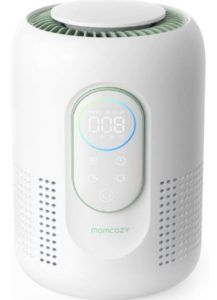
1. Momcozy Nursery Air Purifier — Best Overall for Baby Rooms
Product Description
The Momcozy Nursery Air Purifier is built specifically with babies in mind. That shows in nearly every design decision — from the ultra-quiet sleep mode to the soft night light to the real-time air quality display. It uses a four-layer filtration system that includes an H13 True HEPA filter, activated carbon, a pre-filter, and a cold catalyst filter layer.
Best Use Cases
This one shines as a dedicated nursery air purifier. It’s ideal for parents who want full-time air cleaning with the ability to monitor air quality without leaving the room. If you’re sharing a room with your newborn or have a small to medium nursery, this is a strong pick.
Key Features Explained Simply
The H13 HEPA filter is the gold standard for filtration. It captures 99.97% of airborne particles including pollen, pet dander, mold spores, smoke particles, and fine dust. The carbon layer handles diaper odors, formula smells, and VOCs from nursery furniture. The cold catalyst filter adds an extra level of chemical pollutant breakdown that most air purifiers skip entirely.
The PM2.5 real-time air quality monitor is a genuinely useful feature. A small display shows you the current particle count in the air, along with a three-color indicator — green for clean, yellow for moderate, red for poor. You can glance at it during a 3 AM feeding and know instantly if the air is safe.
Sleep mode runs at just 21 dB. That’s quieter than a whisper. Most parents report they can’t hear it at all when it’s on the lowest setting.
The dimmable night light is a thoughtful touch. You can turn it down completely if your baby is sensitive to light, or use it as a soft guide during nighttime checks.
Real-Life Usage Insight
Parents using this in nurseries consistently note that the air quality indicator drops to green within 15 to 30 minutes of starting the unit in a sealed room. The night light is subtle enough to not disturb sleep, and the auto mode adjusts fan speed based on detected air quality — so it ramps up when you open a diaper pail and settles back down once the odor clears.
One thing to keep in mind: the four-filter system means slightly higher ongoing filter costs than simpler units. But replacement filters are easy to find, and the unit alerts you when it’s time for a change.
Pros
- H13 True HEPA filtration is one of the highest grades available for home use
- Real-time PM2.5 display with color-coded status is genuinely helpful for anxious parents
- 21 dB sleep mode is nearly silent
- Dimmable night light serves double duty
- Auto mode intelligently adjusts based on air quality
- Specifically designed for nursery environments
Cons
- Four-filter system means slightly more complex (and slightly costlier) filter replacements
- Coverage area is best suited for small to medium rooms
- Design is compact, which is great for shelves, but means the tank is small
Performance Discussion
For a baby room air purifier, the Momcozy delivers strong performance. The four-filter setup catches everything from coarse allergens down to fine PM2.5 particles. The auto mode keeps the room consistently clean without you having to manually adjust settings. In practical terms, you set it up, forget about it, and check the color display occasionally.
Ease of Use
Very beginner-friendly. The controls are simple and clearly labeled. Auto mode handles the heavy lifting. Filter replacement is straightforward once you remove the back panel.
Value for Money
Given the H13 HEPA grade, the air quality monitor, the sleep mode, and the nursery-specific design, the Momcozy offers solid value. It’s priced in the mid-range and earns every dollar for parents who want the best air purifier for newborn babies.
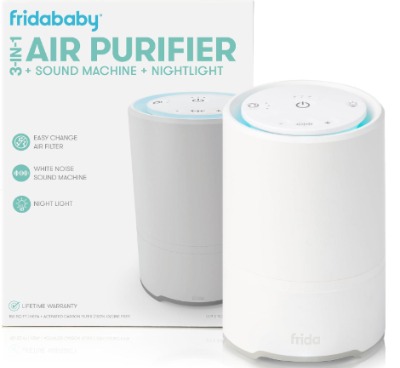
2. Frida Baby 3-in-1 Baby Air Purifier — Best for Multi-Function Simplicity
Product Description
Frida Baby is one of the most trusted names in baby care, and their air purifier lives up to that reputation. This 3-in-1 unit combines a HEPA filter air purifier, a white noise sound machine, and a soft nightlight into one compact device. It’s built for the nursery and doesn’t try to be anything more than that — and that focus shows.
Best Use Cases
This is the go-to pick for parents who want to simplify the nursery setup. Instead of buying a separate white noise machine, a nightlight, and an air purifier, you get all three in one footprint. It works well for smaller nurseries and for parents who are setting up their first baby room on a budget.
Key Features Explained Simply
The HEPA filter captures particles down to 0.3 microns — dust, pollen, pet dander, mold spores, and smoke particles. It won’t catch gases or odors the way a carbon filter would, but for pure particle filtration, it does a solid job.
The sound machine includes multiple white noise settings. White noise helps babies sleep longer and sounder by masking sudden household sounds like doors closing or dogs barking. Having it built into the air purifier means one less device to plug in.
Three fan speeds give you control over airflow. The lowest speed is quiet enough for sleeping, and the higher speeds kick in some real cleaning power when needed.
The easy-change filter is a practical feature. Frida made the filter swap simple even for parents who aren’t gadget-savvy. You don’t need any tools, and the process takes about a minute.
The auto-off timer lets you set the unit to shut off after a certain time. This is useful if you want to run the purifier during a nap but don’t want it running all night.
Real-Life Usage Insight
Parents love this for the first few months with a newborn when the nursery setup needs to be as simple as possible. The white noise function pulls real weight — many parents credit it with significantly improving their baby’s sleep. The air purification runs quietly in the background while the sound machine does the heavy lifting audibly.
The limitation here is the lack of activated carbon filtration. If diaper odors or VOCs from new furniture are a concern, you may find the Frida Baby handles airborne particles well but falls short on smell control.
Pros
- Three functions in one compact unit saves space and simplifies the nursery
- HEPA filtration handles the most common airborne allergens
- Built-in white noise machine is a genuine sleep aid
- Easy-change filter system is parent-friendly
- Auto-off timer is convenient for nap times
- Trusted Frida Baby brand with proven track record in baby care
Cons
- No activated carbon filter means limited odor and chemical control
- Coverage area is smaller than some competitors
- No real-time air quality display
- Limited to three fan speeds with no auto mode
Performance Discussion
For particle filtration in a small nursery, the Frida Baby does well. The HEPA filter catches the common culprits — pet hair, dust, and allergens. The sound machine is genuinely effective. But if you’re dealing with persistent odors or you’re concerned about VOCs from new baby furniture, you’ll want something with carbon filtration alongside it or instead of it.
Ease of Use
Extremely easy. This is probably the simplest unit on this list. Plug it in, turn it on, set the fan speed. The filter swap is effortless. For first-time parents who are already overwhelmed, the Frida Baby’s simplicity is a real selling point.
Value for Money
For what it does — and particularly for the three-in-one convenience — the Frida Baby offers good value. You’re paying for the air purifier plus essentially a free white noise machine and nightlight. For parents who need all three, the math works out well.
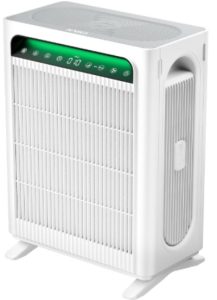
3. KNKA Air Purifier APH4000 — Best for Large Nurseries and Open Spaces
Product Description
The KNKA APH4000 is a different kind of pick for this list. It’s built for large rooms — up to 3,500 square feet — which makes it overkill for a typical nursery but ideal for open-concept homes or large shared spaces where a baby spends time. It’s AHAM Verified, meaning its cleaning claims have been independently tested and confirmed.
Best Use Cases
This one is for parents with large nurseries, open-plan living areas, or homes where the baby room is adjacent to a kitchen or pet area. If you want one unit that can clean the air for a larger portion of your home rather than just a single small room, the KNKA handles that with ease.
Key Features Explained Simply
AHAM Verified is a big deal. AHAM (Association of Home Appliance Manufacturers) independently tests air purifiers and verifies their Clean Air Delivery Rate (CADR) claims. Many budget air purifiers make up their own numbers. When a unit is AHAM Verified, those numbers mean something real.
The HEPA filter captures fine particles — dust, pollen, mold, smoke, and pet dander. The washable pre-filter handles larger particles like hair and lint, and because it’s washable, you save money on replacement filters over time. Just rinse it under the tap and let it dry.
The AQI display shows real-time air quality in a simple numerical format. You can see at a glance how clean or polluted the air is in the room.
ECO Mode drops the fan to its lowest power setting when the air quality is already clean, saving electricity without turning the unit off completely. Pet Mode adjusts filtration behavior to better handle pet dander and pet-related particles.
Real-Life Usage Insight
Parents using this in larger homes appreciate the genuine power behind it. It can significantly reduce allergen levels across a broad area in a short time. For homes with pets, Pet Mode is a practical addition.
The size and weight are worth noting — this is a larger unit and won’t sit on a shelf. It needs floor space. The noise level at higher fan speeds is also more noticeable than the compact units on this list, so you’d want to run it at a lower speed during actual sleep time.
Pros
- AHAM Verified with honest, tested CADR ratings
- Covers up to 3,500 square feet — massive coverage
- Washable pre-filter reduces ongoing maintenance costs
- AQI display provides real-time air quality data
- ECO Mode saves energy when air is already clean
- Pet Mode is a useful addition for pet-owning families
- Works well for open floor plans or large connected spaces
Cons
- Too large and powerful for a typical small nursery
- Higher fan speeds produce noticeable noise
- Takes up floor space — not a shelf-friendly unit
- More air purifier than most baby rooms need
Performance Discussion
The KNKA APH4000 is a powerhouse, and it earns its keep in larger spaces. Its CADR ratings are verified, not claimed, which is a meaningful distinction. If you have a large nursery or an open living space where your baby plays and sleeps, this unit will genuinely improve air quality across that entire space. In a small room, it’s simply more than needed.
Ease of Use
Straightforward operation with an intuitive control panel. The AQI display is easy to read. Washing the pre-filter is simple. The only complexity comes from the size — moving it around for cleaning or rearranging the room takes a bit of effort.
Value for Money
For large-room coverage with AHAM verification, the KNKA APH4000 delivers strong value. If you need what it offers, you’ll be satisfied. If your nursery is a standard small bedroom, you might be paying for more capacity than you’ll ever use.
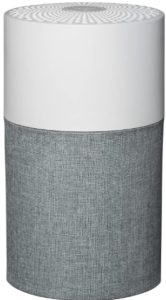
4. Blueair Blue Pure 511 — Best Compact Air Purifier for Nursery
Product Description
Blueair is a Scandinavian brand known for clean design and solid filtration technology. The Blue Pure 511 uses their HEPASilent technology, which combines mechanical filtration with electrostatic charging to capture particles more efficiently at lower fan speeds. That means it runs quieter while still cleaning the air effectively.
Best Use Cases
The Blue Pure 511 is ideal for parents who want a sleek, quiet air purifier that doesn’t look out of place in a nicely designed nursery. It works in small to medium rooms and handles common baby room concerns like dust, pet dander, allergens, and basic odor control well.
Key Features Explained Simply
HEPASilent technology is Blueair’s signature feature. Standard HEPA filters need higher airflow (and thus higher fan speeds and more noise) to capture fine particles. HEPASilent adds an electrostatic charge to particles before they hit the filter, making them easier to trap. The result is cleaner air at lower, quieter fan speeds.
The filter design includes a fabric pre-filter that wraps around the outside of the unit. This pre-filter is washable and comes in different colors, so you can match it to the nursery decor. It’s a small thing, but parents who care about their nursery aesthetic appreciate it.
The unit is compact and lightweight. It sits easily on a dresser, shelf, or the floor without demanding much space.
For virus and bacteria capture, Blueair specifically notes virus air purification capability. The HEPASilent filter is effective at capturing very fine particles in the size range of viruses and bacteria, which is relevant to parents worried about airborne pathogens in the nursery.
Real-Life Usage Insight
Parents consistently praise the quiet operation of the Blue Pure 511. At lower fan speeds, it’s very quiet — comparable to a soft fan hum. The color choices for the pre-filter are a nice touch that lets the unit blend into the nursery environment rather than sticking out as an appliance.
One common note: the unit doesn’t have a digital display or auto mode. You manually set the fan speed and that’s it. For parents who prefer simplicity over features, that’s perfectly fine. For parents who want automatic adjustment or real-time air quality data, it’s a limitation.
Pros
- HEPASilent technology delivers effective filtration at lower, quieter fan speeds
- Compact and stylish — fits into a well-designed nursery without looking industrial
- Washable fabric pre-filter in multiple colors adds design flexibility
- Lightweight and easy to move between rooms
- Captures viruses, bacteria, dust, pet dander, pollen, and smoke
- Blueair is a well-established, reputable brand in air purification
Cons
- No auto mode or air quality display
- Smaller coverage area compared to larger units on this list
- Manual fan speed control only
- No carbon filter in the base model (available as an add-on filter)
Performance Discussion
The Blue Pure 511 performs well within its intended scope. HEPASilent technology genuinely allows for quieter operation without sacrificing meaningful filtration effectiveness. For a nursery dealing with common allergens — dust, pollen, pet hair — it handles the job quietly and reliably. The lack of a carbon filter in the base model is a limitation for odor control, but a combination filter with carbon is available.
Ease of Use
Very easy. Three buttons, three fan speeds, and a washable pre-filter you can toss in the laundry. There’s almost nothing to learn. The filter indicator light tells you when a replacement is needed. Beginner-friendly in the truest sense.
Value for Money
The Blue Pure 511 sits at a mid-range price and offers solid value for what it does. You’re paying for the quiet technology and the brand’s reliability. If design and quiet performance matter to you, the price is justified. If you want more features, you might want to look elsewhere.
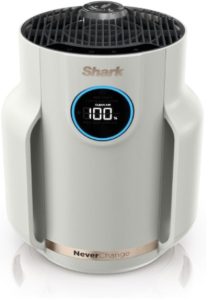
5. Shark NeverChange Compact Pro HP072 — Best for Long-Term Low Maintenance
Product Description
The Shark NeverChange Compact Pro is built around a single compelling idea: what if you didn’t have to change the filter for years? Shark uses a combination of a nano-sealed HEPA-exceeding filter and a cleaning system that lets you maintain the filter with a simple rinse rather than replacing it frequently. This dramatically cuts the long-term cost of ownership.
Best Use Cases
This is the best pick for parents who find ongoing maintenance annoying or expensive. It’s great for nurseries, bedrooms, home offices, and dorm rooms. If you want to set it up and not worry about filter costs every few months, the Shark NeverChange is built for you.
Key Features Explained Simply
The “NeverChange” name refers to the filter maintenance approach. The filter in this unit is designed to last for the life of the product under normal use. You clean it periodically rather than replacing it. This is different from most air purifiers where replacement filters cost $20 to $60 or more every few months.
The HEPA-exceeding filter captures at least 99.97% of particles at 0.3 microns — meeting and surpassing standard HEPA requirements. It handles pet dander, dust, smoke, pollen, and odors.
The nano-seal technology prevents dirty air from bypassing the filter, which is a problem with some cheaper air purifiers that have gaps around their filter edges. Every bit of air that passes through the unit goes through proper filtration.
It handles dust, pet dander, smoke, and odor. For a nursery with pets, a smoky neighborhood, or that new-furniture smell, the Shark covers multiple bases.
Real-Life Usage Insight
Parents love the idea of not buying replacement filters. The NeverChange system works as advertised in normal conditions — you vacuum or rinse the filter as directed, and it continues performing well. The compact size makes it easy to place in a nursery without dominating the space.
Some parents note that the unit works best when you actually follow the cleaning schedule for the filter. Neglecting filter cleaning can reduce performance over time. But for parents who are consistent, the long-term savings are real.
The noise level is reasonable for a baby room, and the unit fits comfortably on a dresser or small table. It’s not the quietest unit on this list, but it’s not disruptive at lower speeds.
Pros
- NeverChange filter design eliminates recurring filter replacement costs
- HEPA-exceeding filtration captures more than standard HEPA requirements
- Nano-seal technology prevents air bypass around the filter edges
- Compact size works well in small and medium nurseries
- Handles pet dander, dust, smoke, and odors
- Trusted Shark brand with solid customer support
Cons
- Filter still requires regular cleaning — “NeverChange” means no replacement, not no maintenance
- No real-time air quality display
- Noise at higher speeds is more noticeable than ultra-quiet competitors
- No auto mode based on air quality detection
Performance Discussion
The Shark NeverChange Compact Pro performs well in nurseries and small bedrooms. The HEPA-exceeding filter does what it claims, and the nano-seal design ensures you’re getting clean air rather than partially filtered air with bypass leaks. The real advantage is the long-term financial model — you spend more upfront but far less over the life of the unit.
Ease of Use
Simple and practical. The controls are intuitive, and the filter cleaning process is clearly explained in the manual. For parents who just want a set-and-maintain unit without ongoing shopping for replacement filters, the Shark fits that lifestyle well.
Value for Money
This is where the Shark really stands out. If you calculate the cost of a typical air purifier over two to three years including filter replacements, the Shark’s total cost of ownership is often lower despite a similar or slightly higher purchase price. For budget-conscious parents playing the long game, this is excellent value.
Side-by-Side Comparison: Which One Fits Your Needs?
| Feature | Momcozy | Frida Baby | KNKA APH4000 | Blueair 511 | Shark HP072 |
|---|---|---|---|---|---|
| Filter Type | H13 HEPA + Carbon + Cold Catalyst | HEPA | HEPA + Washable Pre-Filter | HEPASilent | HEPA-Exceeding |
| Air Quality Display | Yes (PM2.5) | No | Yes (AQI) | No | No |
| Auto Mode | Yes | No | Yes (ECO) | No | No |
| White Noise Built-In | No | Yes | No | No | No |
| Carbon Filtration | Yes | No | No | Optional | Yes |
| Best Room Size | Small-Medium | Small | Large (up to 3,500 sq ft) | Small-Medium | Small-Medium |
| Filter Replacement | Periodic | Periodic | Pre-filter washable | Periodic | Long-term/Cleanable |
| Sleep Mode Noise | 21 dB | Very Quiet | Moderate | Very Quiet | Quiet |
| Night Light | Yes (Dimmable) | Yes | No | No | No |
| Standout Feature | Nursery-specific, 4-filter system | 3-in-1 with sound machine | AHAM Verified large coverage | HEPASilent quiet tech | NeverChange filter economics |
Buying Guide: What to Look For in a Baby Room Air Purifier
True HEPA vs. HEPA-Type
This is the most important distinction in air purifier shopping. True HEPA (or H13 HEPA) filters capture 99.97% of particles at 0.3 microns. HEPA-type or HEPA-style filters are marketing terms that don’t meet the same standard. Every product in this roundup uses genuine HEPA or HEPA-exceeding filtration.
Coverage Area
Match the air purifier’s coverage to your room size. A unit rated for 200 square feet won’t clean a 400-square-foot open nursery effectively. Most standard nurseries are 100 to 200 square feet, so the compact and mid-size units on this list work well. The KNKA is the exception — it’s built for very large spaces.
Noise Level
Babies sleep a lot, and they’re sensitive to sudden noises. Look for a unit with a low-decibel sleep mode. The Momcozy’s 21 dB sleep mode is excellent. The Blueair’s HEPASilent technology achieves quiet operation through smart engineering rather than just lowering the fan.
Activated Carbon Filtration
A HEPA filter handles particles. An activated carbon layer handles gases, odors, and volatile organic compounds (VOCs). If your nursery has new furniture, fresh paint, diaper odors, or pet smells, carbon filtration matters. The Momcozy and Shark both include carbon. The Frida Baby and Blueair base models don’t.
Ozone-Free Operation
Some air purifiers — particularly ionizers and UV light units — produce ozone as a byproduct. Ozone is a respiratory irritant and particularly harmful to developing lungs. All five units on this list are safe, ozone-free options. Stick to HEPA-based filtration for the nursery and avoid ozone-generating units entirely.
Filter Replacement Costs
The purchase price is only part of the story. Factor in how much replacement filters cost and how often they need changing. The Shark’s NeverChange system and the KNKA’s washable pre-filter are the most economical long-term options. The Momcozy’s four-filter system involves more complex replacements.
Auto Mode and Air Quality Monitoring
Auto mode uses sensors to detect air quality and adjusts fan speed automatically. It’s a genuinely useful feature for nurseries because you’re not always in the room to notice a problem. The Momcozy and KNKA both offer this. The Blueair and Frida Baby are manual-only.
Extra Features
Night lights, sound machines, and dimmable displays are bonus features that matter in a nursery context. The Momcozy covers night light and real-time display. The Frida Baby covers night light and white noise. Think about what doubles up with your existing nursery setup.
Who Should Buy Each Product?
Buy the Momcozy if: You want the most complete nursery air purifier with smart monitoring, a four-layer filtration system, auto mode, and a dimmable night light. Best for parents who want peace of mind from data.
Buy the Frida Baby if: You want to simplify the nursery by replacing three separate devices with one. Best for first-time parents who are setting up a new nursery and want less clutter and less expense across all baby sleep products.
Buy the KNKA APH4000 if: You have a large nursery or an open-plan living area and want AHAM-verified performance with a washable pre-filter. Best for parents in larger homes or those with pets and allergy concerns across multiple connected rooms.
Buy the Blueair Blue Pure 511 if: You care about quiet operation and clean design. Best for parents with a small to medium nursery who don’t want to think about air quality settings — just quiet, reliable performance that fits the room’s aesthetic.
Buy the Shark NeverChange Compact Pro if: Filter replacement costs drive you crazy and you want the most cost-effective long-term option. Best for practical parents who run the numbers and prefer a unit that rewards consistent maintenance over frequent purchasing.
Common Mistakes to Avoid When Buying a Baby Room Air Purifier
Trusting “HEPA-Type” Labels
HEPA-type is not True HEPA. The standard for True HEPA filtration is well-defined and tested. HEPA-type is a marketing label with no set standard. Always look for True HEPA or H13 HEPA on the spec sheet.
Buying for Too Small a Coverage Area
It’s tempting to buy the cheapest option, but an air purifier rated for 100 square feet in a 180-square-foot nursery won’t clean the air effectively. Check the coverage rating and buy slightly above your room size for best results.
Ignoring Noise Levels
A purifier that sounds fine at noon will seem extremely loud at 2 AM when you’re trying to get a colicky baby back to sleep. Always check the decibel rating for sleep mode, not just the general operating noise.
Overlooking Ongoing Filter Costs
Some air purifiers are priced attractively but have expensive proprietary filters that need changing every 60 to 90 days. Calculate the annual filter cost before buying. A $40 unit with $50/year in filter costs can end up more expensive than a $100 unit with $20/year in filter costs.
Placing the Unit Incorrectly
Air purifiers work best when air can circulate freely around them. Don’t stuff one behind a crib or in a corner with blocked airflow. Give it at least a foot of clearance on all sides and position it where air naturally flows in the room.
Running It Only When Problems Arise
Air purifiers work best when running continuously at a low setting rather than running at high speed occasionally. Keep it on auto mode or low speed all day. The goal is consistent air quality, not reactive air cleaning.
Buying a Unit That Produces Ozone
Some cheap ionizing air purifiers and UV light units produce ozone. Ozone is dangerous for babies’ developing lungs. Stick to HEPA-based filtration only. All five products in this roundup are safe.
Tips for Getting the Most Out of Your Baby Room Air Purifier
Keep the nursery door closed while the purifier runs — this concentrates its cleaning power in the room rather than spreading it across the whole hallway. Clean or replace filters on schedule; a clogged filter makes the unit work harder and filters less effectively. Run the purifier on auto mode or low speed continuously rather than high speed for short bursts. Keep windows closed during high pollen seasons or when outdoor air quality is poor. Vacuum the nursery carpet or rug regularly — air purifiers catch airborne particles, but particles sitting on surfaces need to be removed manually before they become airborne again.
Frequently Asked Questions About Air Purifiers for Baby Rooms
Is an air purifier necessary for a baby room?
It’s not strictly necessary in every home, but it provides meaningful benefits in homes with pets, allergy sufferers, smokers nearby, high outdoor pollution, or new furniture with off-gassing concerns. For most families, the improvement in air quality is noticeable and worthwhile.
Can I use any air purifier in a baby room?
Avoid ionizing air purifiers and UV light purifiers that produce ozone — those are harmful to babies. Stick to True HEPA-based units, which are safe, effective, and ozone-free.
Where should I place the air purifier in a nursery?
Place it on a table or dresser near the center of the room, not in a corner or directly behind furniture. Keep it out of reach of curious toddlers as they grow. Make sure airflow isn’t blocked.
How often should I replace the filter?
It depends on the unit and your air quality. In a typical home, most HEPA filters last three to six months. If you have pets or high dust, they may need replacing more often. Follow the manufacturer’s guide and pay attention to the filter indicator light.
Do air purifiers help with baby allergies?
Yes, significantly. HEPA air purifiers remove the most common allergens — dust mites, pet dander, pollen, and mold spores — from the air. For babies with known sensitivities or families with allergy history, an air purifier is one of the most effective environmental interventions available.
Final Verdict: Our Top Recommendations
After going through all five products in detail, here’s the bottom line.
Best overall for the nursery: The Momcozy Nursery Air Purifier takes this spot. It was designed specifically for baby rooms, and that focus shows in every feature. The H13 HEPA filtration, real-time PM2.5 monitor, 21 dB sleep mode, dimmable night light, and auto mode combine into a package that covers everything parents need. It’s the most complete nursery air purifier on this list.
Best for simplicity and multi-function use: The Frida Baby 3-in-1 is the right call for parents who want to combine air purification, white noise, and a nightlight in one small device. It’s not the most powerful purifier, but it’s the most practical for a first nursery setup.
Best for large spaces: The KNKA APH4000 wins for coverage area and verified performance. If you have a large home or an open layout, this is the one to get.
Best for quiet, stylish performance: The Blueair Blue Pure 511 earns its place for parents who want quiet, reliable filtration in a design that doesn’t clash with their nursery aesthetic. HEPASilent technology genuinely works.
Best for long-term savings: The Shark NeverChange Compact Pro wins on economics. If you plan to use an air purifier for years and hate buying replacement filters, this pays for itself over time.
Every one of these units will meaningfully improve the air quality in your baby’s room. The right choice depends on your room size, your budget, the features that matter to you, and how much ongoing maintenance you want to deal with. Start with the Momcozy if you’re not sure — it covers the most bases and was built specifically for the nursery environment.
Your baby deserves clean air. Any of these five purifiers will help you provide it.
Disclosure: This article contains independently researched product information. Always refer to the manufacturer’s current product specifications before purchasing, as features and pricing may change.
Hi, I’m Mary, the founder of Homygear.com. I’m passionate about creating a comfortable, smart, and beautiful home. I share practical insights and real-world experience on home gear that makes everyday life easier. Behind the scenes, my dedicated research team studies products in depth, and our writers craft honest reviews using trusted, authentic sources—so you can choose home gear with confidence.