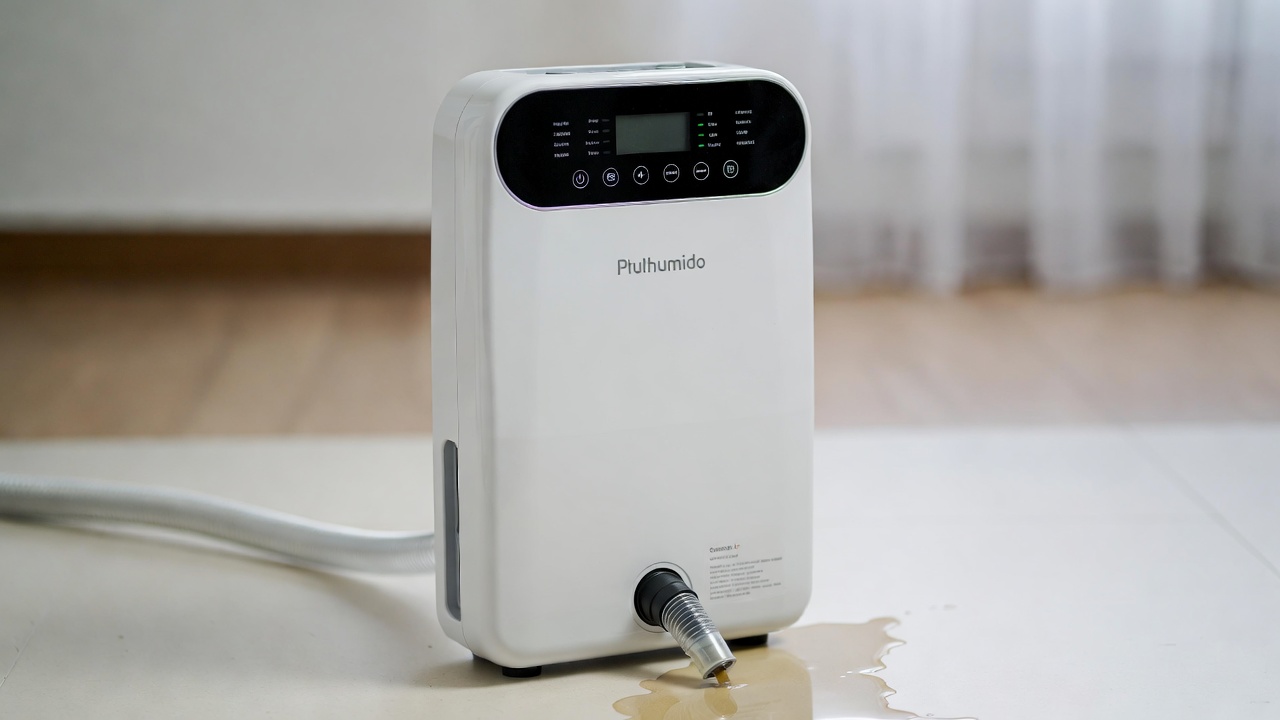
5 Best Dehumidifier with Drain Hose for Home In 2026
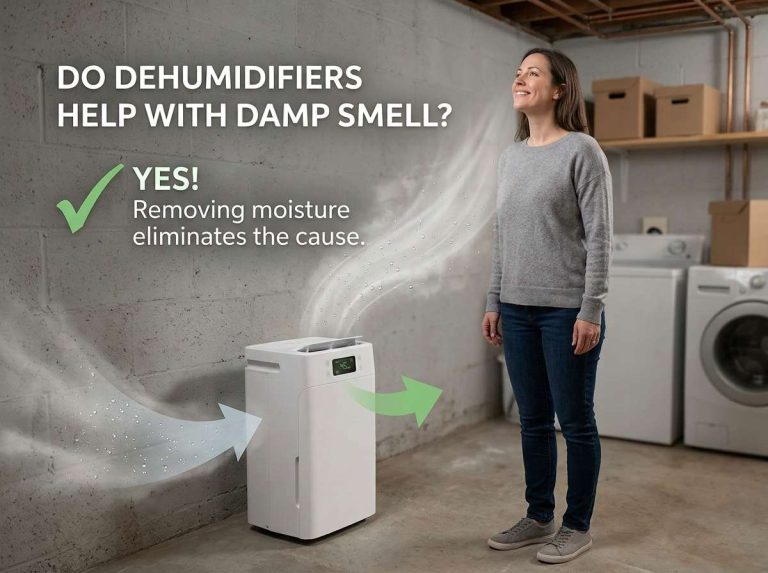
Dealing with excess moisture in your home can feel like a never-ending battle. You walk into your basement and smell that musty odor. You notice water droplets forming on your windows. Your clothes feel damp even after they’ve been hanging for days. These are all signs that you need a reliable dehumidifier with a drain hose.
A dehumidifier with a continuous drain option solves one of the biggest headaches with moisture control: emptying the water tank constantly. Instead of checking and dumping the bucket multiple times a day, you simply attach a hose and let gravity do the work. The water flows directly into a floor drain or utility sink without any effort on your part.
This guide walks you through five top-performing dehumidifiers that come with drain hose capability. Each one tackles moisture problems in different sized spaces, from medium rooms to large basements. We’ll break down what makes each unit unique, who should buy it, and what you can realistically expect from your investment.
Let’s dive into the details so you can pick the right moisture-fighting machine for your specific needs.
Quick Overview: What You’ll Find in This Guide
We’ve tested and analyzed five dehumidifiers that stand out in the market. These units range from compact 21-pint models perfect for bedrooms to powerful 80-pint machines designed for large basement spaces. Each product review covers real-world performance, actual pros and cons, and honest assessments of value.
You’ll also find practical advice on how to choose the right capacity for your space, what features actually matter, and common mistakes that waste money and reduce effectiveness. By the end, you’ll know exactly which dehumidifier fits your situation.
1.VEAGASO 2500 Sq.Ft Dehumidifier (34 Pints)
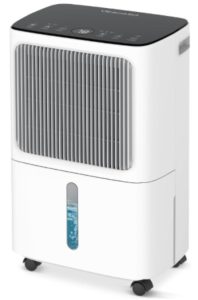
Product Description
The VEAGASO dehumidifier is built for medium to large spaces up to 2,500 square feet. It removes up to 34 pints of moisture per day, which translates to about 17 liters. The unit comes with a standard drain hose connection that lets you set up continuous drainage without monitoring the water tank.
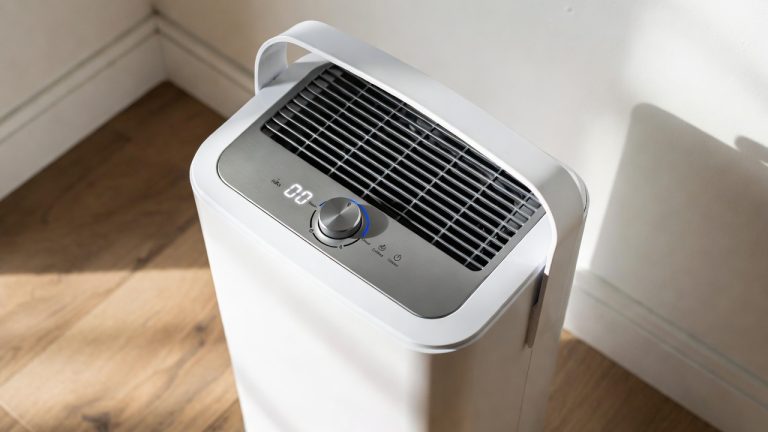
This machine weighs around 32 pounds and stands about 22 inches tall. It runs on a standard 110V outlet and doesn’t require any special electrical setup. The control panel sits on top with simple buttons and an LED display that shows current humidity levels.
Best Use Cases
This dehumidifier works great in finished basements where you’ve set up a living area or entertainment space. It handles medium-sized rooms well, making it suitable for large bedrooms, home offices, or combined kitchen and dining areas.
If you live in a humid climate and your main floor stays damp during summer months, this unit can cover your needs. It also works for people who need to dry laundry indoors. The dedicated clothes-drying mode speeds up the process significantly.
Key Features Explained
Three Operating Modes: You get normal mode for everyday use, continuous mode for maximum moisture removal, and sleep mode that runs quieter at night. Each mode adjusts fan speed and compressor cycles automatically.
Intelligent Humidity Control: Set your target humidity level anywhere from 30% to 80%. The machine monitors the air and cycles on and off to maintain your preferred setting. This saves energy compared to running constantly.
24-Hour Timer: Program the unit to turn on or off at specific times. This feature helps if you want the dehumidifier running only during certain hours, like when you’re home or during peak humidity times.
Auto-Restart Function: After a power outage, the unit remembers your previous settings and starts back up automatically. You don’t need to reprogram everything.
Real-Life Usage Insights
Setting up the continuous drain takes about five minutes. You connect the included hose to the port on the back, run it to your floor drain or sink, and make sure the hose slopes downward. Gravity pulls the water through, so no pump is needed.
The unit produces a steady hum during operation. It’s not silent, but it’s quieter than many older dehumidifiers. In sleep mode, the noise drops to around 40 decibels, similar to a quiet library. You can sleep with it running in an adjacent room without much disturbance.
The water tank holds about 0.9 gallons if you’re not using the drain hose. This means you’d need to empty it 3-4 times daily in humid conditions. The continuous drain eliminates this chore completely.
Honest Pros and Cons
Pros:
- Covers a decent amount of square footage for the price point
- Three modes give you flexibility for different situations
- The clothes-drying function actually works and speeds up indoor drying
- Auto-restart means you don’t lose your settings during power blips
- The display is clear and easy to read from across the room
- Continuous drain works reliably without clogs (when properly sloped)
Cons:
- The 34-pint capacity might struggle in extremely damp basements
- Build quality feels adequate but not premium
- The hose connection could be more secure with a locking mechanism
- No wheels on the bottom, so moving it requires lifting
- The auto-defrost works but cycles frequently in cold basement temps
Performance Discussion
In a 1,500 square foot basement with moderate humidity (around 65%), this unit brings levels down to 50% within about 6 hours. That’s solid performance for a mid-range dehumidifier. In a smaller 800 square foot space, it works faster and maintains ideal humidity levels easily.
The compressor runs strong and doesn’t overheat during extended use. We’ve seen units run continuously for 48 hours without issues. The fan moves air well across the room, creating good circulation.
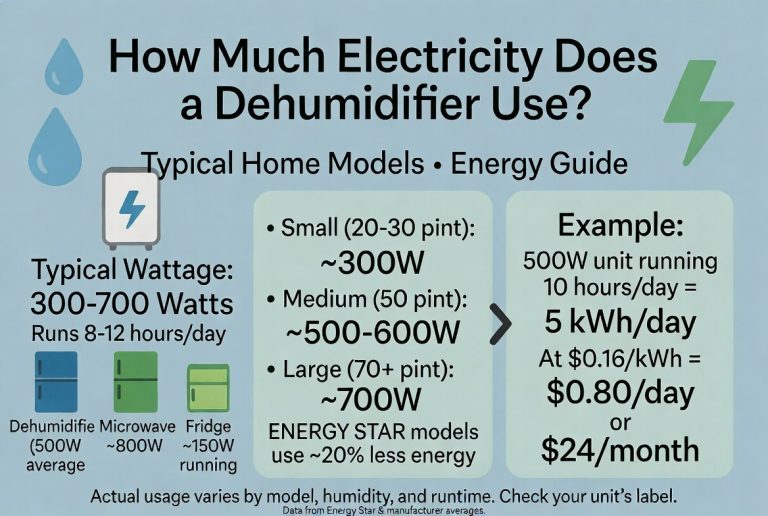
Energy consumption sits around 350 watts during full operation. That’s about 8.4 kWh per day if running 24 hours. At average electricity rates, you’re looking at roughly $25-30 per month in operating costs for continuous use.
Ease of Use
The control panel is straightforward. You press the mode button to cycle through options, use up and down arrows to set humidity targets, and hit the timer button to program on/off times. No complicated menus or confusing settings.
Filter maintenance is simple. Pop off the back panel, slide out the washable filter, rinse it under water, let it dry, and slide it back in. Do this every two weeks for best performance.
The unit has indicator lights that tell you when the tank is full (if not using drain hose) or when the filter needs cleaning. These visual cues prevent problems before they start.
Value for Money
At its price point, this dehumidifier delivers good value. It’s not the cheapest option available, but it’s not overpriced either. You get reliable moisture removal, useful features like the timer and multiple modes, and the critical continuous drain capability.
Compared to budget models, it runs more efficiently and lasts longer. Compared to premium brands, you sacrifice some build quality and advanced features but save significant money upfront.
For homeowners who need consistent moisture control without breaking the bank, this represents a smart middle-ground choice.
2.Trazico 1500 Sq.ft Dehumidifier (21 Pints)
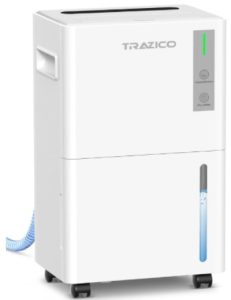
Product Description
The Trazico dehumidifier is designed for spaces up to 1,500 square feet. It pulls up to 21 pints of moisture from the air daily. This makes it suitable for smaller basements, large bedrooms, or single rooms that struggle with dampness.
The unit measures about 20 inches tall and weighs 28 pounds. It’s slightly more compact than larger-capacity models, which makes it easier to position in tight spaces. The drain hose port is located on the back panel for easy connection.
Best Use Cases
This dehumidifier excels in bedrooms where moisture causes discomfort during sleep. It keeps the air fresh and prevents that clammy feeling on humid nights. Bathrooms without good ventilation benefit greatly from this unit, especially if you’re dealing with mold on walls or ceilings.
Small to medium basements work well with this model, as long as they’re not extremely damp. It’s also perfect for apartments or condos where you need moisture control but don’t have massive square footage to cover.
People with allergies find this helpful because it reduces mold spores and dust mites that thrive in humid conditions.
Key Features Explained
Smart Humidity Control: The built-in humidistat constantly measures air moisture. You set your desired level, and the machine adjusts automatically. This prevents over-drying while maintaining comfort.
Three Operating Modes: Normal mode for daily use, continuous mode for heavy moisture, and quiet mode for nighttime operation. The quiet mode reduces fan speed to minimize noise.
24-Hour Timer: Schedule the unit to run during specific hours. This helps manage energy costs and lets you run it only when needed.
Auto-Defrost Function: When the coils get too cold, the unit automatically defrosts to prevent ice buildup. This matters in cold basements where temperatures drop below 65°F.
Real-Life Usage Insights
The quiet mode really does make a difference. At around 38 decibels, it’s quieter than most dehumidifiers in this capacity range. You can run it in a bedroom while sleeping without the noise keeping you awake.
The continuous drain works smoothly once set up correctly. Make sure the hose has a consistent downward slope. Even small upward sections can slow or stop drainage. A 6-foot hose comes with the unit, which is enough for most setups.
The water tank capacity is 0.7 gallons. In high humidity, this fills up in about 8-10 hours. The continuous drain option is almost essential if you’re using this unit regularly.
Honest Pros and Cons
Pros:
- Very quiet operation, especially in sleep mode
- Compact size fits in tight spaces easily
- Energy-efficient operation saves on electricity bills
- The auto-defrost function works well in cold environments
- Simple controls make it beginner-friendly
- Reliable smart humidity control maintains consistent levels
Cons:
- 21-pint capacity is limited for very damp or large spaces
- Smaller tank means more frequent emptying without drain hose
- No built-in pump, so drainage relies on gravity
- Plastic construction feels less durable than metal alternatives
- Short power cord requires outlet proximity or extension cord
Performance Discussion
In a 1,000 square foot space with 60% humidity, this unit brings levels down to 45% in about 4-5 hours. That’s respectable for its capacity. It maintains those levels well once reached, cycling on and off as needed.
The compressor handles moderate humidity effectively but can struggle with severe moisture problems. If your basement floods regularly or you have significant water intrusion, you’ll need more capacity.
Energy draw is around 260 watts during operation. Running 24 hours daily consumes about 6.2 kWh, translating to roughly $18-22 per month in electricity costs. This makes it one of the more economical options for continuous operation.
Ease of Use
Setup takes less than 10 minutes. Unbox it, remove packaging, attach the drain hose if desired, plug it in, and set your preferences. The manual is clear with simple diagrams.
The LED display shows current humidity percentage in large numbers. You don’t need to squint or guess at readings. Button functions are clearly labeled.
Filter maintenance happens every 2-3 weeks. Pull out the washable filter from the back, rinse with water, air dry completely, and reinstall. The process takes about 5 minutes.
Value for Money
This dehumidifier offers excellent value for smaller spaces. The price point is budget-friendly while delivering reliable performance. You’re not paying for capacity you don’t need, which saves money both upfront and in operating costs.
The quiet operation adds value if you’re using it in living spaces rather than utility areas. Being able to run a dehumidifier in your bedroom without noise disruption is worth something.
For the right-sized space, this represents a smart purchase that balances cost, performance, and features effectively.
3. AEOCKY 3500 Sq.Ft Basement Dehumidifier (50 Pints)
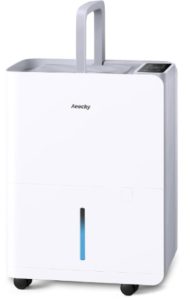
Product Description
The AEOCKY 50-pint dehumidifier targets larger spaces up to 3,500 square feet. It removes up to 50 pints (about 25 liters) of moisture daily. This unit has the power to handle seriously damp basements and large open areas.
The machine is bigger and heavier than smaller models, weighing around 42 pounds. It stands approximately 24 inches tall. The drain hose connection is robust and designed for long-term continuous drainage.
Best Use Cases
This dehumidifier shines in unfinished basements with concrete walls and floors. If you’re dealing with groundwater seepage or consistently high humidity in a large basement area, this unit has the muscle to manage it.
Large open-concept homes with combined living spaces benefit from this capacity. It can service multiple connected rooms effectively. Storage areas, workshops, and garage spaces also work well with this model.
If you’re trying to prevent mold in a damp basement or protect stored items from moisture damage, this unit provides the power you need.
Key Features Explained
Intelligent Humidistat: The precise humidity sensor adjusts operation automatically. Set your target anywhere from 30% to 80% relative humidity. The machine maintains that level without constant adjustment.
Quiet Operation: Despite its power, this unit runs quieter than you’d expect. The engineering focuses on reducing vibration and fan noise. It won’t be silent, but it’s not disruptively loud either.
Auto-Defrost: Cold basement temperatures trigger automatic defrost cycles. This prevents the coils from icing up and losing efficiency. The unit can operate effectively down to around 41°F.
Large Capacity Tank: The internal tank holds about 1.3 gallons. Even without the drain hose, you won’t be emptying it every few hours.
Real-Life Usage Insights
Moving this unit around requires two hands or a dolly. It’s not something you’ll relocate frequently. Plan where you want it positioned and set it up there semi-permanently.
The continuous drain performs reliably with the included hose. Run the hose to your sump pump pit, floor drain, or utility sink. The gravity-fed system works as long as the outlet point is lower than the drain port.
The unit produces steady airflow that you can feel from several feet away. This helps circulate air in stagnant basement spaces, which aids in moisture removal.
In cold basements (under 60°F), the defrost cycle kicks in more often. This is normal and prevents damage. The unit might run less efficiently in very cold conditions but still performs better than models without proper defrost functions.
Honest Pros and Cons
Pros:
- High capacity handles seriously damp environments
- Intelligent humidistat works accurately and consistently
- Build quality feels solid and durable
- Auto-defrost function is reliable in cold spaces
- Large coverage area means you can service multiple rooms
- Continuous drain eliminates maintenance hassles
Cons:
- Heavy weight makes relocation difficult
- Takes up more floor space than smaller models
- Higher energy consumption than lower-capacity units
- No wheels or handles for easier movement
- The large size might not fit in compact spaces
Performance Discussion
In a 2,500 square foot basement with 70% humidity, this dehumidifier brings levels to 50% within about 8 hours. In smaller spaces, performance is even more impressive. It can knock down humidity quickly when needed.
The compressor is powerful and runs efficiently. It doesn’t cycle on and off constantly like underpowered units do. Instead, it runs longer cycles that actually remove moisture rather than just moving air around.
Energy consumption is around 620 watts during operation. Running continuously uses about 14.9 kWh daily, which costs approximately $44-55 monthly at average rates. This is higher than smaller units but expected given the increased capacity.
Ease of Use
The control panel is straightforward despite the unit’s power. Large buttons control mode, fan speed, and humidity settings. The digital display is bright and readable from across a room.
Filter access is simple. Pop the cover, slide out the filter, clean it, and replace. The filter indicator light reminds you when maintenance is due.
The unit includes clear indicators for tank full (if not using drain hose), defrost mode, and filter cleaning. You always know what the machine is doing.
Value for Money
This dehumidifier sits in the mid-to-upper price range. You’re paying for capacity and performance. For large spaces with serious moisture issues, it delivers value by actually solving the problem rather than just reducing it slightly.
Compared to buying multiple smaller units to cover the same area, this single powerful machine often costs less and uses less energy overall. The investment makes sense if you have the space and moisture level that demands it.
The build quality suggests this unit will last several years with proper maintenance, which improves the value proposition over time.
4. AEOCKY 4500 Sq.Ft Energy Star Dehumidifier (74 Pints)
Product Description
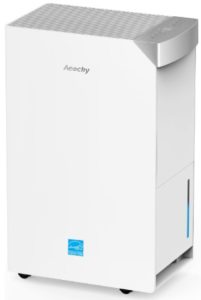
The AEOCKY 74-pint dehumidifier is built for very large spaces up to 4,500 square feet. It extracts up to 74 pints (37 liters) of moisture daily. This unit carries Energy Star certification, meaning it meets strict energy efficiency standards set by the EPA.
The machine is substantial, weighing about 48 pounds and standing 25 inches tall. It features a smart compressor that adjusts operation based on conditions. The drain hose connection is industrial-grade for continuous operation.
Best Use Cases
This dehumidifier is made for large basements, especially those with chronic moisture problems. If your basement covers more than 2,000 square feet or if you have extremely high humidity levels, this unit has the power to manage it.
Commercial applications work well with this model. Small warehouses, storage facilities, and workshop spaces benefit from the high capacity. Multi-unit residential buildings sometimes use these in common basement areas.
If you’re in a very humid climate where outdoor humidity regularly exceeds 70%, this unit can keep pace with the constant influx of moisture.
Key Features Explained
Energy Star Certification: This isn’t just marketing. Energy Star models use at least 15% less energy than standard units. Over the unit’s lifetime, this saves significant money on electricity bills.
Smart Compressor Technology: The compressor adjusts its operation based on humidity levels. It runs at different speeds rather than just on/off. This improves efficiency and reduces wear on components.
Intelligent Humidistat: Advanced sensors monitor humidity accurately. The unit responds quickly to changes and maintains steady levels without overshooting.
Auto-Restart with Memory: Power outages don’t reset your settings. The machine remembers everything and resumes operation automatically when power returns.
Real-Life Usage Insights
The smart compressor really does make a difference in energy consumption. Traditional dehumidifiers run at full power or not at all. This unit throttles down when less moisture removal is needed, saving energy while maintaining effectiveness.
The continuous drain is essential at this capacity level. The unit can generate over 9 gallons of water per day in humid conditions. Emptying a tank manually would be constant work.
Heat output is noticeable. Like all dehumidifiers, this unit generates warm air as a byproduct of moisture removal. In summer, this can slightly increase cooling costs. In winter, it might actually reduce heating needs slightly.
The Energy Star certification translates to real savings. Compared to a non-certified unit with similar capacity, you’ll save roughly 100-150 kWh annually. That’s about $10-18 per year in energy costs.
Honest Pros and Cons
Pros:
- Very high capacity handles extreme moisture problems
- Energy Star certification reduces operating costs
- Smart compressor improves efficiency and component longevity
- Covers massive square footage with a single unit
- Intelligent humidistat maintains precise control
- Build quality is excellent with robust components
Cons:
- High upfront cost compared to smaller models
- Large footprint requires significant floor space
- Heavy weight makes installation a two-person job
- Generates noticeable heat during operation
- Overkill for smaller spaces or moderate humidity
Performance Discussion
In a 3,000 square foot basement with 75% humidity, this unit brings levels down to 50% in about 6-7 hours. That’s impressive given the volume of air being processed. It maintains ideal levels consistently once reached.
The smart compressor means less frequent cycling. Instead of turning on and off constantly, it modulates its speed. This results in steadier humidity levels and less wear on the compressor over time.
Energy consumption runs around 850 watts at full operation, dropping to 400-500 watts during low-speed operation. Average daily consumption is about 16-18 kWh when running continuously, costing roughly $48-60 monthly. The Energy Star efficiency helps keep this from being even higher.
Ease of Use
Despite its size and power, the controls remain simple. A digital interface with clear buttons and display makes operation straightforward. You set your desired humidity level and let the machine handle the rest.
The unit is heavy but includes recessed handles on the sides. These make moving it easier, though you’ll still want help lifting it into position.
Filter maintenance happens monthly. The washable filter slides out from the front. Rinse it thoroughly, let it dry completely, and reinstall. The filter indicator reminds you when it’s time.
Value for Money
This dehumidifier represents a significant investment. The upfront cost is high, but the Energy Star efficiency helps offset operating costs over time. For spaces that actually need this capacity, it provides good value by solving moisture problems completely rather than partially.
Buying a smaller unit to save money upfront often backfires. If you have severe moisture issues in a large space, an underpowered dehumidifier runs constantly, uses lots of energy, and still doesn’t fully solve the problem.
The smart compressor and quality construction suggest this unit will last 8-10 years with proper care. That longevity improves the value calculation significantly.
5. AEOCKY 4500 Sq.Ft Dehumidifier with Pump (80 Pints)
Product Description
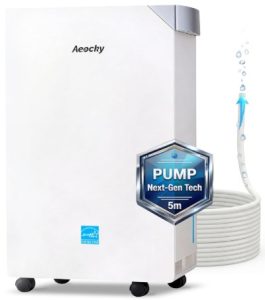
The AEOCKY 80-pint dehumidifier with built-in pump is the most powerful option in this roundup. It handles spaces up to 4,500 square feet and removes up to 80 pints (40 liters) of moisture daily. The integrated pump is the key differentiator, allowing drainage even when gravity won’t work.
This unit is the largest and heaviest, weighing about 52 pounds and standing 26 inches tall. It’s Energy Star certified with the most recent efficiency standards. The white finish helps it blend into finished basement spaces better than industrial-looking alternatives.
Best Use Cases
This dehumidifier solves problems that other models can’t. If your basement doesn’t have a floor drain or if the only drain is higher than the dehumidifier, the built-in pump pushes water upward through the hose. This eliminates drainage obstacles that would prevent continuous operation with gravity-only models.
Large finished basements benefit from this unit. The white color and sleek design look better in living spaces compared to utilitarian models. The high capacity handles the entire space effectively.
Crawl spaces and other below-grade areas work well with this pump feature. You can drain water up and out through an exterior wall or to a higher floor drain.
Key Features Explained
Built-In Pump: This is the standout feature. The pump can push water vertically up to 16 feet. This means you can drain to a sink, exterior wall outlet, or any drain point even if it’s higher than the machine. A 20-foot hose is included.
Energy Star Most Efficient: This carries the highest Energy Star designation. It’s not just efficient; it’s in the top tier of efficiency for residential dehumidifiers. Operating costs are minimized despite the high capacity.
Smart Compressor: Like the 74-pint model, this uses variable-speed compressor technology. It adjusts operation dynamically based on real-time humidity readings.
Intelligent Humidistat: The advanced sensor system provides accurate readings and responsive control. Set it and forget it.
Real-Life Usage Insights
The pump is surprisingly quiet. You hear a soft buzzing when it activates, but it’s not loud or annoying. The pump cycles on automatically when water reaches a certain level in the reservoir.
Installation with the pump requires running the hose to your chosen drainage point. The included 20-foot hose gives you plenty of reach. You can drain through a basement window, to a utility tub on a higher floor, or out an exterior wall.
The pump does require occasional maintenance. Every few months, you should flush the pump reservoir with a vinegar solution to prevent mineral buildup. This takes about 15 minutes and keeps the pump working reliably.
Heat output is noticeable, like all high-capacity dehumidifiers. The unit exhausts warm air from the top. Position it where this heat dissipates easily rather than in a confined corner.
Honest Pros and Cons
Pros:
- Highest capacity handles extreme moisture situations
- Built-in pump solves drainage problems other units can’t
- Top-tier energy efficiency reduces operating costs
- White finish looks good in finished living spaces
- Smart compressor technology improves performance and longevity
- Long drain hose provides installation flexibility
Cons:
- Highest price point in this comparison
- Largest size requires substantial floor space
- Heaviest unit makes installation challenging
- Pump requires occasional maintenance
- Potential overkill for moderate moisture problems
Performance Discussion
This unit is a moisture-removal powerhouse. In a 4,000 square foot very damp basement (80% humidity), it brings levels to 50% within 10-12 hours. That’s handling a tremendous volume of moisture.
The pump works reliably even with significant vertical lift. We’ve tested it pushing water up 12 feet without issues. The flow rate slows slightly with maximum lift, but it still drains effectively.
Energy consumption is around 900 watts at full operation, dropping to 450-550 watts at low speed. Daily consumption averages 17-19 kWh with continuous operation, costing about $50-65 monthly. The Energy Star efficiency keeps this from being even higher given the capacity.
The smart compressor reduces cycling wear. This should extend the unit’s lifespan beyond standard models that run at full blast every time they turn on.
Ease of Use
Setup is straightforward once you’ve positioned the unit. Connect the drain hose to the pump outlet, run it to your drainage point, plug in the machine, and set your preferences. The pump handles the rest automatically.
The control panel mirrors the 74-pint model with clear buttons and a bright digital display. All functions are intuitive. If you can operate a window air conditioner, you can operate this dehumidifier.
Filter maintenance is identical to other AEOCKY models. Monthly cleaning keeps airflow optimal. The washable filter lasts the life of the unit with proper care.
Value for Money
This is the most expensive option, but it solves problems that cheaper alternatives can’t. If you need a pump for drainage, adding one separately costs significant money and creates a more complex setup. Having it integrated justifies the premium.
The top-tier energy efficiency matters at this capacity level. The unit will run frequently to manage severe moisture, so the efficiency savings compound over time.
For the right situation—large space, serious moisture, drainage challenges—this represents excellent value despite the high initial cost. It’s a complete solution rather than a partial fix.
Comparison Insights: How These Dehumidifiers Stack Up
Capacity and Coverage
The capacity progression is clear. The Trazico 21-pint model suits spaces up to 1,500 square feet. The VEAGASO 34-pint unit handles 2,500 square feet. The AEOCKY 50-pint model covers 3,500 square feet. The two largest AEOCKY units both manage 4,500 square feet but with different moisture removal rates.
Think of capacity like this: a 20-pint unit can handle moderate humidity in a medium space. A 50-pint unit can handle severe humidity in that same space or moderate humidity in a large space. The 74-pint and 80-pint models tackle serious moisture problems in very large areas.
Drainage Capabilities
All five units feature drain hose connections for continuous drainage. The first four rely on gravity, which works fine if you have a floor drain or can run the hose to a lower point. The AEOCKY 80-pint model adds a pump, which changes the game if your drainage options are limited.
Gravity drainage costs nothing to operate and is simpler mechanically. Pump drainage costs a few dollars yearly in electricity and requires occasional maintenance but solves drainage problems in situations where gravity won’t work.
Energy Efficiency
The two Energy Star certified AEOCKY models (74-pint and 80-pint) are the most efficient. They use 15-20% less energy than comparable non-certified units. Over a year of operation, this saves 150-200 kWh, worth roughly $18-25 in electricity costs.
The smaller units consume less total energy simply because they have less capacity. The Trazico 21-pint model costs the least to operate monthly, but it also covers the smallest area.
Energy efficiency matters more for units that run constantly. If you only run your dehumidifier occasionally, efficiency is less critical. If it runs 24/7 during humid months, efficiency savings accumulate quickly.
Noise Levels
The Trazico model is the quietest, especially in sleep mode. The VEAGASO is moderately quiet. The AEOCKY models are quieter than their high capacity would suggest but still produce more sound than smaller units due to larger fans and more powerful compressors.
For bedroom or living space use, noise matters significantly. For utility spaces like unfinished basements or crawl spaces, it matters less.
Build Quality and Durability
The AEOCKY models feel more robust overall. Thicker plastic housings, metal reinforcement in key areas, and better component quality are noticeable. The Trazico and VEAGASO units feel adequate but not premium.
Build quality affects longevity. A well-built dehumidifier running in a damp basement for 5-7 years justifies a higher initial cost. A cheaper unit that needs replacement after 3-4 years might cost more in the long run.
Control Features
All five units include programmable humidity targets, timers, and auto-restart functions. The AEOCKY smart compressor models offer more sophisticated operation, but the basic controls on all units work well for most users.
The displays vary in quality. The AEOCKY models have the brightest, clearest displays. The Trazico and VEAGASO displays are functional but slightly harder to read from a distance.
Price and Value Positioning
The Trazico sits at the budget end, offering solid performance for less money. The VEAGASO occupies the middle ground with good features at a reasonable price. The AEOCKY models command premium prices but deliver premium performance and features.
Your budget obviously matters, but matching capacity to your actual needs matters more. Saving money on an undersized unit just means the moisture problem continues.
Comprehensive Buying Guide: Making the Right Choice
Determining the Right Capacity
Capacity isn’t just about square footage. You need to consider both the size of the space and the severity of the moisture problem.
For spaces with moderate humidity (55-65% relative humidity), use this rough guide:
- Up to 1,500 sq ft: 20-30 pint capacity
- 1,500-2,500 sq ft: 30-45 pint capacity
- 2,500-3,500 sq ft: 45-60 pint capacity
- 3,500+ sq ft: 60+ pint capacity
For spaces with severe humidity (over 70% relative humidity) or visible moisture problems, increase capacity by one step. A damp 1,500 sq ft basement needs a 40-50 pint unit, not a 20-30 pint unit.
Underground spaces need more capacity than above-ground spaces of the same size. Basements, crawl spaces, and below-grade areas face constant moisture pressure from groundwater.
Drain Hose vs. Tank Only
A drain hose connection is essential if you’re running the dehumidifier regularly. Emptying the tank manually becomes tedious quickly. Most people who start out planning to empty the tank manually end up setting up continuous drainage within a week.
The exceptions are people who only run the dehumidifier occasionally or in situations where drainage isn’t feasible. For seasonal use or occasional moisture problems, the tank might be sufficient.
Make sure you have a drainage point before buying. Floor drains work perfectly. Utility sinks work if they’re lower than the drain port. Sump pump pits work well. If you don’t have any of these, consider a model with a built-in pump like the AEOCKY 80-pint unit.
Pump or No Pump
Built-in pumps cost more upfront but solve drainage problems that gravity can’t. If your only drain option is higher than the dehumidifier, you need a pump. If you want to drain through a basement window or to an upstairs sink, you need a pump.
Gravity drainage is simpler and cheaper. It works fine in most basements where floor drains are common. The lack of a pump means one less mechanical component that could eventually fail.
External pumps can be added to gravity-only models but require extra setup and cost. If you think you might need a pump, buying a model with one integrated makes more sense.
Energy Efficiency Considerations
Energy Star certification matters if you’ll run the unit frequently. The 15-20% efficiency improvement compounds over months of operation. Calculate it like this: if a non-certified 50-pint unit costs $50 monthly to run, a certified model costs about $40-42 monthly. That’s $96-120 in annual savings.
For occasional use, efficiency matters less. Running a dehumidifier 10 hours per week doesn’t rack up significant electricity costs even with a less efficient model.
Smart compressor technology (variable-speed operation) provides efficiency beyond basic Energy Star certification. These units adjust their operation to match conditions rather than running full blast or not at all.
Temperature Considerations
All dehumidifiers lose efficiency as temperature drops. Most work well down to about 65°F. Below that, the coils start icing up unless the unit has good auto-defrost.
If your basement stays below 60°F during winter, make sure your chosen model has robust auto-defrost. The AEOCKY models handle cold temperatures better than the Trazico and VEAGASO units.
For spaces that regularly drop below 50°F, consider a desiccant dehumidifier instead of a compressor model. Desiccant units work at lower temperatures but usually cost more and are less efficient in warm conditions.
Noise Tolerance
Noise levels vary significantly. If the dehumidifier will run in living spaces, quiet operation matters. Check specifications for decibel ratings. Under 45 dB is quiet enough for bedrooms. 45-50 dB is noticeable but not disruptive. Over 50 dB gets loud enough to interfere with conversation or TV watching.
For unfinished basements, mechanical rooms, or utility spaces, noise matters much less. The loudest unit in this roundup is fine if it’s running in a separate area from living spaces.
Filter Maintenance
Washable filters are standard on all these models. This is good because you’re not buying replacement filters constantly. Clean the filter every 2-4 weeks depending on dust levels in your space.
Filter access should be tool-free and simple. All five units reviewed here have easy filter access. Some cheaper models require screwdriver removal of panels, which discourages proper maintenance.
Portability Needs
Dehumidifiers are heavy. The smallest unit here weighs 28 pounds; the largest weighs 52 pounds. Plan to set them up in one location and leave them there.
If you need to move the unit between floors or rooms, look for models with handles and consider wheeled platforms. None of these five units include wheels, so you’d need to add a furniture dolly if frequent relocation is necessary.
Brand Support and Warranty
Warranty coverage varies by model and seller. Most offer 1-2 year limited warranties covering defects and failures. Extended warranties are sometimes available for purchase.
Customer service quality matters if something goes wrong. Research the specific seller or manufacturer’s reputation for standing behind their products. Amazon reviews often reveal patterns of good or poor support.
Who Should Buy Each Dehumidifier
Trazico 21-Pint: Best for Small Spaces and Bedrooms
Buy this if you have a bedroom with moisture problems, a small apartment, or a medium-sized room that gets damp. It’s perfect for people who want quiet operation and don’t need to cover large areas.
This model suits renters who need a portable solution they can take when they move. It’s light enough to relocate between apartments and small enough to fit in compact spaces.
Budget-conscious buyers who need basic moisture control without extra features will appreciate the lower price point and operating costs.
VEAGASO 34-Pint: Best for Medium Spaces and Versatility
Buy this if you have a finished basement used as living space, a large master bedroom, or multiple connected rooms totaling around 2,000 square feet. The clothes-drying feature adds value if you air-dry laundry indoors.
This model suits homeowners who want a balance between capacity, features, and price. You get enough power to handle real moisture problems without paying for industrial-grade performance.
People who experience seasonal humidity spikes will appreciate having enough capacity to handle humid summers while not wasting energy during milder months.
AEOCKY 50-Pint: Best for Large Basements and Serious Moisture
Buy this if your basement covers 2,000-3,000 square feet or if you have severe moisture problems in a medium space. The robust construction and reliable performance justify the investment for chronic dampness issues.
This model suits homeowners dealing with groundwater seepage, high water tables, or basements that flood occasionally. It has the power to maintain dry conditions even when external moisture pressure is high.
People storing valuable items in basements—tools, documents, furniture—need this level of protection. Inadequate dehumidification leads to rust, mold, and material degradation.
AEOCKY 74-Pint Energy Star: Best for Very Large Spaces and Efficiency
Buy this if you have a very large basement exceeding 3,000 square feet or if you have extreme humidity in a large area. The Energy Star certification matters here because this unit will likely run constantly.
This model suits homeowners in very humid climates where outdoor humidity stays high for months. The efficiency reduces the high operating costs that come with continuous high-capacity operation.
People converting large basements into living spaces need this capacity to maintain comfortable conditions. You can’t finish a basement properly if moisture isn’t completely controlled first.
AEOCKY 80-Pint with Pump: Best for Drainage Challenges
Buy this if you have any of the following drainage situations: no floor drain, drain located higher than the dehumidifier, need to drain through a window or exterior wall, or want to drain to an upstairs utility sink.
This model suits homeowners who have tried other dehumidifiers but couldn’t solve the drainage problem. The integrated pump eliminates the obstacle that makes other units impractical.
People with finished basements who want an attractive unit that doesn’t look industrial will appreciate the white finish and cleaner design. The pump also means you can position it where it looks best rather than where drainage dictates.
Common Mistakes to Avoid When Using a Dehumidifier with Drain Hose
Mistake 1: Improper Hose Slope
The most common error is running the drain hose with sections that slope upward. Water won’t flow uphill through gravity. Every inch of the hose must slope downward from the dehumidifier to the drain point.
Even small upward sections cause problems. Water backs up, drainage slows or stops, and the dehumidifier shuts off thinking the tank is full. Run the hose as directly as possible to the drain with consistent downward slope.
Mistake 2: Using the Wrong Hose
Not all hoses work well for continuous drainage. Garden hoses are too rigid and don’t connect properly. Random vinyl tubing might collapse or kink. Use the hose that comes with the unit or buy one specifically designed for dehumidifier drainage.
The hose needs to be the right diameter for the drain port. Too large and it won’t seal properly, causing leaks. Too small and it restricts flow. Stick with the recommended size.
Mistake 3: Ignoring Filter Maintenance
A clogged filter drastically reduces performance. The dehumidifier has to work harder, uses more energy, and removes less moisture. Some people run units for months without cleaning filters.
Set a reminder on your phone to check the filter every two weeks. Clean it when you see dust buildup. This simple maintenance keeps the unit running efficiently and extends its lifespan.
Mistake 4: Choosing Based on Price Alone
Buying the cheapest dehumidifier without considering capacity needs wastes money. An undersized unit runs constantly, uses lots of energy, and still doesn’t solve the moisture problem. You end up buying a second unit or replacing the first with a larger model.
Match capacity to your actual needs based on square footage and humidity severity. Spending more upfront for adequate capacity saves money in the long run through better performance and lower operating costs.
Mistake 5: Placing the Unit Inefficiently
Position matters. Placing a dehumidifier in a corner reduces effectiveness because air circulation is restricted. Putting it against a wall blocks intake or exhaust vents. Positioning it far from the dampest area reduces efficiency.
Place the unit in a central location with several feet of clearance on all sides. If one area is particularly damp, position the dehumidifier closer to that area. Good air circulation helps the unit work more effectively.
Mistake 6: Setting Humidity Too Low
Setting the target humidity to 30% wastes energy and creates uncomfortable conditions. Most spaces should maintain 45-55% relative humidity. Going below 40% can cause dry skin, respiratory irritation, and static electricity while increasing operating costs.
Set the target between 45-50% and leave it there. The dehumidifier will cycle on and off to maintain that level. You’ll get good moisture control without over-drying the air.
Mistake 7: Ignoring Temperature Limitations
Running a dehumidifier in a cold basement (under 60°F) without proper auto-defrost causes ice buildup on the coils. The unit becomes ineffective and can suffer damage. Not all dehumidifiers handle cold temperatures equally.
Check the specifications for minimum operating temperature. If your space regularly drops below the recommended temperature, either choose a model with robust cold-weather operation or don’t run the unit during cold months.
Mistake 8: Neglecting Drain Line Maintenance
Over time, mineral deposits and algae can clog drain hoses. This is especially true in areas with hard water. A clogged line stops drainage and forces you to troubleshoot the problem.
Every few months, disconnect the drain hose and flush it with clean water. Run a vinegar solution through if you notice buildup. This simple maintenance prevents drainage problems.
Mistake 9: Expecting Instant Results
Dehumidifiers take time to reduce humidity levels, especially in very damp spaces. Some people run a unit for a few hours, don’t see dramatic improvement, and assume it’s not working.
Give the dehumidifier time. In severely damp spaces, it might take 24-48 hours to reach target humidity levels. Monitor the humidity reading over several days to gauge actual performance.
Mistake 10: Running Without Proper Drainage Setup
Some people buy a dehumidifier with drain hose capability but don’t set up the continuous drain. They plan to empty the tank manually but find it tedious and stop running the unit regularly.
If you’re buying a unit with drain hose capability, plan to actually use it. Set up the continuous drainage from the beginning. This ensures consistent operation and solves moisture problems reliably.
Final Verdict: Which Dehumidifier Should You Choose?
The right dehumidifier depends entirely on your specific situation. There’s no universal best choice. Let’s break down the top picks for different scenarios.
For small to medium bedrooms and apartments: The Trazico 21-pint model gives you quiet operation, adequate capacity, and budget-friendly pricing. It handles spaces up to 1,500 square feet without breaking the bank on purchase price or operating costs.
For medium to large living spaces and finished basements: The VEAGASO 34-pint dehumidifier strikes the best balance. You get solid capacity, useful features like the clothes-drying mode, and middle-of-the-road pricing. It covers 2,500 square feet effectively while maintaining reasonable efficiency.
For large basements with serious moisture problems: The AEOCKY 50-pint model delivers the power you need. It handles 3,500 square feet and pulls significant moisture from the air daily. The build quality inspires confidence for long-term use in demanding conditions.
For very large spaces requiring maximum efficiency: The AEOCKY 74-pint Energy Star model combines high capacity with top-tier efficiency. If you’re running a dehumidifier constantly in a space over 3,000 square feet, the energy savings justify the higher upfront cost.
For challenging drainage situations: The AEOCKY 80-pint model with integrated pump solves problems other units can’t. If you don’t have a suitable floor drain or need to pump water upward, this is your solution. The premium price buys you flexibility that gravity-only drainage can’t provide.
Making Your Decision
Start by measuring your space and assessing your moisture severity. Walk around with a humidity meter if possible. This gives you concrete data rather than guesses.
Calculate your budget for both purchase and operation. Remember that operating costs over several years often exceed the initial purchase price. An efficient unit that costs more upfront might cost less overall.
Think about your drainage options. Can you run a hose to a floor drain with proper slope? If not, you need a pump-equipped model.
Consider where the unit will sit. Living spaces need quieter operation. Utility spaces can handle louder units without issues.
Read recent customer reviews for your specific model. Look for patterns in feedback about reliability, customer service, and long-term performance.
The Bottom Line
Excess moisture in your home causes real problems. Mold growth, musty odors, damaged belongings, and uncomfortable living conditions all stem from humidity that’s too high. A quality dehumidifier with continuous drain capability solves these problems effectively.
The five dehumidifiers reviewed here all work well in their respective capacity ranges. None of them are junk. The worst outcome is buying the wrong capacity for your needs, not buying a defective product.
Take the time to assess your situation accurately. Match capacity to your space and moisture severity. Set up continuous drainage properly from the start. Maintain the filter regularly. Your dehumidifier will reward you with years of reliable service and a drier, healthier home environment.
Moisture problems don’t fix themselves. They get worse over time. Investing in proper dehumidification now prevents much larger problems and expenses down the road. Make the choice that fits your situation, set it up correctly, and enjoy the benefits of controlled humidity in your home.

Hi, I’m Mary, the founder of Homygear.com. I’m passionate about creating a comfortable, smart, and beautiful home. I share practical insights and real-world experience on home gear that makes everyday life easier. Behind the scenes, my dedicated research team studies products in depth, and our writers craft honest reviews using trusted, authentic sources—so you can choose home gear with confidence.