The Best Desk Height for Sitting Posture
Your desk height matters more than you think. It’s not just about comfort. The wrong desk height can damage your spine, create neck pain, and leave your shoulders aching by the end of the day. The good news? Getting it right is easier than you’d expect.
This guide will show you exactly how to find the best desk height for your body. You’ll learn about ergonomics, posture mechanics, and practical tips you can use today to feel better at work.
Why Desk Height Really Matters
Most people don’t think about their desk height until pain shows up. Then it’s too late. Your body is already hurting.
The truth is simple: your desk height directly affects how you sit. When your desk is too high or too low, your muscles work harder than they should. Your neck bends the wrong way. Your shoulders shrug up toward your ears. Your lower back gets no support.
Over time, this bad posture leads to problems. You might get chronic pain. Your shoulders could develop tension knots. Your neck might feel stiff and sore every morning. Some people even get carpal tunnel syndrome from poor desk positioning.
A desk at the right height keeps your spine neutral. Your muscles relax. You feel less tired at the end of the day. Your focus improves because your body isn’t screaming for attention.
The cost of fixing this is zero if you get it right from the start. The cost of ignoring it? Expensive medical bills and years of chronic pain.
Understanding Ergonomic Positioning
Ergonomics is the science of fitting your workspace to your body. It’s not magic. It’s just physics and human anatomy working together.
When you sit correctly, several things happen:
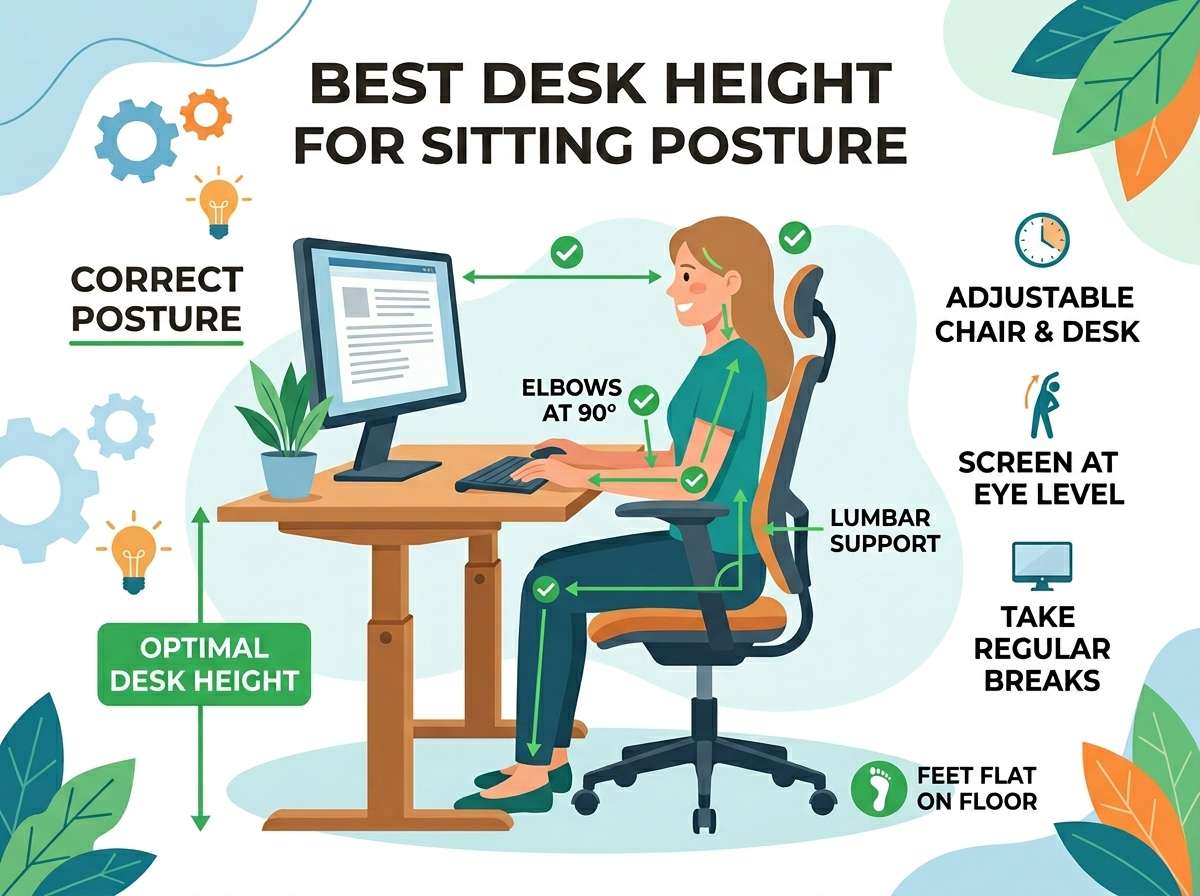
- Your feet rest flat on the floor
- Your knees bend at a 90-degree angle
- Your hips are level with or slightly higher than your knees
- Your back has a slight natural curve
- Your shoulders sit relaxed, not hunched or shrugged
- Your elbows bend at approximately 90 degrees
- Your wrists stay straight, not bent up or down
- Your eyes look slightly downward at your screen
This is the neutral position. It’s the shape your body wants to be in. When your desk height matches this position, everything else falls into place.
How to Measure Your Ideal Desk Height
Don’t guess. Measure.
Start by sitting in your work chair in the position you’ll use most of the day. Your feet should be flat on the floor. If your feet dangle, use a footrest first.
Now measure from the floor to the top of your thighs. This measurement tells you where your desk surface should be.
Here’s the key: your elbows should hover just slightly above your desk when your arms hang naturally at your sides. Your forearms should rest on the desk surface with your elbows at 90 degrees.
If you measure from your elbows down to your thighs, the distance should be about the same as your forearm length plus a couple inches. Your desk should sit at about the same height as your elbows when you’re sitting normally.
For most people, this works out to somewhere between 28 and 30 inches tall. But everyone is different. A person who is 5 feet tall might need a desk around 26 inches high. Someone who is 6 feet tall might need 32 inches.
Don’t use standard desk heights as your guide. Use your own body measurements.
The Standard Desk Height Problem
Most desks sold today are 30 inches tall. This standard was set decades ago based on average heights from that time. People are different heights now. People have different body proportions now.
A 30-inch desk works perfectly for some people. It’s completely wrong for others.
If you’re shorter than average, a standard desk will be too high. You’ll need to hunch your shoulders and reach down to use your keyboard and mouse. Over months and years, this damages your neck and shoulders.
If you’re taller than average, a standard desk will be too low. You’ll crouch and bend forward to see your screen and reach your keyboard. Your back suffers. Your neck gets strained.
Don’t assume the standard is right for you. Measure your own body. Find your own right height.
Ergonomic Sitting Posture Essentials
Good sitting posture is about alignment. Think of your spine as a stack of blocks. Each block needs to sit on top of the one below it.
Your head is heavy. It weighs about 10 pounds. When your head moves forward just one inch, your neck has to support an extra 10 pounds of force. Over a full day at work, this causes real damage.
Keep your head aligned over your shoulders. Your eyes should look at your screen without bending your neck forward or back. This is why screen height matters too, not just desk height.
Your shoulders should feel relaxed. You shouldn’t feel tension in the upper back and neck. If you do, either your desk is too high or your screen is too low.
Your elbows should rest at 90 degrees. This is the magic number. When your elbows bend at 90 degrees, your arms are positioned to type without strain. Your wrists stay straight. Your hands don’t have to bend up or down to reach the keyboard.
Your lower back should have support. If your chair back doesn’t support your lower spine’s natural curve, add a lumbar support pillow. This makes a huge difference.
Your core muscles should engage lightly to hold you upright. You shouldn’t feel like you’re muscling your way into good posture. It should feel natural and easy once you’re positioned right.
Finding the Right Height for Your Body Type
Everyone’s body is different. Your arm length, leg length, and torso length all matter.
For shorter people (under 5 feet 4 inches):
A standard 30-inch desk is likely too high. You might benefit from a desk that adjusts down to 26 or 27 inches. Alternatively, you could use a lower sitting surface or a footrest that brings your thighs up slightly, which can help.
For average height people (5 feet 4 to 5 feet 10 inches):
A standard 30-inch desk often works well. Some of you might be more comfortable at 28 or 29 inches. Everyone is different, so measure yourself before assuming standard is perfect.
For taller people (over 5 feet 10 inches):
You likely need a desk higher than 30 inches. A height of 31 to 33 inches might feel much better. If your desk is too low, you’ll constantly bend forward, which strains your back and neck.
For people with long arms relative to leg length:
You might need a higher desk than your height would suggest. Measure your elbows when sitting, not just your height.
For people with short arms relative to leg length:
You might need a lower desk than your height would suggest. Again, measure what actually works for you.
The Impact of Chair Height on Desk Height
Your chair is just as important as your desk. The two work together.
A good office chair lets you adjust the height. Start by setting your chair so your feet rest flat on the floor and your thighs are parallel to the floor. This is your baseline.
From here, adjust your desk height so your elbows rest at 90 degrees with your forearms parallel to the floor.
If your chair can’t be adjusted, or if it’s stuck at the wrong height, your desk height won’t matter much. You’ll still be uncomfortable.
Invest in a chair that adjusts. It’s one of the best things you can do for your posture and health.
The backrest of your chair should support your lower back. It should maintain the natural curve of your spine. If it doesn’t, add a lumbar roll or pillow.
Your seat should be padded enough to be comfortable but firm enough to support good posture. A seat that’s too soft lets you sink in, which creates bad posture.
Monitor Placement and Desk Height
Your monitor needs to be at the right height too. This works together with your desk height.
Your eyes should look slightly downward when you’re looking at the center of your screen. Not downward like you’re looking at your feet. Just a slight downward angle.
The top of your monitor should be at or just below eye level. For most people, this means the top of the screen is 15 to 20 degrees below eye level.
If your monitor is too high, you’ll tilt your head back and create neck strain. If it’s too low, you’ll hunch forward.
The distance from your eyes to the screen should be about 20 to 26 inches. About an arm’s length away.
This is why laptop work is so hard on posture. The screen is lower than it should be, and the keyboard is attached. You have to choose between having the screen at the right height or the keyboard at the right height. You can’t have both.
If you use a laptop regularly, get an external keyboard and mouse. Put the laptop on a stand to bring the screen to eye level. Then position your keyboard and mouse so your elbows are at 90 degrees.
Your desk height is only part of the solution. The whole setup has to work together.
Adjustable Desks vs. Fixed Height Desks
An adjustable desk can move up and down. A fixed desk stays at one height.
Adjustable desks have become popular in recent years. For good reason.
Even if you find the perfect desk height, you shouldn’t sit in exactly the same position all day. Your body needs variety. Movement is healthy.
An adjustable desk lets you change between sitting and standing throughout the day. Sitting for eight hours straight isn’t ideal. Neither is standing for eight hours straight. Changing position every hour or two helps.
If you get an adjustable desk, use it. Don’t just set it at one height and forget about it.
The downside of adjustable desks? They cost more. They take up more space. They’re more complicated.
A fixed desk is simpler and cheaper. If you find the right height for you, a fixed desk works fine. The key is that it has to be the right height.
Some people use adjustable desks but leave them at the same height most of the time anyway. In that case, they’re paying extra for a feature they don’t use. A fixed desk at the right height might be better.
Common Desk Height Mistakes to Avoid
People make the same mistakes over and over. Learn from them.
Mistake 1: Assuming standard is right for you.
Standard desks are 30 inches. This doesn’t match everyone. Measure yourself. Find your own right height.
Mistake 2: Making your desk height match your old desk.
Just because you were used to your old desk doesn’t mean it was right. Start fresh. Measure properly.
Mistake 3: Prioritizing storage over height.
Some desks look nice because they have shelves and drawers, but these features can make the desk height wrong for you. Get the height right first. Add storage later if you need it.
Mistake 4: Ignoring your chair.
A great desk doesn’t help if your chair is terrible. Invest in both.
Mistake 5: Setting up your desk without considering your monitor.
Desk height, chair height, and monitor height all work together. You can’t optimize one without the others.
Mistake 6: Sitting at your desk without breaks.
Even with perfect height, sitting for hours on end is bad for you. Stand up. Walk around. Stretch. Your body needs movement.
Mistake 7: Setting the height based on how it looks, not how it feels.
A desk might look good at a certain height, but if your body is uncomfortable, it’s not right. How it feels matters more than how it looks.
How Desk Height Affects Different Body Problems
Different problems call for different approaches.
Neck pain: Usually comes from a desk that’s too high, forcing you to look down at your work. Lower the desk. Also check your monitor height. Your screen might be too low.
Shoulder tension: Often comes from a desk that’s too high, making you shrug your shoulders up toward your ears. Lower the desk a few inches and see if it helps.
Lower back pain: Usually comes from poor back support. Get a chair with lumbar support. Make sure your desk is at the right height so you’re not slumping forward.
Wrist pain: Comes from wrists bent up or down while typing. Keep your wrists straight. Your desk height controls this. If your desk is too high, your wrists bend down. If it’s too low, they bend up.
Elbow pain: Can come from a desk that’s the wrong height. Your elbows should rest at 90 degrees when your forearms are on your desk.
Hip pain: Comes from sitting in a position that pinches your hips. Make sure your chair height is right so your thighs are parallel to the floor.
If you have pain, changing your desk height might help. But it might not be the only thing you need to fix. Stretch. Move around. Strengthen your core. Talk to a doctor if pain is severe.
Tips for Working at the Right Desk Height
Once you’ve found your ideal height, here are ways to make it work for you.
Set reminders to move. Even at the perfect desk height, sitting for hours is tough on your body. Stand up every hour. Walk to get water. Do some stretches.
Get a footrest if you need one. If your feet dangle when you sit with your thighs parallel to the floor, a footrest brings them up and improves your posture significantly.
Use a document holder. If you reference papers while working, prop them at eye level next to your monitor. Don’t look down at your desk. This kills your neck.
Keep your keyboard and mouse close. They should be at the same height as your desk, right in front of you. Don’t reach far to the side. Don’t reach far forward.
Adjust your monitor distance. Keep your screen about an arm’s length away. Closer isn’t better. You’ll just strain your eyes.
Position your monitor straight ahead. It shouldn’t be off to one side. You shouldn’t have to turn your head to see it.
Get a proper office chair. It’s an investment. It’s worth it. Your back will thank you for years.
Use good lighting. Poor lighting forces you to lean toward your monitor to see better. Good lighting lets you maintain perfect posture.
Keep your desk organized. Things scattered everywhere force you to reach and move. Organization helps you maintain good posture.
Take real breaks. Don’t just stare at another screen during your break. Go outside. Move your body. Rest your eyes.
Adjusting Your Current Setup
If your desk is already the wrong height, you have options.
Raise your desk: Use desk risers under the legs. These are cheap and work well. You can raise a desk a few inches quickly and easily.
Lower your desk: This is harder with fixed desks. You might need to replace it. Adjustable desks make this easy.
Raise or lower your chair: Adjust your chair height to get the positioning right. If your chair doesn’t adjust, this is a sign you need a new one.
Use a footrest: Raises your thighs slightly and helps with positioning if your desk is a bit too high.
Use a desk pad: Some desk pads have slight angles that can help positioning.
Add lumbar support: A pillow or lumbar roll behind your lower back helps you maintain good posture.
Get a monitor arm: Lets you move your monitor to the perfect height and distance without desk changes.
Small adjustments often fix problems. Don’t assume you need to buy a whole new desk.
The Long-Term Benefits of Proper Desk Height
Getting this right isn’t just about feeling better today. It’s about protecting your health for years to come.
People with good ergonomic setups have less pain. They get sick less often. They have more energy. Their focus is better.
People who work at poorly positioned desks develop chronic pain, poor posture habits, and health problems that stick with them.
Your desk height is one of the easiest things to fix. You don’t need special equipment. You don’t need expensive ergonomic specialists. You just need to measure yourself and set your desk to match your body.
Do it now. Your future self will be grateful. Your back will be grateful. Your neck will be grateful.
Quick Reference: Desk Height by Height Range
Use this as a starting point. Then measure your own body to fine-tune.
- Under 5 feet: Try 26 to 27 inches
- 5 feet to 5 feet 4 inches: Try 27 to 28 inches
- 5 feet 4 inches to 5 feet 8 inches: Try 28 to 30 inches
- 5 feet 8 inches to 6 feet: Try 30 inches
- 6 feet to 6 feet 4 inches: Try 31 to 32 inches
- Over 6 feet 4 inches: Try 32 to 33 inches
Remember: these are guides, not rules. Your body might differ from average. Measure to be sure.
Conclusion: Your Desk Height Matters
Your desk height directly affects your posture, your comfort, and your long-term health. The right height keeps your spine neutral. The wrong height creates pain and damage over time.
The solution is simple: measure your body, find your ideal desk height, and set up your desk to match.
This doesn’t require special expertise. It doesn’t cost much. You can do it today.
Your body works hard for you every single day. It deserves support that matches its unique shape and size. A desk at the right height is the foundation for comfortable, healthy work.
Get your desk height right. Your back will thank you.

Hi, I’m Mary, the founder of Homygear.com. I’m passionate about creating a comfortable, smart, and beautiful home. I share practical insights and real-world experience on home gear that makes everyday life easier. Behind the scenes, my dedicated research team studies products in depth, and our writers craft honest reviews using trusted, authentic sources—so you can choose home gear with confidence.