Dehumidifier Size Guide
Humidity problems sneak up on you. One day you notice the walls feel clammy, mold spots appear in the corner, or your clothes smell musty even though you just washed them. That’s when you realize you need a dehumidifier. But stepping into the market to find one, you face a confusing question: what size dehumidifier do you actually need?
The truth is, buying the wrong size dehumidifier wastes your money and leaves you with a wet room. Get the right one, though, and you’ll breathe easier, feel more comfortable, and protect your home from damage. This guide walks you through everything you need to know to pick the perfect dehumidifier for your space.
Why Size Matters More Than You Think
Before you start shopping, understand why dehumidifier sizing is so important. A unit that’s too small runs constantly, struggles to remove moisture, and burns through electricity without fixing your problem. A unit that’s too large cycles on and off too often, which also wastes energy and doesn’t run long enough to clean the air properly.
The right-sized dehumidifier removes moisture efficiently, runs for reasonable periods, and keeps your room at a comfortable humidity level without overworking. Getting this right saves money on your power bill and extends the life of your machine.
Humidity levels in your home directly affect your comfort. When the air contains too much moisture, you feel sticky and uncomfortable. Your family sleeps worse. Dust mites and mold love wet environments, so allergens multiply. Wooden furniture warps, paint peels, and electronics corrode. All these problems stem from one issue: your dehumidifier isn’t powerful enough for the space.
Understanding Humidity and Moisture Load
To find your perfect dehumidifier, you need to understand what creates moisture in your room. Every space has a “moisture load,” which is the total amount of water vapor that builds up over time.
Several factors create moisture in a room. Showers and baths release huge amounts of steam into the air. Cooking on the stove adds moisture. Simply breathing and sweating releases water vapor into the air. Damp basement walls leak moisture. Wet laundry drying indoors releases water. Even plants and aquariums add moisture to the environment.
The more moisture sources you have, the more powerful your dehumidifier needs to be. A basement with water seeping through the walls needs a much stronger unit than a dry bedroom. A laundry room where you hang-dry clothes all day needs serious dehumidifying power. A kitchen where you cook daily needs help managing steam.
Your location also matters. Homes near oceans, lakes, or rivers naturally have more humidity in the air. Basements are always wetter than upper floors because moisture rises and settles there. Bathrooms trap steam and stay humid longer than living rooms.
The season affects humidity levels too. Summer brings hot, wet air that carries more moisture than winter air. In warm climates, humidity stays high year-round. Cold climates see seasonal humidity spikes during transition periods when you switch between heating and cooling systems.
The Pints Per Day Rating Explained
Every dehumidifier carries a “pints per day” rating. This number tells you how many pints of water the machine removes from the air in 24 hours under standard test conditions.
Here’s the thing: manufacturers test these units in perfect conditions that rarely match your real home. They test at 60% relative humidity and 86 degrees Fahrenheit. In your actual home, humidity and temperature vary constantly. A humid basement might run at 80% humidity in summer. A dry bedroom might stay at 40% humidity year-round.
This means the pint rating is a starting point, not a guarantee. You’ll rarely achieve the maximum rating in real life. Cold basements pull less moisture than warm ones. Poorly insulated rooms with constant air leakage need larger units. Well-sealed, small spaces might need less power.
Think of the pints per day rating like the horsepower on a car engine. It tells you the power level, but you won’t drive at maximum power every second. Similarly, your dehumidifier rarely runs at maximum capacity. Instead, it adjusts to the moisture load in your space.
Measuring Your Room Size
The first step in finding your ideal dehumidifier is measuring your space. You need two numbers: the square footage of the room and the ceiling height.
To find square footage, measure the length and width of the room in feet. Multiply these two numbers together. A bedroom that’s 12 feet long and 10 feet wide is 120 square feet. A basement that’s 30 feet by 40 feet is 1,200 square feet. Do this for every area you plan to dehumidify.
If your space has an irregular shape, divide it into rectangles. Measure each section separately, multiply length times width, then add all the sections together. Most rooms are simple enough to measure in under five minutes.
Next, measure from the floor to the ceiling. Most homes have 8-foot ceilings, but older houses might be 7 feet or newer homes 9 feet. Vaulted ceilings create more air volume, so note where ceilings vary in height.
Now calculate the total cubic feet of air in your space. Take the square footage and multiply it by the ceiling height. A 120 square foot room with 8-foot ceilings has 960 cubic feet of air. A 1,200 square foot basement with 8-foot ceilings has 9,600 cubic feet of air.
This cubic footage number helps determine how much dehumidifying power you need. Larger spaces need stronger units. Spaces with high ceilings hold more air and take longer to dehumidify.
Using the Room Size Chart
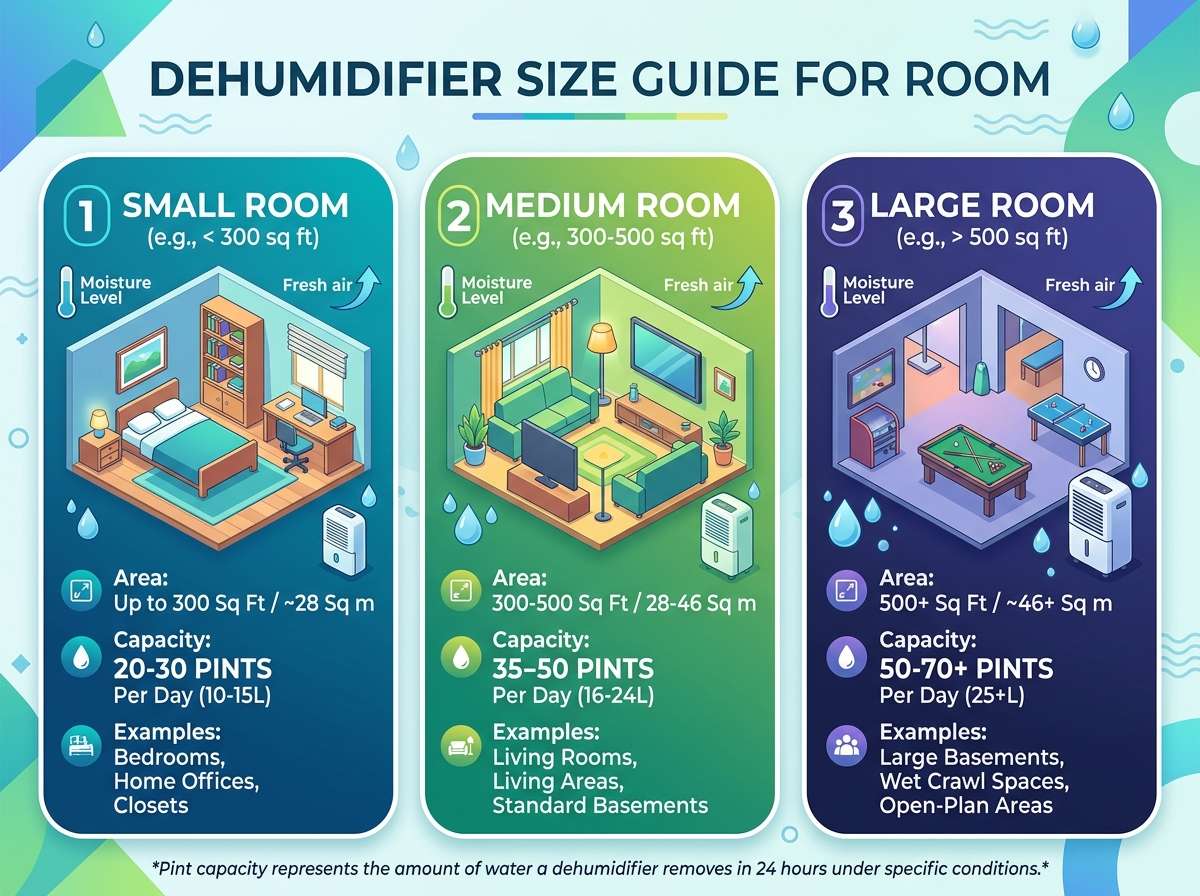
Once you know your space dimensions, use a room size chart to estimate dehumidifier capacity. These charts factor in moisture load and climate conditions. They take out much of the guesswork and point you toward the right pint rating for your situation.
Here’s a general guideline for moderately humid spaces:
Small rooms (up to 500 square feet): A 30 to 50 pint per day unit works well. Bedrooms, home offices, and small bathrooms fit this category. A 30 pint dehumidifier removes 30 pints of water daily under standard conditions.
Medium rooms (500 to 1,000 square feet): Look for 50 to 70 pint per day capacity. Large living rooms, master bedrooms, and small basements need this power level. Some spaces in this range might manage with a 50 pint unit if humidity isn’t extreme.
Large rooms (1,000 to 1,500 square feet): Choose a 70 to 100 pint per day dehumidifier. Big basements, large living areas, and whole-floor spaces need this capacity. If your basement is damp from leaks or water seepage, err toward the higher end.
Very large spaces (over 1,500 square feet): Install a 100+ pint per day unit or multiple smaller units. Finished basements, large open-concept areas, and multi-room spaces need serious dehumidifying power. Some people use two or three units positioned around the space.
Remember, these are guidelines for typical humidity levels. If your space is extremely damp, add 20 to 30 percent to these estimates. If your space is only mildly humid, you might go slightly smaller.
Adjusting for Moisture Load and Climate
The chart above assumes average moisture levels. Your actual needs might differ significantly based on specific conditions in your home.
Damp basements are the most common dehumidifier application. These spaces fight constant moisture from soil contact, water seepage, and poor ventilation. If your basement walls feel wet or you see standing water, you need a larger unit than the size chart suggests. Add 30 to 50 pints per day to your estimate for heavily damp basements. A 1,000 square foot basement with moisture problems might need a 100 pint unit instead of a 70 pint one.
Bathrooms are naturally humid from showers and baths. The moisture load spikes during and after showers, then slowly decreases. You don’t need a unit running at full power all day, but you do need one that handles the peak moisture. A 30 to 50 pint unit works well for most bathrooms unless it’s very large or gets multiple showers daily.
Laundry rooms create significant moisture when you hang-dry clothes indoors. This creates a temporary but intense moisture load. If you dry laundry regularly, jump up one size category from your room size. A 100 square foot laundry room might need a 50 pint unit instead of the standard 30 pint recommendation.
Kitchens with poor ventilation accumulate moisture from cooking. Daily cooking creates steady humidity. A separate dehumidifier in the kitchen, combined with running your range hood fan, manages this well. Most kitchens do fine with a 30 to 50 pint unit.
Hot, humid climates need larger units than dry climates. If you live in a tropical or subtropical region, move up one category from your size estimate. A 500 square foot bedroom in a humid climate might need a 70 pint unit instead of a 50 pint one.
Cold climates with winter heating see seasonal humidity spikes. Spring and fall transitions are worst. If you live somewhere with harsh winters, pick a unit that handles the transition seasons well. A 1,000 square foot basement in a cold climate might need 70 to 80 pints instead of 70.
Older homes with poor insulation and air sealing need larger units. Air leaks constantly let in outside moisture. Newer, tight homes with good seals need less dehumifying power. If your home is over 30 years old or has visible drafts around windows and doors, add 20 percent to your estimate.
The Importance of Room Conditions
Beyond size and moisture load, how you use your space affects dehumidifier performance. A closed room dehumidifies much faster than an open space with air flowing in from other areas.
If you keep doors closed and seal off the room, use the standard size chart. Your dehumidifier only fights the moisture in that contained space.
If you leave doors open and treat the room as part of a larger open-concept area, you need a bigger unit. The dehumidifier must handle moisture from the entire connected space. An open basement connected to a main floor might need 30 to 50 percent more capacity than a sealed basement of the same size.
Your dehumidifier placement affects how well it works. Install the unit in the dampest area of your space, ideally on a wall away from corners. Position the exhaust toward the center of the room so dry air circulates throughout. Never place a dehumidifier against a wall or in a corner, as this reduces effectiveness.
Air circulation helps dehumidifiers work better. In large spaces, run a fan to move humid air toward the unit. In small, sealed rooms, this matters less. Run your home’s central air conditioning or heating system to circulate air if you have it.
The hours per day you dehumidify matter too. If you run the unit 24/7, it removes more total moisture than if you run it just during humid times. For spaces with high moisture loads, continuous operation works best. For mildly humid rooms, running the unit during peak moisture times might work fine.
Humidity Readings and Real-World Testing
The best way to know if your dehumidifier is the right size is to measure actual humidity levels in your room. Buy a digital hygrometer for $15 to $30. This small device displays your room’s relative humidity percentage in real-time.
Ideal indoor humidity ranges from 30 to 50 percent relative humidity. Below 30 percent, the air feels too dry and causes dry skin and respiratory irritation. Above 60 percent, moisture problems develop and mold growth accelerates.
Place your hygrometer in the area you want to dehumidify. Check readings at different times of day and in different seasons. Morning readings are usually higher because humidity builds overnight. Readings spike after showers or cooking.
Once you install your dehumidifier, monitor humidity levels closely for the first week. If your unit brings humidity down to 50 percent and keeps it there while running a few hours daily, you’ve sized it correctly. If humidity stays above 60 percent even with the unit running 24/7, you need a larger unit. If humidity drops below 30 percent and the unit barely runs, you’ve oversized.
Some dehumidifiers have built-in humidistats that automatically control the unit. These prevent oversizing issues by allowing the machine to cycle on and off as needed. A unit with this feature gives you more flexibility in sizing.
Understanding Energy Efficiency
Dehumidifier energy use varies widely. A 50 pint dehumidifier might draw anywhere from 700 to 1,500 watts depending on design and efficiency. Running a dehumidifier 24/7 significantly impacts your power bill.
More powerful units generally use more electricity. However, buying an oversized unit doesn’t save energy. An oversized unit cycles on and off, using energy inefficiently. A properly sized unit runs steadily at reasonable power levels.
Look for the Energy Star label on dehumidifiers. These models use 15 to 20 percent less energy than standard units. Over several years of operation, this savings add up.
Calculate potential operating costs before you buy. Check the unit’s wattage and multiply by the hours you plan to run it daily. Divide by 1,000, then multiply by your local electricity rate per kilowatt-hour. A 1,000 watt unit running 8 hours daily in an area with $0.12 per kilowatt-hour costs roughly $3.50 per month, or $42 per year.
Common Dehumidifier Types and Their Best Uses
Different dehumidifier designs suit different situations. Understanding the main types helps you pick the best fit for your needs.
Refrigerant dehumidifiers are the most common type. These units work like air conditioners, cooling air to remove moisture. They work well in warm environments above 65 degrees Fahrenheit. In cold basements or unheated spaces, they lose effectiveness. A 50 pint refrigerant dehumidifier is affordable and efficient in typical home conditions.
Desiccant dehumidifiers use a special material that absorbs moisture from the air. They work well in cold spaces that refrigerant units struggle with. Desiccant models are quieter and lighter than refrigerant types. The trade-off is they use more electricity. These suit unheated basements and cold garages better than warm rooms.
Whole-home dehumidifiers integrate with your HVAC system. These units dehumidify your entire house continuously. They’re expensive to install but provide consistent humidity control throughout your home. Homes in very humid climates sometimes install these systems instead of portable units.
Combination units include a dehumidifier with an air purifier. These remove moisture and clean the air simultaneously. They work well in spaces where you want both benefits, though they cost more than standalone dehumidifiers.
Portable units on wheels offer flexibility. You can move them between rooms or position them in different areas as needs change. These work well for temporary humidity problems or if you want to dehumidify different spaces at different times.
Special Situations and Adjustments
Some spaces create unusual dehumidification challenges that don’t fit standard guidelines.
Crawl spaces and attics accumulate moisture from different sources than basements. Crawl spaces need ventilation control combined with dehumidification. A 30 to 50 pint unit handles most crawl spaces. Attics need different approaches depending on climate and ventilation.
RVs and boats in humid environments benefit from small dehumidifiers. Tiny 10 to 20 pint units handle these spaces. Moisture causes mold and mildew in enclosed mobile spaces, making dehumidifiers essential.
Garages with cars present unique challenges. Car engines release moisture, and cold concrete absorbs and releases moisture seasonally. A 50 to 70 pint unit handles an attached garage, but placement matters greatly.
Finished basements used as living spaces need larger units than unfinished basements. Living spaces generate more moisture from occupants, and you want comfort-level humidity control. A finished basement might need 20 to 30 percent more capacity than an unfinished one of the same size.
Bedrooms in humid climates need special attention. You spend 8 hours daily in your bedroom, and poor humidity affects sleep quality. Don’t skimp on sizing for bedrooms in tropical or subtropical regions.
Calculating Your Dehumidifier Capacity Step by Step
Let’s walk through a complete example to see how everything comes together.
Suppose you have a 600 square foot basement with 8-foot ceilings in a moderate climate. The basement feels somewhat damp but not wet. Following the room size chart, a 600 square foot space suggests a 50 to 70 pint unit.
Now adjust for conditions. Your basement doesn’t have visible water seeping, so you don’t need the heavy-duty oversizing for seriously damp basements. You heat the basement in winter, so temperature stays above 65 degrees year-round. The space is fairly well sealed with few drafts. These factors suggest staying at the lower end of the range.
Next, consider how you use the space. It’s open to your main floor with doors usually left open. This means the dehumidifier fights moisture from both the basement and some air from upstairs. Increase your estimate by 25 percent. A 50 pint unit becomes 62 pints, suggesting a 70 pint dehumidifier.
You might run the dehumidifier 12 hours daily during summer when humidity is worst, and 4 hours daily in winter. During test periods, monitor humidity levels. If your 70 pint unit keeps humidity at 45 to 50 percent during summer, you’ve sized correctly.
If humidity stays above 60 percent, jump to an 85 to 100 pint unit. If humidity drops below 30 percent regularly, a 50 pint unit would work fine.
Placement and Setup for Maximum Performance
Where you position your dehumidifier dramatically affects how well it works. Even the perfect size unit performs poorly with bad placement.
Install your dehumidifier in the dampest area of your space. In a basement, this usually means the lowest point or near walls where moisture enters. In a bathroom, it might go in the corner farthest from the bathroom fan. Position it away from walls and furniture to allow air circulation on all sides.
Leave at least 12 inches of clear space around your dehumidifier. This allows humid air to flow toward the intake vents easily. Blocked intakes force the unit to work harder and reduce efficiency.
Position the water exhaust where water can drain safely. Most portable dehumidifiers have a bucket that fills with collected water. You can empty this bucket, or run a hose from the unit to a nearby drain for continuous drainage. Never run the hose uphill against gravity.
In large spaces, use a separate fan to circulate air toward the dehumidifier. Position the fan to push air from the far side of the room toward the dehumidifier. This ensures the whole room dehumidifies evenly.
Keep doors closed in the space you’re dehumidifying. If you’re treating a basement, close doors to upstairs. If you’re treating a single room, keep the door closed. Open areas require larger units and dehumidify less efficiently.
Allow clearance above the dehumidifier as well. Don’t place it directly under shelves or in tight closets where warm exhaust air can’t escape properly. This slightly warms the air it produces, which is normal and helps distribute the dry air throughout the room.
When You Need Multiple Dehumidifiers
Large homes or homes with persistent humidity problems sometimes need multiple dehumidifiers instead of one large unit.
Two smaller units often work better than one huge unit. They’re easier to position, more flexible to operate, and sometimes use less total energy. A 1,200 square foot basement might dehumidify better with two 60 pint units positioned at opposite ends than with one 100 pint unit.
Run multiple units in different rooms or spaces simultaneously. A 50 pint unit in your bathroom, a 70 pint unit in your basement, and a 40 pint unit in your laundry room all work together to manage moisture throughout your home.
Homes with whole-floor open concept living spaces sometimes install a unit on each level. This lets you control humidity independently and place units in optimal locations.
Multiple units provide redundancy. If one unit fails, you still have dehumidification capability while you arrange repairs.
Final Thoughts on Dehumidifier Sizing
Finding the right dehumidifier size combines math, real-world assessment, and a bit of practical testing. Start with your room dimensions and use the sizing charts as a foundation. Adjust for your specific conditions, moisture load, and climate. Buy the unit, install it properly, and monitor humidity levels closely during your first week.
Once you find the right size, your dehumidifier quietly removes moisture and keeps your home comfortable and healthy. You’ll notice the difference immediately: less musty smells, better sleep, reduced allergy symptoms, and a more comfortable living environment.
Taking time to size your dehumidifier correctly pays dividends for years. You’ll spend less on electricity, your unit will last longer, and your home will feel better. That’s a win on every level.
Hi, I’m Mary, the founder of Homygear.com. I’m passionate about creating a comfortable, smart, and beautiful home. I share practical insights and real-world experience on home gear that makes everyday life easier. Behind the scenes, my dedicated research team studies products in depth, and our writers craft honest reviews using trusted, authentic sources—so you can choose home gear with confidence.