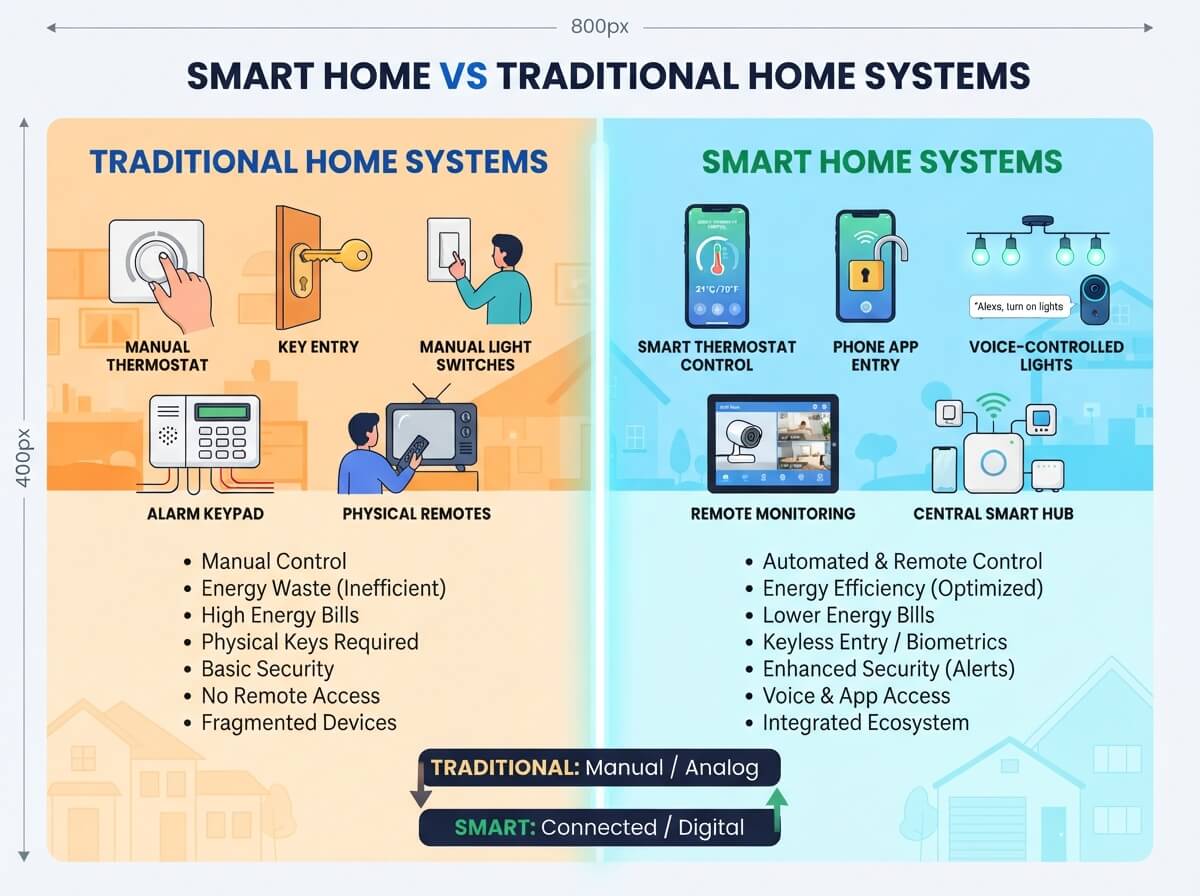
Smart Home vs Traditional Home Systems
Your home is more than just a place to live. It’s your sanctuary, your investment, and your biggest expense. So when it comes to how your home operates, you want to make the right choice. Today, homeowners face a big decision: stick with traditional home systems or embrace the world of smart home automation. Both options have real benefits, real drawbacks, and real costs. Let’s dive deep into this comparison so you can figure out what works best for your life.
What Exactly Is a Smart Home?
A smart home uses internet-connected devices and automation to control everything from your lights to your heating system. These devices talk to each other through your home network and respond to your commands. You can control them from your smartphone, a voice assistant, or a central hub.
Smart home technology includes smart thermostats, smart lighting, smart security cameras, smart door locks, and smart appliances. All of these devices gather data and make decisions based on your habits and preferences. They learn when you wake up, when you leave for work, and when you come home. Over time, your home starts to adapt to you.
The core idea is convenience and efficiency. Instead of walking to your thermostat to adjust the temperature, you ask your voice assistant. Instead of worrying about whether you locked the door, you check your phone. This technology eliminates small frustrations and creates a home that responds to your needs.
Understanding Traditional Home Systems
Traditional home systems are what most homes still have today. Your lights have regular switches. Your thermostat sits on the wall and you turn it manually. Your locks work with keys. Your appliances start with buttons. Everything operates independently with no internet connection or central control.
Traditional systems are simple and reliable. They’ve been around for decades. Electricians know how to install them. Handymen can fix them. When your light switch breaks, you replace it. When your thermostat stops working, you call a technician. There’s no software, no apps, and no learning curve.
Many people find comfort in this simplicity. You don’t need to think about passwords, updates, or connectivity. Your home works the same way it has for years. Turn on the light, adjust the heat, lock the door. That’s it.
The Real Advantages of Smart Home Technology
Convenience That Actually Matters
Smart homes save you time and effort every single day. You can adjust your temperature before you even get home. Your lights turn on automatically when you enter a room. Your coffee maker starts brewing when your alarm goes off. These small conveniences add up to real quality-of-life improvements.
Imagine coming home on a cold winter day. Your smart home has already warmed up your house. The lights are on. Your favorite music is playing. This isn’t science fiction. It’s real technology that thousands of people use every day.
Energy Savings and Lower Bills
Smart homes help you use less energy. Smart thermostats learn your schedule and adjust the temperature automatically. If you’re away at work, they lower the heat. When you’re coming home, they warm things up. This prevents wasted heating and cooling while keeping you comfortable.
Smart lighting systems turn off lights automatically when you leave a room. They also adjust brightness based on natural sunlight. This means less electricity consumption and lower utility bills. Over time, these savings add up to hundreds of dollars per year.
Studies show that smart home automation can reduce energy consumption by 10 to 15 percent. That’s money back in your pocket every month.
Better Home Security
Smart security systems give you eyes on your home at all times. Smart cameras let you watch your property from anywhere in the world. Smart door locks let you unlock your door remotely for a delivery person or guest. Motion sensors alert you instantly if something suspicious happens.
You get real-time notifications on your phone. You know who’s at your door before you open it. You can check on your home while you’re on vacation. This peace of mind is valuable, especially if you travel frequently.
Smart security systems also deter criminals. Visible cameras and smart lights that turn on automatically make your home look occupied even when you’re away. Burglars target easy targets, and a smart home looks like more trouble than it’s worth.
Customization and Personalization
Your smart home adapts to your lifestyle. You create routines and automations that match your daily habits. Your “Good Morning” routine might turn on lights, adjust the temperature, and start your coffee maker. Your “Leaving Home” routine locks doors, turns off lights, and activates security mode.
Everyone’s routine is different, and smart homes let you design one that fits you perfectly. You have complete control over how your home behaves.
The Real Advantages of Traditional Systems
Simplicity and Reliability
Traditional systems just work. There’s no troubleshooting, no apps to open, no connectivity issues. You flip a switch and the light turns on. Every single time. This reliability means you never wake up to a malfunctioning system.
Smart homes sometimes glitch. Your internet goes down and you can’t control anything. Software updates cause problems. Devices become outdated and stop receiving support. Traditional systems never have these issues.
Lower Upfront Costs
Building a smart home costs money. A smart thermostat runs $200 to $400. Smart lighting for an entire house can cost $500 to $2,000. Smart security systems run $500 to $2,000. Add smart door locks, smart appliances, and a central hub, and you’re spending thousands.
Traditional systems cost much less to install. Your existing switches, thermostat, and locks probably came with your house. Replacing them with traditional versions is cheap and straightforward.
No Technology Learning Curve
Traditional systems require zero training. Everyone knows how to turn on a light switch. Everyone knows how to adjust a thermostat. Your 80-year-old grandmother can operate traditional systems without any help.
Smart homes are different. You need to download apps, create accounts, connect devices to your WiFi, and learn how to set up automations. Some people love this tech-savvy approach. Others find it overwhelming.
Independence From Internet Connectivity
Traditional systems work even if your internet goes down. Your lights still turn on. Your furnace still heats. Your shower still works. You have full control over your home regardless of your WiFi or your internet provider’s reliability.
Smart homes depend on internet connectivity. When your internet is down, many smart home features stop working. You might not be able to control lights, lock doors, or check security cameras. This dependence creates a vulnerability.
Cost Comparison: Smart vs Traditional
Let’s talk numbers because this matters for your wallet.
Initial Installation Costs
Traditional home installation is cheap. You’re just running wires and installing switches. For a 2,000 square foot house, expect to spend $2,000 to $5,000 for a complete traditional electrical system.
Smart home installation costs much more. A basic smart home setup for one room might cost $800 to $1,500. For an entire house, budget $5,000 to $15,000 or more. This includes devices, installation, and any necessary upgrades to your electrical system.
Ongoing Maintenance Costs
Traditional systems have minimal maintenance costs. When something breaks, you replace it with an inexpensive part. Annual costs for maintenance and repairs typically stay under $200 for most homeowners.
Smart home maintenance is more complex. Devices need occasional updates. Hardware eventually becomes obsolete and needs replacement. Your smart thermostat might work great for 8 years, then become incompatible with new systems. Replacement costs add up. Plan on spending $100 to $300 per year for maintenance, updates, and device replacements.
Monthly Service Fees
Traditional systems never charge monthly fees. You own everything, and you control everything forever.
Some smart home systems charge monthly fees. A professional security monitoring service adds $15 to $50 per month. Cloud storage for security cameras costs $5 to $20 per month. Smart home hubs sometimes require subscriptions for advanced features. These fees add $1,000 to $4,000 per year.
Long-Term Cost Summary
Over a 10-year period, traditional systems cost less overall. However, smart homes provide ongoing value through energy savings that partially offset their higher costs.
Installation and Setup: How Hard Is It?
Traditional System Installation
Installing or upgrading traditional systems requires a licensed electrician. Electrical work needs permits and inspections. This sounds complicated, but electricians do this work daily and have established processes. Installation is straightforward and predictable.
Once installed, you’re done. No setup, no configuration, no ongoing management.
Smart Home Setup
Setting up a smart home requires more hands-on work from you. After devices are installed, you need to:
- Connect each device to your WiFi
- Download apps for each brand
- Create accounts and log in
- Pair devices together
- Set up automations and routines
- Configure security settings
This takes time and technical knowledge. Many smart home companies offer professional installation to handle this complexity for you. This adds to the cost, but it also takes the stress off you.
The learning curve is real. Your first smart home experience might feel overwhelming. Most people master it within a few weeks of regular use.
Security and Privacy Concerns
Traditional System Security
Traditional systems have minimal security concerns. Your door lock works with a physical key. Your thermostat has no sensors collecting data. Your lights don’t transmit information anywhere. What you do in your home stays private.
However, traditional systems offer less protection against break-ins and emergencies. You can’t check if your door is locked from across town. You can’t watch security footage from your phone.
Smart Home Security and Privacy
Smart homes collect data about your habits. Your thermostat knows when you’re home. Your doorbell camera records who visits. Your smart lights show your patterns. This data could potentially be hacked or misused.
Smart home companies take security seriously. They use encryption and authentication to protect your data. However, no system is 100 percent secure. Hackers are clever, and new vulnerabilities are discovered regularly.
The bigger question is privacy. Do you want your home sending information to companies’ servers? Different people have different comfort levels with this. Some people love the convenience and accept the privacy tradeoff. Others prefer the privacy of a traditional system.
Best Practices for Smart Home Security
If you choose a smart home, use strong passwords and two-factor authentication. Update devices regularly. Use a secure WiFi network. Buy devices from reputable manufacturers. Read privacy policies before purchasing.
Don’t assume your smart home is completely secure. It’s safer than leaving your home unsecured, but it’s not perfect.
Energy Efficiency: Where Smart Homes Shine
How Smart Homes Reduce Energy Use
Smart thermostats are the biggest energy savers. They learn your temperature preferences and adjust automatically based on your schedule. They can lower the temperature when you’re away and raise it before you return. This intelligent scheduling eliminates wasted heating and cooling.
Smart lighting systems also save significant energy. Lights turn off automatically in empty rooms. Dimming functions reduce electricity draw. Motion sensors prevent lights from staying on accidentally. These features add up to meaningful savings.
Smart appliances optimize their operation. A smart washer uses the right amount of water for each load. A smart refrigerator adjusts its cooling based on how often the door opens. Smart ovens cook more efficiently.
Real Numbers on Energy Savings
The average household spends $1,200 to $1,500 on energy annually. Smart home automation can reduce this by 10 to 15 percent. That’s $120 to $225 in annual savings.
Over 10 years, that’s $1,200 to $2,250 in pure savings. When you factor in that smart home devices might cost $5,000 to $10,000 to install, the energy savings help justify the investment.
Traditional Systems and Energy Waste
Traditional thermostats don’t learn or adapt. If you forget to adjust the temperature before bed, you waste heat all night. If you forget to turn off lights, they stay on indefinitely. This manual control means wasted energy.
A traditional system is only as efficient as the person using it. Smart systems are efficient by design.
User Experience: Day-to-Day Living
Living With Smart Homes
Daily life in a smart home feels futuristic. You talk to your home. You control everything from your phone. Your home anticipates your needs and adjusts automatically. After a few weeks, you wonder how you ever lived without these conveniences.
Morning routines are easier. Your alarm goes off and lights gradually brighten. Your bathroom fan turns on automatically. Your shower has preheated to your preferred temperature. Getting ready for the day becomes smoother.
Bedtime routines are simpler. You say “Good night” and everything locks down. Lights turn off. The thermostat lowers. Your security system activates. It takes seconds instead of checking each room manually.
But smart homes aren’t perfect. Sometimes devices don’t respond. Sometimes automations fail. Sometimes you find yourself yelling at your voice assistant in frustration. You’re trading one set of inconveniences for another.
Living With Traditional Systems
Traditional systems are predictable. Everything works the same way it always has. There’s no learning curve and no surprises.
However, daily life involves more manual tasks. You walk through rooms turning off lights. You adjust the thermostat as seasons change. You lock doors and check them twice. You might forget things. You might waste energy.
Many people prefer this simplicity and don’t mind the extra effort. Others find these tasks tedious and frustrating.
Making Your Decision: What’s Best For You?
Choose Smart Homes If:
- You want convenience and time-saving automation
- You’re tech-savvy and enjoy new technology
- You care about energy efficiency and reducing utility bills
- You want advanced security features and remote monitoring
- You’re planning to stay in your home for many years
- You have a reliable internet connection
- You don’t mind periodic updates and occasional troubleshooting
- You’re willing to invest more money upfront
Choose Traditional Systems If:
- You value simplicity and reliability above all else
- You’re not interested in learning new technology
- You want minimal upfront costs
- You prioritize privacy and don’t want to send data to companies
- You’re renting and can’t make permanent changes
- You have an unreliable internet connection
- You want systems that never require updates or maintenance
- You prefer independence from technology
The Hybrid Approach
You don’t have to choose one or the other. Many people use a hybrid approach. They install smart thermostats and smart security cameras for the benefits these provide. They keep traditional lighting and locks. They add smart technology gradually, device by device.
This approach lets you experience smart home benefits without committing fully. You can add more technology later if you enjoy it. You can stick with just a few devices if that’s all you want.
The Future of Home Technology
Smart home technology is improving rapidly. Devices are becoming cheaper and easier to install. Integration between different brands is improving. Voice assistants are becoming more helpful. Energy savings are increasing.
At the same time, traditional systems aren’t going away. Many people will always prefer simplicity and reliability. Construction practices are changing to accommodate both options. Homes are built with infrastructure that supports smart technology if owners want it.
The future probably looks like this: most homes will have at least some smart devices, but not every system will be smart. People will mix and match based on their needs and preferences. Some rooms might be fully automated while others remain completely traditional.
Final Thoughts
Smart homes offer real conveniences, genuine energy savings, and better security. Traditional systems offer simplicity, reliability, and lower costs. Neither is objectively better. The right choice depends entirely on your priorities, budget, and lifestyle.
If you’re considering the switch to smart home automation, start small. Install one smart device and see how you like it. Smart thermostats are great entry points because they provide immediate, measurable benefits. If you enjoy the experience, add more devices. If you don’t like it, traditional systems will still be there.
Your home should work the way you want it to work. Whether that means embracing cutting-edge automation or sticking with time-tested reliability, the choice is entirely yours. Evaluate your needs, consider your budget, and make the decision that will make your home feel like home.
The best home system is the one that brings you the most comfort, convenience, and peace of mind. For some people, that’s smart technology. For others, it’s traditional simplicity. Both are valid choices for modern homeowners.